




 Some of the links on this site may be affiliate links. ICOBench may receive advertising commissions when users visit recommended platforms via our affiliate links, at no additional cost to you. All recommendations are based on a comprehensive review process.
In XRP news today, CryptoQuant on-chain data published July 16, 2026, shows XRP’s Binance whale-retail spread reverting to May levels, while the all-CEX spread remains elevated.
The divergence points to a Binance-specific liquidity compression that is not fully mirrored across the broader set of centralized exchanges.
XRP News and On-Chain Data: What the Binance Whale-Retail Spread Collapse Actually Reveals About Binance-Specific Liquidity Compression
Context significantly enhances the raw figures. The whale-retail spread is used in CryptoQuant’s exchange-flow framing to compare whale-attributed and retail-attributed activity on a given venue.
In this instance, the July 16 reading is structurally significant because of what it mirrors: it nearly matches an early-May level rather than breaking into a new regime.
XRP Whale-Retail Gap Shrinks On Binance$XRP's Binance whale versus retail spread fell to 35.1% on July 16, nearly matching the 35.6% recorded in early May, CryptoQuant analyst Amr Taha said.
The All CEX whale retail spread now exceeds Binance by 3.3 percentage points,… pic.twitter.com/FHRDEOflBg
— BSCN (@BSCNews) July 17, 2026
The 35.1% reading on July 16 is structurally significant precisely because of what it mirrors. The May 3 reading of 35.6% was itself notable as an early-May low – and the near-exact replication eight weeks later confirms this is not noise.
What ‘muted’ means in structural terms is not directional selling; it is the withdrawal of exchange activity itself, a liquidity retreat where neither accumulation nor distribution is occurring at scale on Binance. For retail participants scanning for a directional read, the absence of a signal is itself the signal: the dominant flow actors on Binance have stepped back from the venue, at least for now.
DISCOVER: Best Crypto Presales to Watch Right Now
The Broader Market Signal: What the All-CEX Spread at 38.4% Actually Reveals About the Binance Divergence
The all-CEX whale-retail spread at 38.4% on July 16 tells a materially different story than Binance’s isolated reading. By July 16, Binance had reverted toward its May baseline while all-CEX remained elevated relative to its May trough.
CryptoQuant’s Quicktake also described an inversion in the relative reading between all-CEX and Binance, with all-CEX above Binance by 3.3 percentage points (38.4% versus 35.1%). In early May the relationship was reversed, Binance at 35.6% was more whale-heavy than all-CEX at 26%.
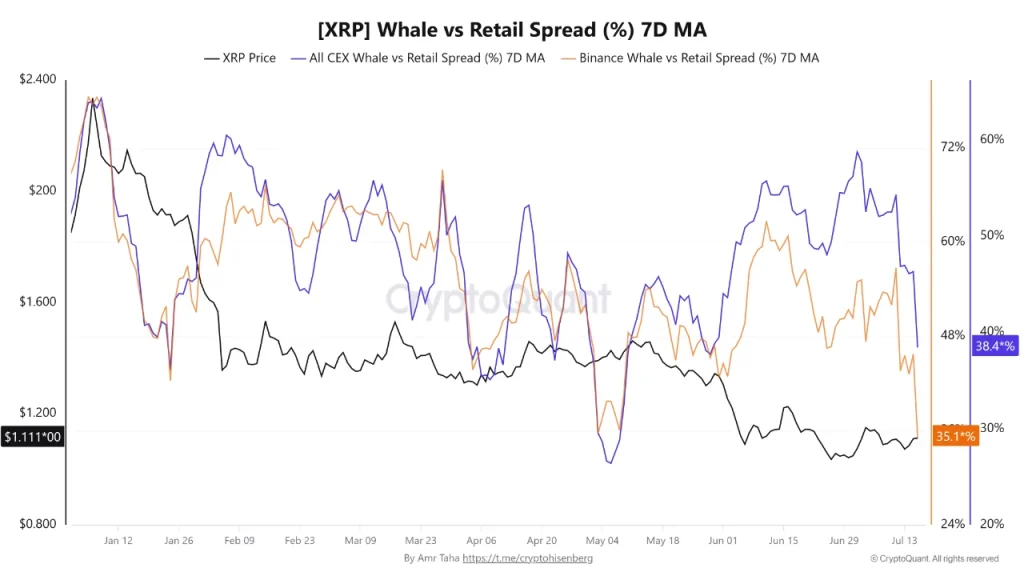
By July 16, non-Binance exchanges are now the more whale-dominated venues, a structural rotation that identifies Binance as the specific site of flow contraction rather than a market-wide phenomenon.
This venue-specific divergence matters because it rules out a simple interpretation of broad market disengagement. Whale and institutional flow behavior, as measured across all centralized exchanges, has not reverted to May lows; only Binance has.
Whether that reflects a deliberate migration of large-holder activity to other venues, a Binance-specific liquidity dynamic, or the growing footprint of off-exchange institutional channels remains an open analytical question that the current data cannot resolve alone.
EXPLORE: Best Memecoins Presales to Watch in July
Institutional Custody and XRP ETF Inflows: What $1.48B in Cumulative Flows and 971M XRP in Custody Actually Reveal About the Supply Vacuum
The institutional layer running beneath the on-chain data is substantial. Cumulative net inflows across seven U.S. spot XRP ETFs reached approximately $1.48B since their November 2025 launch, per KuCoin, with roughly 970.9M XRP now held in institutional custody as of July 9, 2026.
That doubling of the custody figure in six months represents a structural removal of supply from liquid markets, held at Coinbase and BitGo custodian vaults rather than in exchange hot wallets.
Goldman Sachs holds the largest single disclosed position at $153.8M. Thirty-plus institutions appear in 13F filings news, with the top 30 institutional holders accounting for approximately $211M in combined XRP ETF exposure, per Ripple. As large holders increasingly express XRP exposure through ETF shares rather than native on-chain wallets, the visible whale footprint on Binance diminishes even as institutional demand continues to accumulate in regulated product form.

This raises the possibility, not yet confirmed by the data, that the apparent quieting of on-chain whale activity is complementary to, rather than contradictory with, the sustained XRP ETF inflow trend.
An eight-week consecutive inflow streak ended July 13 on a first zero-inflow day, followed by $4.68M in July MTD flows per SoSoValue. For context on how this institutional layer connects to the broader XRP ETF demand floor and regulatory catalysts, the cumulative flow trajectory remains structurally intact even as individual weekly figures have moderated.