



 Some of the links on this site may be affiliate links. ICOBench may receive advertising commissions when users visit recommended platforms via our affiliate links, at no additional cost to you. All recommendations are based on a comprehensive review process.
Elon Musk Grok AI does not do modest price prediction, and it gives no exception to Cardano, as the model predicts the coin to run from $0.158 to $1.50-$3.00 by the end of 2026. That is 10x to 20x upside on a coin most people wrote off months ago.
The case is not just optimism; it is a list of actual things shipping. The Van Rossem hard fork, V11, rolls out in July with cheaper smart contracts and more mature on chain governance.
Behind that sits Ouroboros Leios, currently in testnet, targeting a 50x to 60x throughput jump toward 1,000 plus TPS on mainnet later this year. That is the kind of upgrade that actually changes what a chain can do.
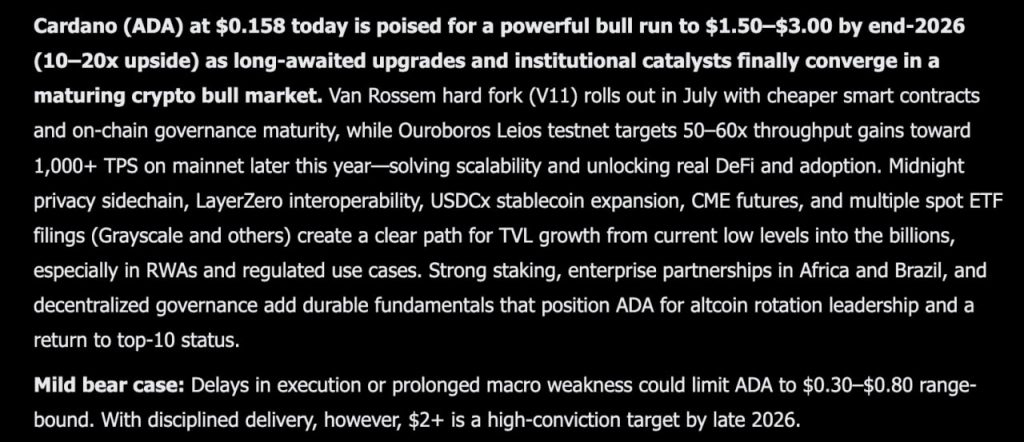
Grok stacks a lot on top of that single upgrade. A Midnight privacy sidechain, LayerZero interoperability, USDCx stablecoin expansion, CME futures, and multiple spot ETF filings from Grayscale and others.
Put together, that is a path for TVL to grow from its current low base into the billions, especially in RWAs and regulated use cases. Add strong staking participation and enterprise partnerships forming in Africa and Brazil, and Grok sees ADA positioned to lead the next altcoin rotation back into top 10 status.
The bear case here is almost gentle by comparison. If execution slips or macro stays weak for longer, Grok sees ADA stuck in a range-bound between $0.30 and $0.80.
Even that downside scenario sits above where ADA trades today. Grok calls $2 plus a high conviction target by late 2026 if the team actually delivers on schedule.
Cardano Price Prediction: ADA Is Down 88 Percent From Its Peak, And Grok Wants It Back In The Top 10
Look at the chart and the size of this call gets a lot more real. ADA topped near $1.02 in September 2025, then began a decline that has barely paused since.
October brought the first serious break, then a long grinding slide through the winter into a low near $0.24 in April. May tried to recover, tapping $0.29, and failed immediately.
June wiped that attempt out entirely, dropping ADA to a fresh low near $0.16, where it has been stuck since. Today closed at $0.164672, down 0.46%, with the session ranging between $0.161944 and $0.169222.
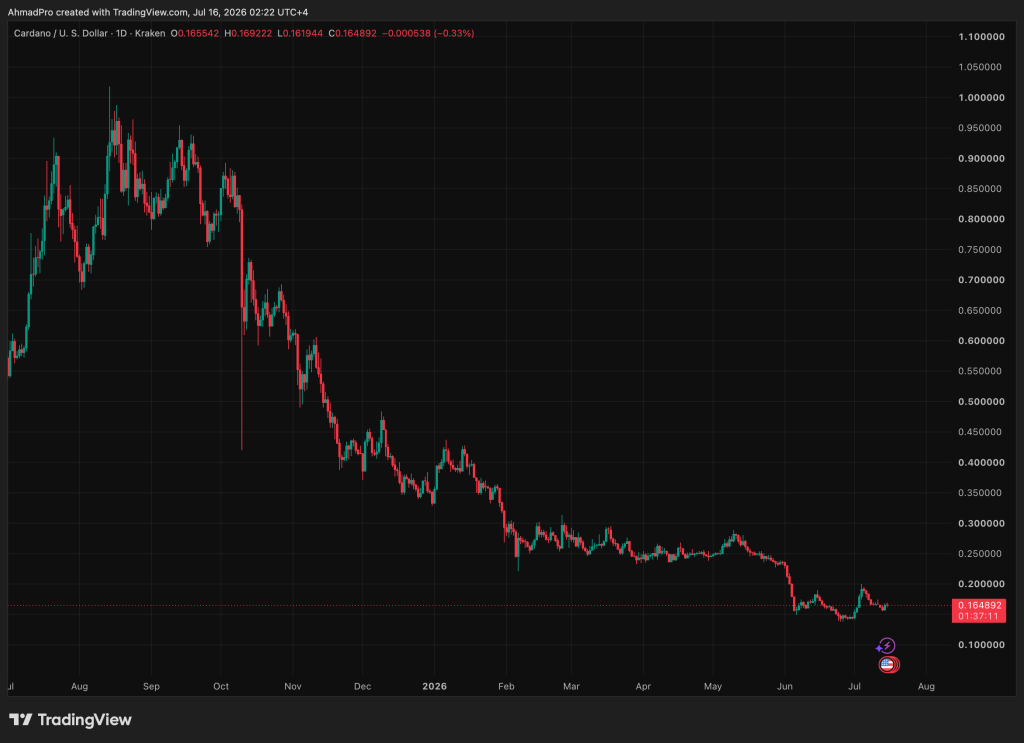
This is not a pullback anymore; it is a market that has been in freefall for ten months. Support sits right at $0.155, then the psychological $0.15 floor.
Resistance stacks close overhead at $0.17, then $0.20, then the May shelf near $0.29. RSI sits around 42 with the signal line just above at 44.
That gap is small and negative, meaning price is still leaking below its own momentum average even after the crash. It is not accelerating lower, but it has not turned either.
For any part of Grok’s bull case to matter, ADA needs to reclaim $0.29 first, a level it has not touched since May. Everything above $1 stays theoretical until this chart proves it can climb, not just stop falling.
EXPLORE: Best Crypto Presales to Watch Right Now
Grok AI Predicts LiquidChain is the Next 1000x Potential Crypto
The cross-chain tax is one of the most accepted inefficiencies in crypto. Accepted because nobody has eliminated it, not because it has to exist.
Isolated pools that cannot see each other. Bridges that process routine volume collapse precisely when congestion peaks. Slippage is extracted before a transaction even reaches its destination. The infrastructure connecting Bitcoin, Ethereum, and Solana was never designed as a unified system. It accumulated over the years, built by separate teams with no shared architecture and no intent to function as one. The friction is not a flaw. It is the inevitable output of systems that were never meant to work together.
Patches have not fixed it because the problem is not the implementation. It is the architecture. Every new bridge, every routing aggregator, every cross-chain solution treats the symptom while the root cause sits completely untouched.
LiquidChain replaces the root cause.
The project operates at Layer 3, above all 3 networks, collapsing their isolated liquidity systems into one unified execution environment. A single deployment reaches Bitcoin, Ethereum, and Solana simultaneously. No fragmented codebases across separate chains. No bridging overhead is extracted from every cross-ecosystem interaction.
4 specific failure points get dismantled. The Unified Liquidity Layer collapses the silos entirely. Single-Step Execution removes the multi-transaction overhead, inflating costs. Verifiable Settlement strips out the trust assumptions that create counterparty risk. The Deploy-Once model means one codebase reaches everywhere it needs to go.
Grok AI predicts a full-blown launch. The presale is live at $0.01454 per $LIQUID token with over $890,000 raised so far.