




 Some of the links on this site may be affiliate links. ICOBench may receive advertising commissions when users visit recommended platforms via our affiliate links, at no additional cost to you. All recommendations are based on a comprehensive review process.
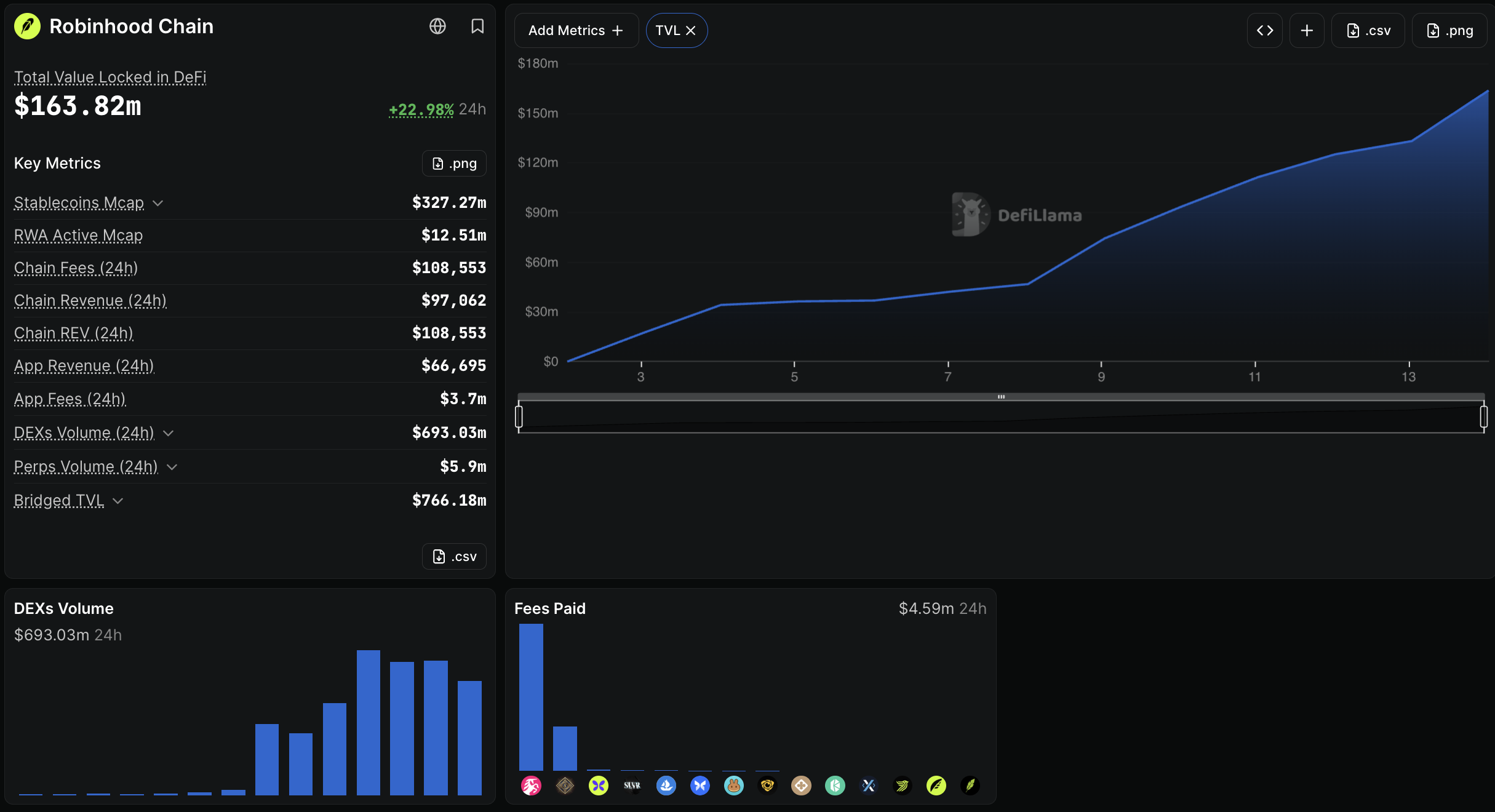
Robinhood Chain debuted two weeks ago as a home for tokenized assets, yet it has been meme coins that have done the heavy lifting, with $3.1Bn in cumulative DEX volume.
Cash Cat alone commands a $150M+ market cap and roughly 25,000 wallet holders as of July 13, per CoinGecko data.
Robinhood CEO Vlad Tenev predicted that “criticisms about crypto assets being sort of like not tied to anything of fundamental value or mostly meme-based” would go away as tokenization matured, only to watch his own chain’s launch be defined precisely by speculative meme mania.
The open question the market must now resolve is whether this meme-led cold start is a distraction from Robinhood Chain’s RWA ambitions, or the exact mechanism that makes those ambitions viable, and ETH richer in the process.
What $3.1Bn in Seven Days Actually Reveals About Robinhood Chain’s Cold-Start Mechanics
To understand the bull thesis behind $CASHCAT
This is much more than the first runner on the chain, it is the introduction to what its ecosystem will become.
Even though the main focus, as they have already said, will be RWAs, they have also acknowledged memes.
If Cashcat… pic.twitter.com/iGBlbTzTnG
— StarPlatinum (@StarPlatinum_) July 14, 2026
The raw volume figure warrants closer examination. Bernstein analysts noted in a Monday note that the network has rapidly become a top-five destination for on-chain trading, facilitating $3.1Bn in cumulative volume over the prior seven days via decentralized exchanges such as Uniswap and PancakeSwap.
On-chain, the composition of that volume tells the real story. While around 65,000 users have gained exposure to $13M worth of so-called stock tokens, early trading volumes on Robinhood Chain have been driven by meme coins.
Cash Cat, a token modeled after a cat picture, reached a $150M+ market cap and is the most valuable meme coin on the network by market cap. Other names include Wen Lambo, Tendies, and Hoodrat.
Bernstein also emphasized Robinhood’s efforts to expand user activity beyond tokenized assets, focusing on decentralized lending through a partnership with the DeFi protocol Morpho and on perpetual futures through an arrangement with the DEX Lighter.
The primary reporting on Robinhood Chain itself centers on Bernstein’s view that early activity has been fueled by meme coins alongside signs of liquidity and traction from crypto-native traders. Robinhood Chain’s first two weeks are a textbook example of that dynamic playing out at institutional-brand scale.
DISCOVER: Best Crypto Presales to Watch Right Now
Bernstein and Tom Lee Frame the Meme Coin Surge as a Structural ETH Demand Driver
NEWS: @RobinhoodApp Chain crossed $3.1 billion in DEX volume in its first week, ranking among the top five chains, per Bernstein.
Over 65,000 users hold $300 million in stablecoins and $13 million in tokenized stocks on the chain. pic.twitter.com/2Uycsmep7B
— MDN Wire (@MDNwire) July 13, 2026
Bernstein analysts, while acknowledging the meme-coin dominance directly, emphasized that the chain’s explosive retail traction reflects genuine liquidity depth and crypto-native engagement.
They framed the activity as supporting Robinhood’s longer-term push into DeFi lending through a partnership with Morpho and into perpetual futures through an arrangement with the DEX Lighter.
BitMine Chairman Tom Lee argued on X this weekend that the early success of Robinhood Chain has bolstered Ethereum’s perception as money, because transaction fees are denominated in the digital asset.
The logic is straightforward: $3.1Bn in DEX volume on an ETH-denominated fee chain means ETH is functioning as the settlement layer for both retail meme speculation and, eventually, the tokenized stocks and RWAs the chain was built to serve.
That dual mandate, frivolous and fundamental, both priced in ETH, is precisely the kind of broad-base adoption that Ethereum bulls have long argued would arrive through L2 expansion.