Some of the links on this site may be affiliate links. ICOBench may receive advertising commissions when users visit recommended platforms via our affiliate links, at no additional cost to you. All recommendations are based on a comprehensive review process.
U.S. spot Bitcoin ETF products recorded net outflows of approximately $4.3B during June 2026, marking the largest single-month withdrawal since the products launched in January 2024 and nearly doubling May’s $2.4B figure, itself already the second-worst month on record.
Bitcoin ended June trading near its lowest levels since September 2024, with KuCoin data placing the year-to-date low at $58,190 and the asset down approximately 30% across Bitcoin H1 2026, underperforming almost every major asset class.
Ethereum products compounded the picture, logging more than $500M in outflows for a second consecutive month, signalling the institutional retreat is not Bitcoin-specific.
📊 OVER $11B ERASED FROM BITCOIN ETFS IN BIGGEST DRAWDOWN IN HISTORY
CryptoQuant shows more than 160,000 BTC have now left ETF provider reserves since holdings peaked in October 2025.
Over 105,000 BTC of that drop happened in 2026 alone.
That makes this the largest ETF… pic.twitter.com/IxcpLnnn0i
— Coin Bureau (@coinbureau) July 1, 2026
The macro backdrop that drove these Bitcoin ETF outflows shows no immediate sign of reversal. Expectations that major central banks will sustain or tighten monetary policy, reinforced by lingering Middle East tensions that have kept the U.S. dollar and government bond yields elevated, continue to suppress risk appetite across non-yielding assets.
The open question the market must now resolve is whether June’s record institutional selling represents a macro-driven dislocation that corrects as rate expectations shift, or a structural re-rating of Bitcoin’s place in institutional portfolios that will define the asset’s H2 2026 trajectory.
Bitcoin ETF Outflows of $4.3B: What the June 2026 Data Actually Reveals About Institutional Positioning
Context significantly enhances the raw figure. The $4.3B in June Bitcoin ETF outflows did not arrive as a single event, per reporting from Nakitte, two consecutive sessions on June 25 and June 26 alone produced $692M and $696M in single-day redemptions respectively, with BlackRock IBIT leading both.
An earlier Bitcoin Foundation analysis covering a four-week window through early June had already flagged $5.4B in cumulative withdrawals, with IBIT responsible for $1.34B in a single week, underscoring how thoroughly the largest spot Bitcoin ETF has shifted from the dominant marginal buyer of early 2024 to the dominant marginal seller in 2026.
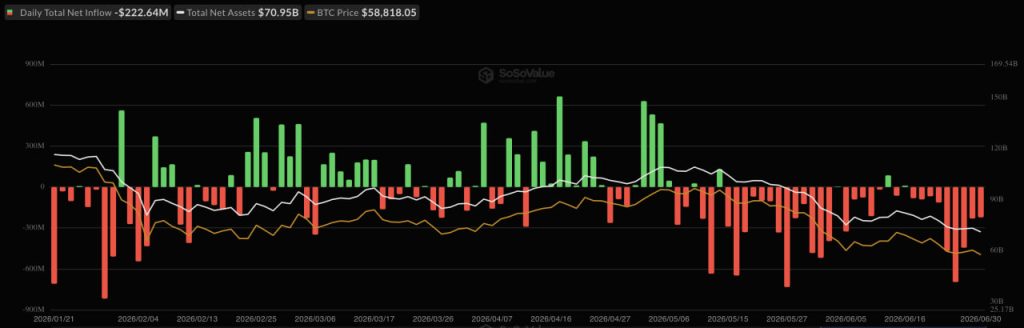
Glassnode analysts characterised the pattern directly, stating that the “scale and duration of these outflows suggest that traditional investors remain defensive”, framing the selling as institutional risk reduction rather than any collapse in underlying crypto adoption.
Mizuho’s June research note, reported by CNBC, reinforced that read, attributing ETF outflows to a broader portfolio de-risking cycle driven by rising rate concerns and cross-asset volatility rather than Bitcoin-specific fundamental deterioration.
The combined May and June two-month total reached $6.5B, per Binance Square data, a figure that reframes June’s record not as an isolated shock but as the acceleration of a trend that has been building since spring.
The institutional selling dynamic is further complicated by corporate accumulation patterns. Strategy continues to add Bitcoin to its treasury, providing a marginal demand offset, but the company’s newly approved policy creates a credible pathway toward significant BTC sales, a scenario that Konstantinos Chrysikos, Head of CRM at Kudotrade, identified as a sentiment risk capable of weighing on broader market confidence if triggered.
For a detailed breakdown of the June institutional retreat, the full ETF outflow data for June 2026 is covered in depth.