




 Some of the links on this site may be affiliate links. ICOBench may receive advertising commissions when users visit recommended platforms via our affiliate links, at no additional cost to you. All recommendations are based on a comprehensive review process.
Perplexity AI just predicts that Cardano will go hard and might skip its moonshot talk. The model sees a realistic path to $1 to $1.20 by the end of 2026, with $2 only in play if a couple of specific things break the right way at once.
The bull case is built on three pieces of technical progress actually maturing rather than just being promised. Hydra scalability upgrades are expected to reach full maturity, addressing one of Cardano’s longest-standing criticisms around throughput.
The Leios testnet needs to prove out gas efficiency and cross-chain compatibility in practice, not just on paper. Voltaire governance is the third piece, and if it unlocks meaningful treasury-driven development, that gives the ecosystem a real funding engine for builders rather than relying purely on community goodwill.
Layered on top of that, institutional interest increasing through ETFs or ETF-like vehicles would bring fresh capital into a market that has mostly been retail-driven. If those technical milestones land alongside rising on-chain activity and growing staking participation, the model sees that combination putting real pressure on price toward the $1 to $1.20 range.
A potential overshoot near $2 becomes possible, specifically if a broader bitcoin rally coincides with major ecosystem apps pulling in sustained capital inflows, though that scenario depends on multiple things aligning rather than just one.
The bear case is just as grounded in specifics. Delays in either the Leios or Voltaire timelines would directly undercut the bull thesis, since both are central to the entire recovery story.
Underwhelming DeFi uptake remains a real risk if developers and users simply do not show up the way the bull case assumes. Regulatory headwinds or a broader crypto downturn could also keep ADA rangebound or sliding toward $0.25 to $0.40, with a real risk of breaching below $0.20 if selling pressure intensifies alongside a sustained bitcoin drawdown.
Market structure issues, like reduced staking participation or a broader exodus of liquidity from the network, would only make that downside scenario worse.
DISCOVER: Best Meme Coins to Buy Right Now
Cardano Price Prediction: ADA Needs Its Roadmap To Finally Catch Up To Its Price
The daily chart shows Cardano at $0.1477 after an extended and almost uninterrupted decline from highs above $0.70 set back in October. That slide has been remarkably consistent, with only brief countertrend bounces breaking up what is otherwise one of the cleanest downtrends in this entire series.
Price spent several months consolidating in a wide range, roughly between $0.25 and $0.30, from February through May, which looked like a potential base before a sharp breakdown in June pushed the price to fresh lows near $0.146.
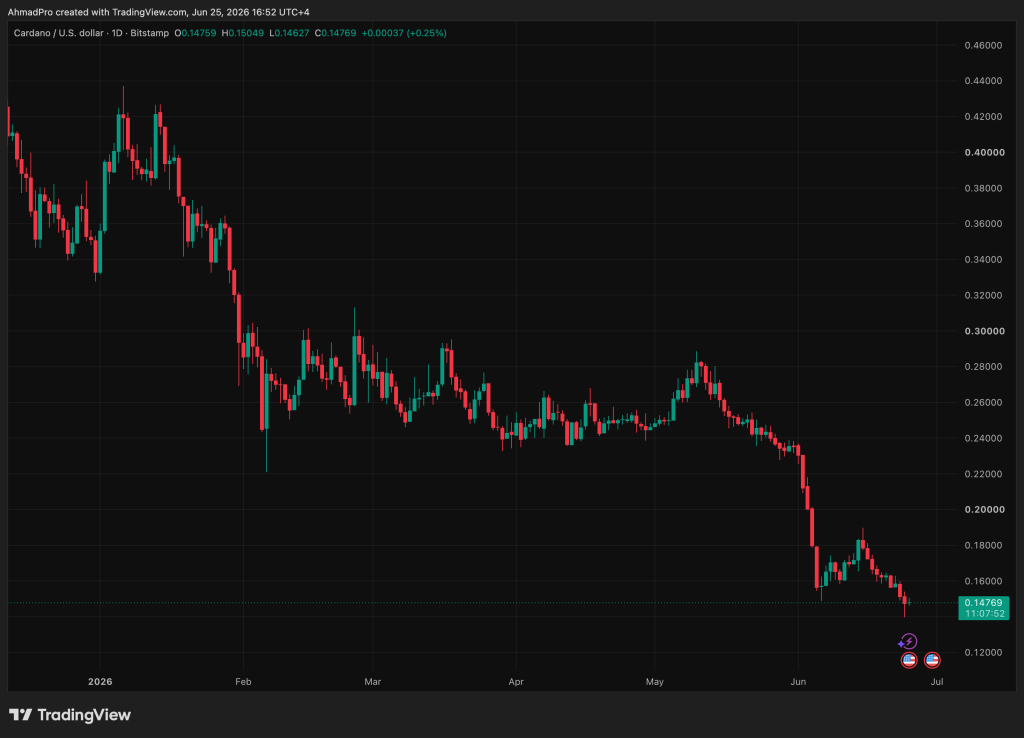
That kind of late-stage capitulation after months of sideways trading often signals exhausted sellers, though it can also mean the downtrend still has room to run. Resistance now sits at $0.20, the level price broke down from most recently, with a heavier ceiling near $0.25, where the multi-month consolidation range lived earlier this year.
Support is being tested right at current levels near $0.146, with no clear floor below that visible on this chart.
The overall structure here is a textbook descending staircase, with each failed bounce setting a lower high than the one before it. Momentum on the daily candles looks weak and still pointed downward, with little evidence yet of the kind of base building that would typically precede a real reversal.
Given how far the price would need to climb just to reach the low end of this prediction, Cardano likely needs to reclaim $0.25 and hold it before the roadmap-driven recovery story has any real technical backing behind it.
DISCOVER: Best Crypto Presales to Watch Right Now
Perplexity AI Predicts LiquidChain is the Next 1000x Potential Crypto
The cross-chain tax is one of the most accepted inefficiencies in crypto. Accepted because nobody has eliminated it yet, not because it has to exist.
Isolated liquidity pools that cannot see each other. Bridges that handle routine volume and fail precisely when congestion peaks. Slippage is the percentage extracted before a transaction reaches its destination. The infrastructure connecting Bitcoin, Ethereum, and Solana was never engineered as a unified system. It grew into a collection of separate components built by different teams, with no shared architecture underneath. The friction that results from that is not a bug. It is the only possible output of systems that were never meant to work together.
Years of patches have not fixed it because patches cannot fix an architectural problem. Every new bridge, every routing aggregator, every cross-chain liquidity solution addresses a symptom while the root cause sits untouched. The root cause is the architecture itself.
LiquidChain replaces the architecture.
The project operates at Layer 3, positioned above all 3 networks, collapsing their isolated liquidity systems into a unified execution environment. A single deployment targets Bitcoin, Ethereum, and Solana simultaneously. No fragmented codebases are maintained across separate chains. No bridging overhead is extracted from every interaction that crosses an ecosystem boundary.
4 failure points get dismantled. The Unified Liquidity Layer collapses the silos. Single-Step Execution eliminates the multi-transaction overhead that inflates costs. Verifiable Settlement strips out the trust assumptions, creating counterparty risk. The Deploy-Once model means one codebase reaches everywhere.
The presale is live at $0.01454 per $LIQUID token with over $860,000 raised so far, and Perplexity AI predicts a full-blown launch.