




 Some of the links on this site may be affiliate links. ICOBench may receive advertising commissions when users visit recommended platforms via our affiliate links, at no additional cost to you. All recommendations are based on a comprehensive review process.
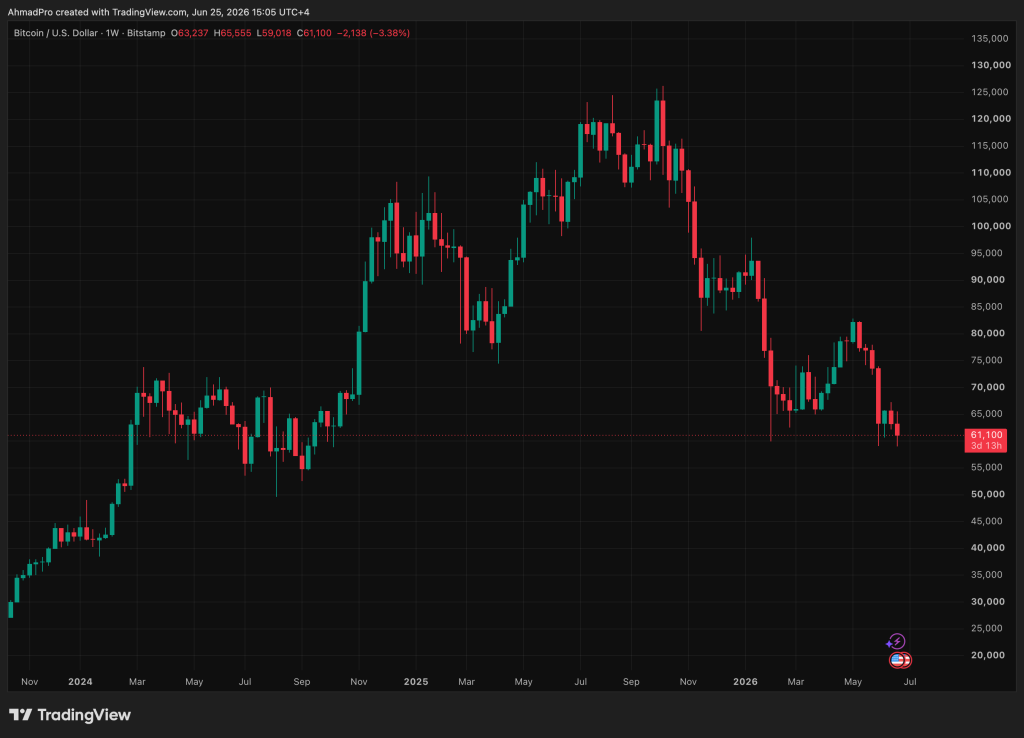
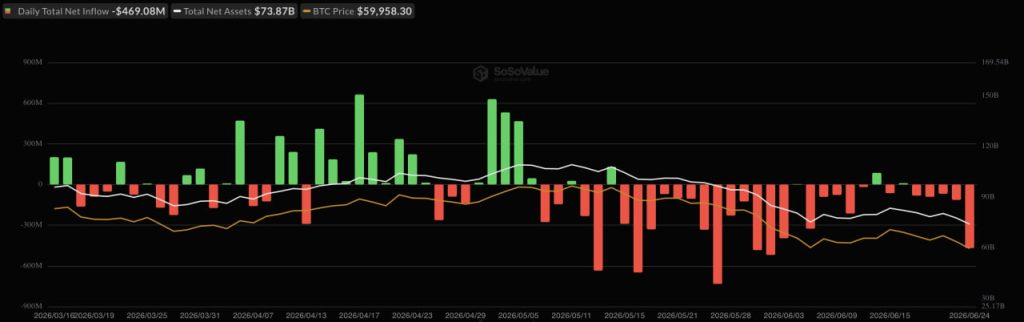
BTC price fell 1.7% to $61,721, remaining pinned near its lowest levels in 18 months after spot Bitcoin ETF products recorded a single-day net outflow of $469 million. It was the largest daily redemption since June 2, and the seventh consecutive week of net withdrawals.
The BTC price drop followed a brief breach below $60,000 on Wednesday, a level not seen since early 2025, as macro capital rotated sharply into AI stocks following blowout earnings from memory chip maker Micron.
The open question the market must now resolve is whether the PCE inflation print due Thursday will deepen the Fed’s hawkish trajectory enough to extend this outflow streak into an eighth consecutive week.
The breadth of Wednesday’s selling extended across the entire crypto complex. Ether fell 1.2% to $1,652.47, Dogecoin dropped 2.2%, and $TRUMP declined 1.6%, with XRP, Solana, Cardano, and BNB all registering smaller losses.
On-chain data from Glassnode showed Bitcoin trading at a significant discount on Coinbase relative to the global average price – a signal interpreted as evidence of structurally weak U.S. retail demand rather than temporary volatility.
Bitcoin ETF News: What the $469M Single-Day Outflow and Seventh Consecutive Week of Redemptions Actually Reveal About Institutional Positioning
Context significantly enhances the raw figure. The $469 million single-day outflow did not arrive in isolation; it landed inside a cumulative multi-week institutional exodus that Bloomberg Senior ETF Analyst Eric Balchunas has described as two record outflow streaks that together wiped $7.2 billion from spot Bitcoin ETF balances and pushed year-to-date flows into negative territory for the first time in 2026.
The week ending June 25 alone generated approximately $1.72 billion in net redemptions across all U.S. spot Bitcoin ETF products, according to Cointelegraph data.
The fund-level breakdown is instructive. BlackRock’s IBIT, which spent the first half of 2024 functioning as the primary inflow engine for the entire ETF complex, accounted for roughly $1.34 billion of the most recent week’s redemptions, more than three-quarters of total outflows in that period. Fidelity’s FBTC shed $201.9 million across the same window, while Grayscale’s GBTC contributed $144.3 million in additional selling.
The scale of IBIT’s reversal is particularly significant: this is not a story of lagging legacy products bleeding assets while newer wrappers absorb the flows. The largest and most liquid spot Bitcoin ETF on the market is itself the primary source of institutional redemption pressure.
A granular June 22 snapshot from CoinNess adds nuance: on that specific date, net outflows totaled $68.3 million, with IBIT losing $172 million and GBTC shedding $81 million, while Fidelity’s FBTC gained $57.4 million and ARK’s ARKB absorbed $64 million.
That rotation between wrappers – capital leaving BlackRock and Grayscale products while selectively re-entering Fidelity and ARK – suggests the institutional behavior is a reshuffling of Bitcoin ETF positioning rather than a uniform exit from BTC exposure entirely. CoinShares and Galaxy Research both characterize the broader trend as macro-driven risk-off behavior, noting that Bitcoin ETF investors are behaving like traditional macro allocators, trimming BTC exposure when rates and equity leadership shift.
The transmission path from ETF outflows to spot BTC price is direct: institutional redemptions require ETF managers to liquidate underlying BTC holdings, adding persistent sell-side pressure to a market already contending with weak retail demand. With institutional Bitcoin accumulation under strain across ETFs, corporate treasuries, and miner balance sheets simultaneously, the bid side of the order book is structurally thin.
DISCOVER: Best Crypto Presales to Watch Right Now