


 Some of the links on this site may be affiliate links. ICOBench may receive advertising commissions when users visit recommended platforms via our affiliate links, at no additional cost to you. All recommendations are based on a comprehensive review process.
Crypto has spent years promising one open financial system, only to quietly ask users to live with a dozen separate ones. It isn’t necessarily a bad thing to have different strengths on the team: Bitcoin has the capital, Ethereum has the deepest DeFi base, and Solana has the speed. The problem is that these strengths still sit behind different doors, with bridges, wrapped assets, duplicated apps, and fragmented liquidity standing in the way.
Today is an uncertain market – Bitcoin is trading at $62,429.62, up 0.42% over 24 hours but down 3.88% across the week, and Ethereum is at $1,663.86, up 0.77% on the day and down 5.30% over seven days. Capital is still in crypto, but conviction is selective, and infrastructure narratives tend to go further than another short-lived rotation.
But for those who like to dig a bit deeper into what crypto does rather than stare at charts, LiquidChain (LIQUID) is building a Layer 3 network designed to solve the fragmentation question once and for all. Its design sits above major chains and makes their liquidity usable in a single layer – no more bridges and wrapped assets.
LIQUID is currently priced at $0.0147 in presale, with $860,000 raised and staking at 1,290% APY. Can it help DeFi stop building walls?
How LiquidChain’s Layer 3 Architecture Works
A Layer 1 is the base chain. Bitcoin, Ethereum, and Solana each have their own settlement rules, validators, assets, and communities. A Layer 2 typically improves one of those systems by adding scale, reducing fees, or enabling faster execution. LiquidChain’s Layer 3 idea is broader: to create a coordination layer that can bring liquidity from multiple ecosystems into a single DeFi environment.
The project’s whitepaper describes the core problem as siloed capital and the fact that users who want to move between chains often face delays, fees, bridge risk, and poor liquidity. Developers face a different version of the same headache: build for one chain and miss users elsewhere, or rebuild the same product several times for different ecosystems.
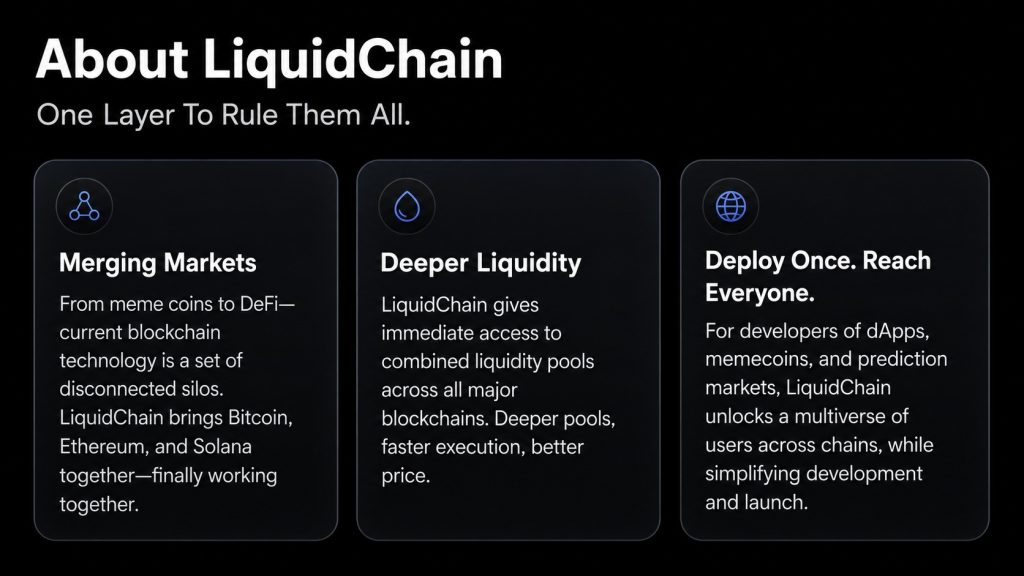
LiquidChain’s answer is a unified execution layer where assets from Bitcoin, Ethereum, and Solana are represented in a verifiable way, so dApps can interact with cross-chain liquidity without forcing users to constantly think about which network they are on. Its architecture includes unified liquidity pools, a high-performance virtual machine, cross-chain proof systems, and interchain messaging.
The simple version is this: instead of asking a trader to bridge, swap, wait, reconnect a wallet, switch networks, and hope nothing breaks, LiquidChain wants the application layer to handle those messy paths. The user should see one DeFi action, and the protocol handles the chain logic.
DeFi has often required users to prove they understand the machinery before they can use the product (and risk losing money with the wrong click). LiquidChain argues that the best infrastructure should become less visible as it gets more important.
Why LIQUID Could Become the Next Crypto to Explode in 2026
The case for LIQUID being the next crypto to explode in 2026 starts with a practical frustration: liquidity fragmentation is not a niche developer complaint but affects trading depth, borrowing markets, staking products, yield strategies, and the speed at which new applications can find users. Every separate chain creates its own economy, but it also creates another border.
A strong Layer 3 can turn those borders into routing decisions rather than user problems, particularly helping DeFi, where capital efficiency is everything. Lending protocols need deeper collateral pools, and decentralized exchanges need tighter execution.
Yield platforms need easier movement between opportunities, and developers need distribution without having to rebuild the same product for every chain. If a developer adapts for LiquidChain, it accesses all chains at once.
POV: You read the about section on the LiquidChain site. 🔥👁https://t.co/vqvBcdSQYC pic.twitter.com/UKD6iXNK8i
— LiquidChain (@getliquidchain) June 22, 2026
The presale figures give LIQUID some momentum, showing that the concept is landing with buyers. The 1,290% staking APY adds another reason for presale participants to hold through the early phase, though high APYs should always be understood as an incentive mechanism rather than a guarantee of long-term yield.
The more important question is whether LiquidChain can turn the idea into usable infrastructure. If developers can deploy once and reach cross-chain liquidity, and if users can trade or stake without worrying about bridges, the project has a route into one of crypto’s most persistent pain points. Not every big infrastructure claim becomes a real network effect. But the best ones tend to start with a problem that users already understand.
The Real Prize Is Making DeFi Feel Whole
LiquidChain’s promise is not about speed, yield, or another presale chart, but the possibility that DeFi stops feeling like a collection of separate rooms.
That is the larger opportunity for LIQUID in 2026 and 2027, and we need to stop asking users to become better at navigating infrastructure. We need infrastructure that stops getting in the way.
If LiquidChain can make Bitcoin capital, Ethereum DeFi, and Solana-speed execution feel like parts of the same market, its Layer 3 model could end up dominating the market.