


 Some of the links on this site may be affiliate links. ICOBench may receive advertising commissions when users visit recommended platforms via our affiliate links, at no additional cost to you. All recommendations are based on a comprehensive review process.
Why are Bitcoin, Ethereum, and Solana still strangers to each other? Crypto liquidity remains fragmented, and it won’t help the space as institutions come in.
Bitcoin still holds the largest share of market value, Ethereum leads in DeFi, and Solana focuses on speed. But putting them together? No chance. And while there is an argument for “the right tool for the right job”, they are effectively entirely lopped off from each other.
So users need to move between blockchains via bridges and wrapped assets, with costs including fees, slippage, delays, and bridge-related risks. It is the kind of problem that feels too big to fix, but one team has an idea.
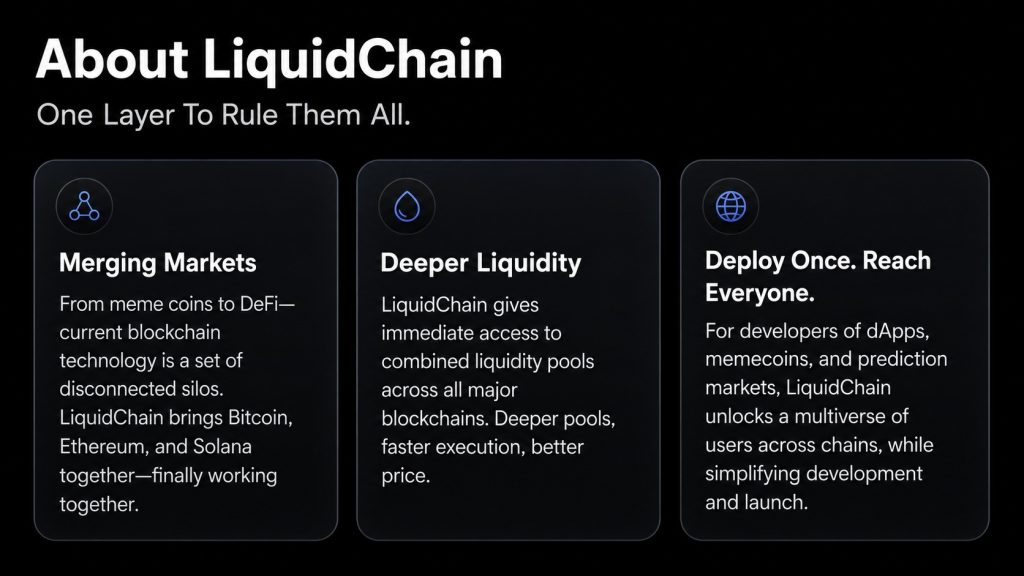
LiquidChain brings Bitcoin, Ethereum, and Solana together – finally working together – and gives immediate access to combined liquidity pools across all major blockchains. That means deeper pools, faster execution, and better price.
The LIQUID token is currently priced at $0.0146 in presale, with the project having raised over $830,000. Early stakers are earning a 1,332% APY, a strong early-network incentive designed to build conviction and reduce sell pressure before mainnet.
How LiquidChain Works: One Layer for the Entire Crypto Economy
This is what’s going on behind the scenes of LiquidChain. Assets from Bitcoin, Ethereum, and Solana are verifiably represented on the Layer 3 – basically, LiquidChain keeps real-time tracking of each chain – creating deep, fungible markets that users can access without wrapping any asset. Imagine it like dipping into whichever pool you want at any time.
Getting rid of wrapping is a great feature, as these always mean trusting an intermediary. LiquidChain’s model removes that trust assumption entirely.
The L3’s goal is to give users and developers access to Bitcoin’s capital base and security, Ethereum’s mature smart contract and DeFi capabilities, and Solana’s speed and low fees, without leaving the LiquidChain environment.
Technically, this is achieved through what the whitepaper calls a Proof-of-State Validation Layer – a consensus mechanism anchored to all three underlying networks simultaneously.
The result is what LiquidChain calls single-step execution: rather than asking users to move capital between separate ecosystems via conventional bridges, LiquidChain acts as a coordination layer that enables BTC, ETH, and SOL liquidity to interact for faster, lower-cost applications.
For developers of dApps, memecoins, and prediction markets, LiquidChain unlocks all chains while simplifying development and launch. A single codebase and a single deployment let them reach everyone – no separate Ethereum and Solana versions of the same application.
Why LIQUID Could Be the Next Crypto to Explode in 2026 and 2027
According to the official roadmap, LIQUID is scheduled for centralized exchange listings in 2026. Alongside the centralized listing, LiquidChain will introduce cross-chain derivatives and lending modules, allowing traders to trade leveraged products in a non-custodial environment and borrow capital from their preferred ecosystem.
The secrets of The Order are within.
Are you ready to find out what they are? 👁⟁https://t.co/vqvBcdSQYC pic.twitter.com/cKT8nEK5R2
— LiquidChain (@getliquidchain) June 11, 2026
That is a genuinely large product surface for a protocol still in presale, and it points to where the team believes the biggest unmet demand is sitting.
For investors and traders, a 100x from here is only a $80 million market cap, when success in this arena is likely to give LIQUID a much larger valuation. Even a small number of people using LIQUID as an alternative to bridges – and using LIQUID as the gas token – leads to a large protocol.
The Bigger Idea Behind a Smaller Token
Over the last few years, crypto has headed towards three dominant networks. Each one solved a specific problem brilliantly – and in doing so, created its own gravitational field, pulling capital and developers inward.
From meme coins to DeFi, current blockchain technology is a set of disconnected silos. LiquidChain brings Bitcoin, Ethereum, and Solana together – finally working together.
Layer 2 tokens dominated previous cycles by solving scalability, and Layer 3 tokens may well dominate 2026 and 2027 by solving fragmentation. Whether the protocol delivers at the scale it envisions is still an open question – mainnet hasn’t launched yet. But whoever solves this “obvious in hindsight” problem is going to win big.