

 Some of the links on this site may be affiliate links. ICOBench may receive advertising commissions when users visit recommended platforms via our affiliate links, at no additional cost to you. All recommendations are based on a comprehensive review process.
Google Gemini AI is delivering the most bearish Cardano price prediction in this entire series, predicts the next 90 days decidedly bearish and putting $0.12 to $0.15 on the table as the destination if the current trajectory continues. This is not a cautious hedge, it is a fundamental indictment of where Cardano stands right now.
The catalyst for that bearish read is not macro, it is internal. The shutdowns of TapTools and JPG.Store are not minor casualties, they are 2 of the most visible and frequently used applications in the Cardano ecosystem, and their closures signal that the dApp layer is experiencing a genuine liquidity and viability crisis rather than just a price correction.
When the infrastructure that users actually interact with starts shutting down, the network activity narrative collapses alongside it.
The detail Gemini AI is highlighting around Charles Hoskinson is the part that separates this prediction from the others. A founder publicly warning of a wave of failures and announcing an operational break is not standard communication strategy.
It reads as a passive acknowledgment that capital flight and stagnant network utility are happening faster than the roadmap can address them. That kind of founder signal, whether intentional or not, removes the forward-looking optimism that has been sustaining the Cardano thesis through months of price decline.
The bullish counter-case exists but Gemini AI predicts it as a modest one. If the current selloff marks a definitive capitulation bottom and broader market liquidity expands, a technical relief rally toward $0.28 to $0.32 is possible. But even in that scenario Gemini is explicit: reclaiming past all-time highs remains highly improbable for the foreseeable future.
That is a sentence no other AI prediction in this series has written about any of the assets covered, and it reflects a fundamentally different level of concern about Cardano’s trajectory versus its peers.
ADA Just Had a 20.53% Weekly Loss and Is Now Trading at Levels Not Seen Since Late 2023
ADA is closing the current week at $0.1870, down 20.53% in a single weekly candle, and the weekly chart going back to 2023 is showing something genuinely alarming.
The weekly close at $0.1870 is the lowest Cardano has printed on a weekly close since the 2023 accumulation period before the 2024 to 2025 bull run, and it has now broken below the $0.20 psychological floor that has been the last line of defense for months.
The weekly chart tells the complete story of ADA’s cycle. The 2024 to 2025 bull run launched from a base around $0.30 to $0.40, ran to $1.30 in November 2024, recovered to $1.05 in mid-2025, and has been in freefall ever since.
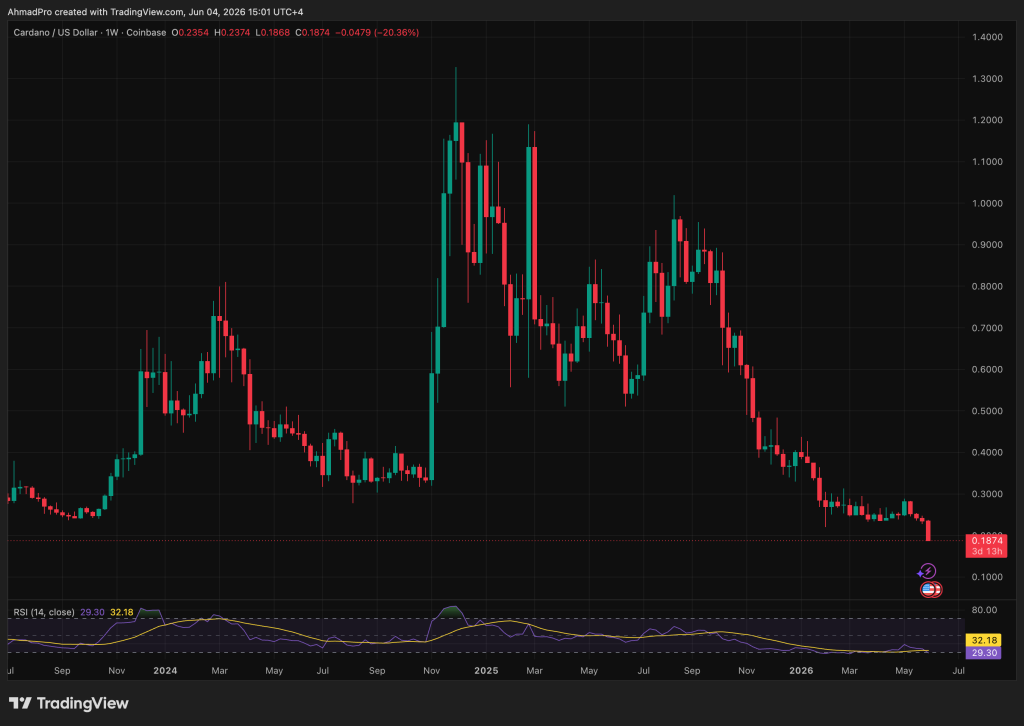
The current price at $0.1870 means ADA has given back everything from this cycle and is now trading below the pre-bull-run base that launched the entire move. That is a full round trip with extra downside.
The $0.12 to $0.15 zone Gemini identified as the bear case target is not abstract anymore. From $0.1870 it is 20% to 36% lower, and there is no structural support on this weekly chart between current price and those levels.
The only potential support is the 2023 accumulation range around $0.25 to $0.35 that ADA has now broken below on a weekly close, and that zone is now overhead resistance rather than a floor.
On the upside the $0.25 level is the first resistance that would need to be reclaimed before any recovery narrative becomes credible. Above that $0.28 to $0.32 is the relief rally zone Gemini mentioned, and clearing it would be the first weekly close structure that suggests the worst is behind rather than ahead.
Gemini AI Predicts LiquidChain is the Next 1000x Potential Crypto
The cross-chain tax is one of the most accepted inefficiencies in crypto. Accepted because nobody has eliminated it yet, not because it has to exist.
Isolated liquidity pools that cannot see each other. Bridges that handle routine volume and fail precisely when congestion peaks. Slippage extracting its percentage before a transaction reaches its destination. The infrastructure connecting Bitcoin, Ethereum, and Solana was never engineered as a unified system. It grew as a collection of separate components built by separate teams with no shared architecture underneath. The friction that results from that is not a bug. It is the only possible output of systems that were never meant to work together.
Years of patches have not fixed it because patches cannot fix an architectural problem. Every new bridge, every routing aggregator, every cross-chain liquidity solution addresses a symptom while the root cause sits untouched. The root cause is the architecture itself.
LiquidChain replaces the architecture.
The project operates at Layer 3, positioned above all 3 networks and collapsing their isolated liquidity systems into one unified execution environment. A single deployment reaches Bitcoin, Ethereum, and Solana at the same time. No fragmented codebases maintained across separate chains. No bridging overhead extracted from every interaction that crosses an ecosystem boundary.
4 failure points get dismantled. The Unified Liquidity Layer collapses the silos. Single-Step Execution removes the multi-transaction overhead inflating costs. Verifiable Settlement strips out the trust assumptions creating counterparty risk. The Deploy-Once model means one codebase reaches everywhere.
The presale is live at $0.01454 per $LIQUID token with over $800,000 raised so far.