Some of the links on this site may be affiliate links. ICOBench may receive advertising commissions when users visit recommended platforms via our affiliate links, at no additional cost to you. All recommendations are based on a comprehensive review process.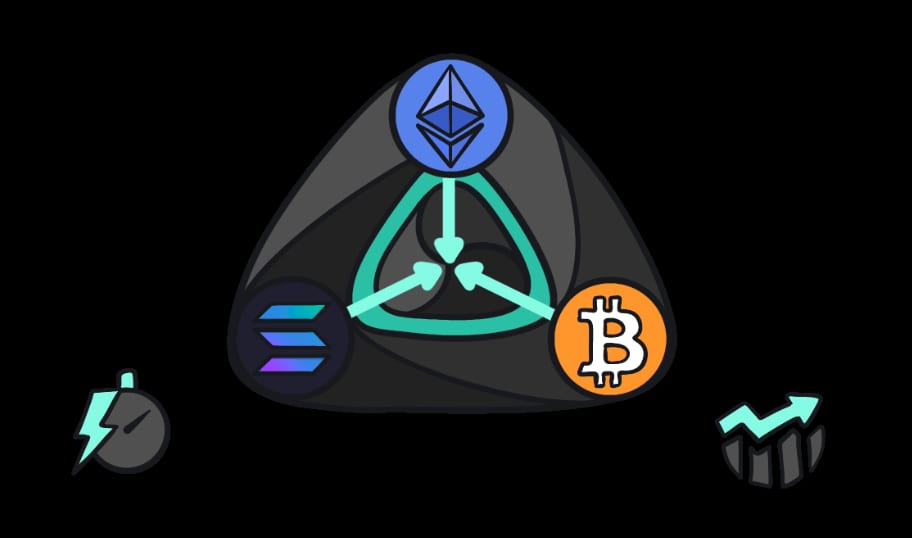
Crypto traders are clearly rewarding on-chain infrastructure again, and the social temperature is shifting with it. Hyperliquid native token HYPE jumped 28% over the past seven days, briefly overtaking Solana by fully diluted valuation as money rotated out of larger assets and into faster-moving decentralized plays.
That move is happening while Bitcoin and Ethereum spot ETFs continue to log steady outflows, a backdrop that is pushing attention toward projects with stronger organic discussion and sharper product-market fit. One of the newer names starting to circulate more often in that conversation is LiquidChain, a Layer 3 protocol aiming to connect Bitcoin, Ethereum, and Solana in one execution environment.
LiquidChain is still in presale, but it has already raised close to $1 million, putting it on traders’ radars as they hunt for younger infrastructure narratives with visible early traction.
Hyperliquid has become one of the clearest sentiment leaders in the current cycle. HYPE traded around $59 at the time of writing, up 45% from a month ago, with the last week alone delivering a 28% gain. That kind of move tends to attract more than just chart-only traders; it also resets what the broader market is willing to pay attention to.
literally one of the most insane charts in crypto during a full blown bear market where the whole industry is considered dead lmao
$100 is programmed.
hyperliquid. pic.twitter.com/NZ2ER9bZio
— lyxe (@cryptolyxe) May 21, 2026
While spot Bitcoin ETFs posted another round of outflows and Ethereum products saw similar pressure, on-chain venues kept attracting activity. Hyperliquid, in particular, has benefited from that shift, with daily trading volumes often running ahead of many centralized exchanges.
The attraction is not hard to read. Traders see ultra-fast execution, deep perpetual liquidity, and a fully on-chain order book as tangible strengths rather than marketing fluff. In a cautious market with Bitcoin hovering near $77,000 and struggling to extend higher, that kind of real usage has made Hyperliquid one of the most credible winners in the decentralized derivatives lane.
Think people are still heavily underestimating the upside potential for $HYPE here.
For the first time, we are seeing a breakthrough crypto native application outside of BTC and stablecoins, which most of CT is not used to.
Throughout each past cycle longing the platform where…
— Daniel Cheung (@HighCoinviction) May 21, 2026
Why LiquidChain Is Starting to Pick Up Fresh Community Interest
When one infrastructure token starts running, the market usually begins scanning for the next adjacent story with room to grow. That is where LiquidChain is starting to gain some heat. Rather than focusing on one trading niche, it is pitching a broader fix for a problem users already understand well: liquidity and activity split across Bitcoin, Ethereum, and Solana.
LiquidChain is building a Layer 3 blockchain designed to unify those ecosystems, allowing assets from the three networks to interact through shared liquidity pools instead of depending on wrapped assets and multiple fragile bridges. The pitch is straightforward: less fragmentation, better capital efficiency, faster trading, and safer cross-chain settlement through atomic proofs and advanced messaging protocols.
From a community-read perspective, what matters is that this is a familiar pain point with a clear audience. Cross-chain fatigue is real, and projects addressing it tend to get more authentic attention when market participants rotate away from passive majors and back toward utility-led infrastructure.
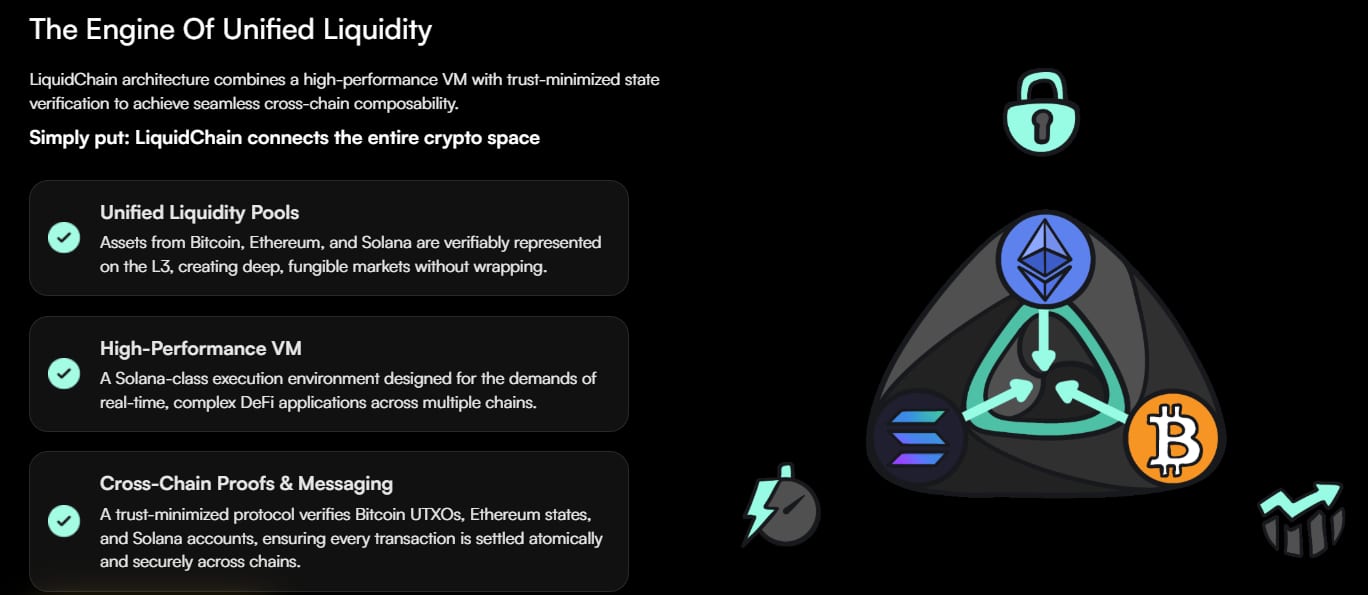
The protocol runs on a specialized virtual machine built for real-time applications, aiming to combine Bitcoin’s capital depth, Ethereum’s DeFi toolkit, and Solana’s speed in a single environment. If that sounds ambitious, it is. But it also gives the project a sharper identity than many generic Layer 3 launches competing for the same crowd.
The timing helps. As traders move away from established Layer 1 names and toward projects with genuine technical differentiation, LiquidChain’s unified liquidity angle aligns with the current mood. It echoes the same appetite for performance and efficiency that has boosted Hyperliquid, just framed around multi-chain infrastructure rather than perpetual trading.
Missed Hyperliquid? LIQUID Presale Traction Looks Early, but It Looks Real
For now, the clearest measurable signal is simple: LiquidChain has raised close to $1 million in its presale. That does not prove long-term success, but it does suggest that interest has held up even while parts of the market remain choppy.
The $LIQUID presale is live at $0.01461 per token. Participants can also stake during the presale, with rewards of up to 1,410% APY available for early backers. As always, aggressive staking numbers grab attention, but the more durable read here is whether the project can keep building a community around a thesis people actually care about.
Token allocation is presented with distributions for ecosystem growth, development, liquidity provision, and community initiatives. For early-stage buyers, that kind of structure tends to matter because it signals whether the project is trying to build a longer runway rather than just manufacture a short-term spike.
Three Thrones for Three Kings. 👑
All wrapped in the world's greatest L3. ⟁👁https://t.co/vqvBcdSQYC pic.twitter.com/j6dG8ZoHZd
— LiquidChain (@getliquidchain) May 19, 2026
How Buyers Are Getting In
Users can join the official LiquidChain presale by connecting a wallet on the project website. The sale supports ETH, BNB, SOL, USDT, USDC, BTC, and bank card payments. Best Wallet users can also participate through the mobile app on the Apple App Store and Google Play.
$LIQUID remains priced at $0.01461 in the presale, with staking rewards offering up to 1,410% APY for those joining at this stage.
For updates and community activity, follow LiquidChain on X and join the official Telegram group.