Some of the links on this site may be affiliate links. ICOBench may receive advertising commissions when users visit recommended platforms via our affiliate links, at no additional cost to you. All recommendations are based on a comprehensive review process.
Bitcoin remains the store of value of cryptocurrency, yet as a functional payment network, it is ineffective. The base layer maxes out at roughly seven transactions per second, so anyone attempting on-chain transfers during peak network congestion gets caught by exorbitant fees and agonizing block times.
Ethereum has largely avoided its own bottlenecks by employing Layer 2 rollups, and Solana has opted to prioritize a high-throughput architecture to handle volume natively.
Bitcoin has settled comfortably into its role as digital gold, but it routinely leaves the heavy lifting of day-to-day utility, decentralized finance, and microtransactions to rival chains.
That identity is becoming a severe liability in 2026, as the market demands far more from its most liquid (but inert) asset, driving a search for infrastructure that can actually use the dormant capital.
A Layer 2 framework that brings low-cost, high-speed payments back to Bitcoin is currently the most heavily capitalized narrative in the digital asset space. The technical barrier is strict: developers must engineer a secondary layer capable of high-frequency throughput and instant finality without diluting the security guarantees of the underlying blockchain.
So the market is moving towards Bitcoin Hyper (HYPER), built for this exact situation. The project has attracted significant attention because it aims to address Bitcoin’s deficiencies head-on, already raising an impressive $31.9 million in its ongoing presale.
Available at a current token price of $0.013677, early participants can also lock in a 37% staking APY. Investors are seeing HYPER as the functional, low-cost payment layer native to the Bitcoin ecosystem rather than waiting for another Layer 1 to solve the problem.
How Bitcoin Hyper Bypasses Base Layer Friction
Bitcoin Hyper functions as an off-chain execution environment, specifically engineered to route and settle transactions at a speed the primary Bitcoin network simply cannot support. The underlying mechanics rely on stripping the transaction volume away from the mainnet. Rather than forcing users to wait ten minutes (or often much longer during peak hours) for a single block confirmation, HYPER processes peer-to-peer transfers and microtransactions almost instantly.
The base Bitcoin chain operates with a strict block size limit, creating an artificial scarcity of block space. When demand spikes, users must outbid each other in transaction fees to incentivize miners to process their transfers first. Bitcoin Hyper bypasses this entirely. By taking the transaction data off the main sequence, it aggregates and processes massive batches of transfers simultaneously. It then anchors cryptographic proofs of these transactions back to the Bitcoin base layer for final security execution.
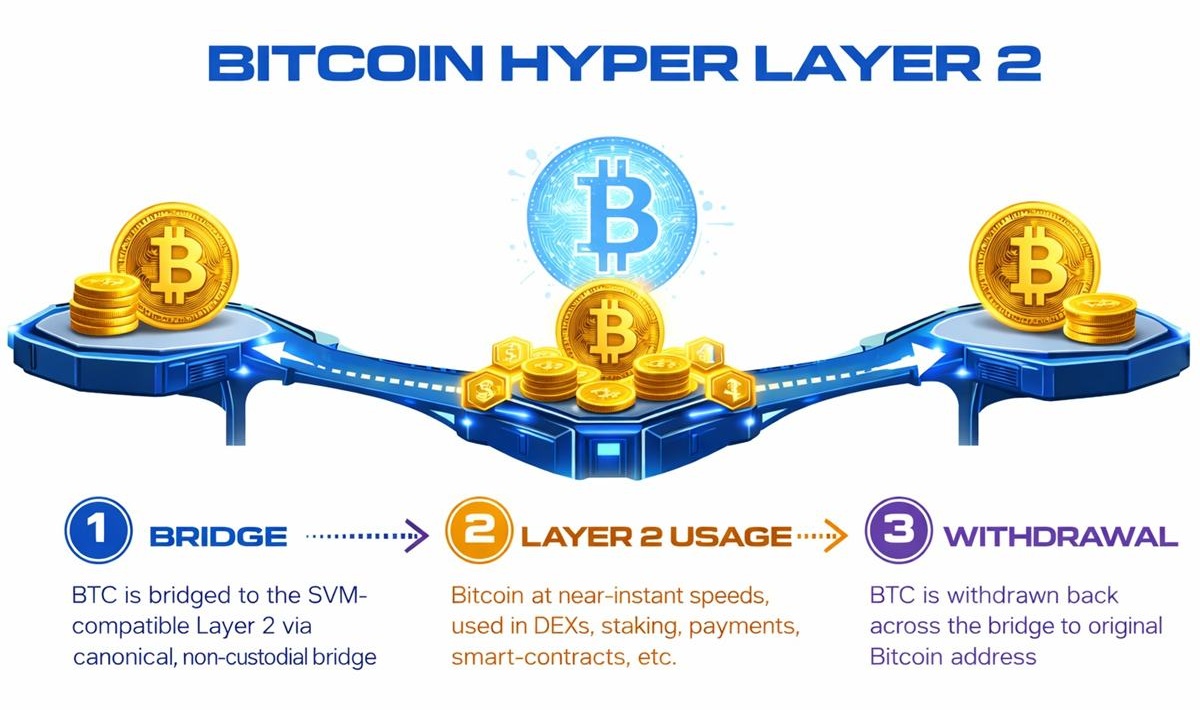
In this architecture, Bitcoin is relegated to its most effective role: a highly secure, immutable settlement layer, while Bitcoin Hyper serves as the actual highway for daily commerce.
The HYPER token covers the microscopic gas fees required to process transactions and serves as the economic incentive securing the network’s validators. Users interacting with decentralized applications or sending cross-border remittances will no longer have to pay Bitcoin’s prohibitive base-layer fees. They can utilize HYPER’s infrastructure to execute transfers for fractions of a cent.
Market Positioning and a Highly Bullish 2026
The sheer size of Bitcoin Hyper’s $31.9 million presale indicates that retail and institutional money are aligned on the need for Bitcoin scaling solutions this year. We are witnessing a massive rotation of capital into infrastructure projects that expand the utility of legacy networks. The Layer 2 sector is outright dominating the 2026 crypto market. Investors are increasingly tired of fragmented liquidity across alternative chains and want a direct mechanism to tap into the vast pool of dormant Bitcoin capital.
HYPER is appearing on watch lists, with Borch Crypto recently exploring the opportunities ahead, with Bitcoin having three times the market cap of Ethereum, and currently no way for people to use that capital without costs and delays.
From a technical and security standpoint, the project has removed the early-stage friction that usually deters serious institutional capital. With audits completed by both Coinsult and SpyWolf, which have verified the integrity of the protocol’s smart contracts, the launch seems close, and security clearances give buyers the confidence required to inject liquidity into a presale at scale.
Best Crypto For the Next Bull Run?
With tens of millions of dollars already committed and a large percentage of those tokens inevitably heading straight to staking contracts, the circulating supply of HYPER will be severely restricted just as the protocol opens to the broader retail public.
If Bitcoin is to be used as peer-to-peer electronic cash, it requires infrastructure that actually works at scale. The initial vision of a frictionless payment network was sacrificed years ago in exchange for unassailable security and the digital properties of gold. Bitcoin Hyper is building the exact Layer 2 environment needed to bring the world’s largest cryptocurrency into the modern transactional economy and is primed to be one of the most explosive narratives of 2026.