Some of the links on this site may be affiliate links. ICOBench may receive advertising commissions when users visit recommended platforms via our affiliate links, at no additional cost to you. All recommendations are based on a comprehensive review process.
The narrative surrounding Bitcoin is endlessly changing, but while the asset remains the undisputed “digital gold” of crypto, its utility has historically lagged behind the rapid-fire ecosystems of Ethereum and Solana.
The market is no longer satisfied with a passive store of value, with investors looking for the same decentralized finance capabilities and transaction speeds found on high-throughput chains – ideally secured by the Bitcoin network.
This has created a vacuum that only a Layer 2 solution can fill, as the base layer remains too rigid for the modern demands of DeFi and instant payments.
The success of networks like Arbitrum proved that users will migrate to where friction and costs are lowest, and security is highest, which has led to huge interest in Bitcoin Hyper (HYPER). The project has already secured $31.6 million in its presale phase, suggesting strong demand for its approach to Bitcoin scaling.
Currently priced at $0.0136764 with a staking APY of 37%, the HYPER token is the centerpiece of an ecosystem designed to address the latency issues plaguing Bitcoin-native applications.
The Mechanics of Bitcoin Hyper
Bitcoin Hyper is a high-speed execution environment that sits on top of the Bitcoin mainnet. It does not attempt to change Bitcoin’s underlying code, which would be a non-starter for the community. Instead, it offloads the heavy lifting of transaction processing and smart contract execution to its own layer.
This allows for near-instant finality and negligible gas fees, two features currently impossible on the Bitcoin base layer. The architecture is built to be compatible with the Solana Virtual Machine (SVM), allowing developers to use familiar tools like Solidity and, in turn, lowering the barrier to entry for decentralized applications that want to tap into Bitcoin’s massive liquidity pool.
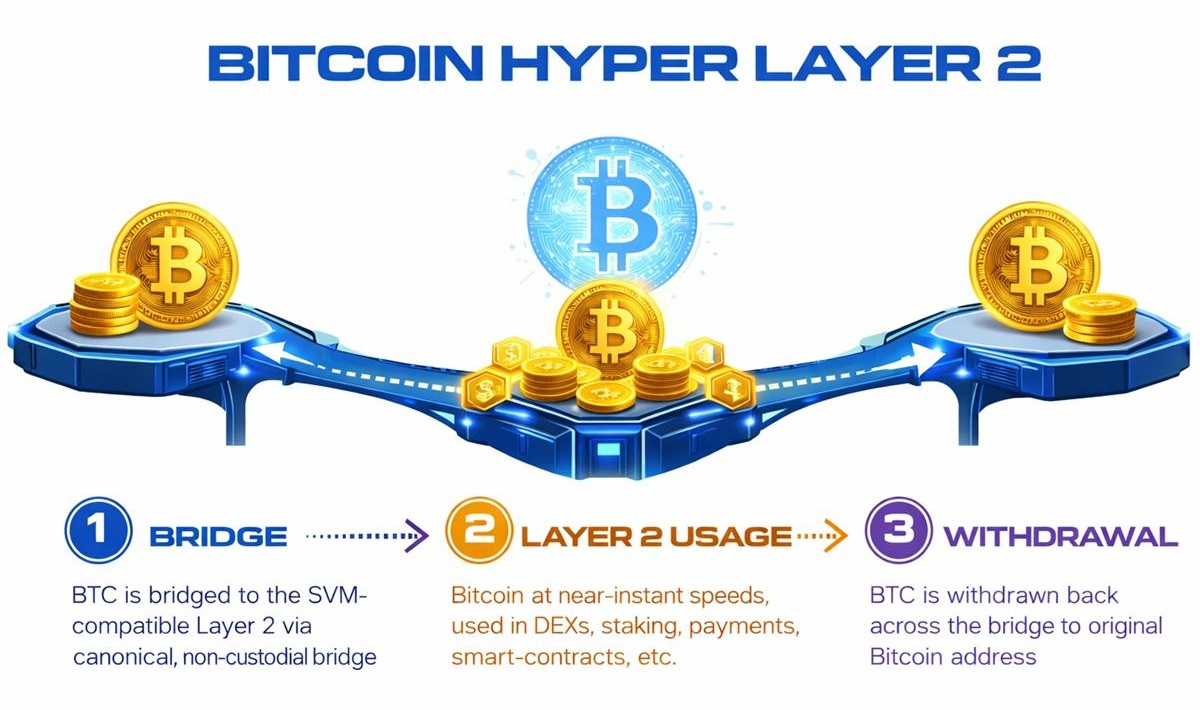
The SVM, in particular, enables parallel transaction processing, which is the primary reason Solana has historically outperformed Ethereum in raw throughput. By adding this high-speed execution layer onto Bitcoin’s settlement layer, Bitcoin gets the speed it deserves, and judging by how many investors are backing HYPER, it looks like the type of product that the market wants.
Once live, users can bridge BTC to the network via a decentralized Canonical Bridge. This means that, once bridged, the assets exist as wrapped tokens on the HYPER network, where they can be used with sub-second finality and negligible fees (under one cent).
Transactions are batched and finally settled back to the Bitcoin mainnet, meaning everything is backed by the security of Bitcoin’s Proof-of-Work network – but operating at the speed of Solana.
HYPER has already undergone and passed audits by both Coinsult and SpyWolf, as is sensible for a project of this size. Completed audits suggest the launch is imminent, although no official date has been announced yet.
Why 2026 Could Be a Bullish Year for HYPER
The timing of HYPER comes during a broader “Bitcoin Renaissance” that is dominating the 2026 fiscal year. Investors want the infrastructure that makes BTC more useful. HYPER’s $31.6 million raised so far suggests that Layer 2s are the primary growth engine for the next cycle.
Bitcoin Hyper’s focus on speed and low costs addresses the two biggest complaints from Bitcoin users. While there have been other Bitcoin scaling projects, many are bogged down by overly complex tech that is difficult for the average user to use.
HYPER promises simplicity and ease of use thanks to the familiar Solana technology. When crypto users become familiar with the idea that Bitcoin can be used for DeFi or as money, restoring the narrative that has been eclipsed by other projects over the last few cycles, the opportunities for HYPER are immense.
It is an opinion that crypto analysts are beginning to share, with Borch Crypto calling the project “huge”. In a video shared with nearly 100,000 followers, he analyzed the market size for HYPER.
HYPER is a Necessary Evolution
Bitcoin Hyper is entering the market at a moment when the technical limitations of the world’s largest cryptocurrency have become a bottleneck for its valuation. By providing a legitimate Layer 2 alternative focused on speed, security, and staking, the project aims to be a necessary evolution of Bitcoin.
The $31.6 million in presale funding provides the runway to execute its roadmap, while the 37% APY offers a compelling reason for the market to take notice.
HYPER is a project that demands a closer look from those interested in the next phase of Bitcoin’s expansion, and for early investors, the presale is the best time to get involved.