


 Some of the links on this site may be affiliate links. ICOBench may receive advertising commissions when users visit recommended platforms via our affiliate links, at no additional cost to you. All recommendations are based on a comprehensive review process.
Crypto is still recovering from a brutal drawdown. Bitcoin remains well below its highs, and most altcoins have yet to reclaim prior momentum. Yet, an even deeper technological issue is forming.
Quantum computing is advancing at a pace that could challenge the cryptographic foundations of today’s blockchains. That possibility introduces a new investment narrative: infrastructure built for the post-quantum era.
BMIC ($BMIC) enters this moment with a live crypto presale priced at $0.049474, positioning itself as quantum-native infrastructure rather than a reactive upgrade. For investors scanning the market for the best altcoin to buy before the next technological breakout, the quantum theme may define the next major Web3 wave.
Quantum Threat Timeline – How Real Is It?
Blockchain security relies on elliptic curve cryptography (ECC) and ECDSA signatures. These systems protect wallets, validate transactions, and secure assets like Bitcoin and Ethereum. Their strength depends on mathematical problems classical computers cannot solve.
Quantum computers change that equation. Shor’s algorithm can theoretically derive private keys from public keys, breaking signature schemes used across major chains. Addresses with exposed public keys are the most vulnerable. Estimates place roughly $718 billion in Bitcoin potentially exposed under certain quantum attack scenarios.
Grover’s algorithm also weakens symmetric encryption such as AES by cutting its security margin in half. This threat is less urgent than signature exposure but still meaningful over time.
The timeline remains debated. Some projections, including models similar to a “Quantum Doomsday Clock,” indicate a cryptographically relevant quantum computer capable of breaking Bitcoin’s ECDSA could emerge as early as March 2028. That places the window at roughly two years.
Whether that estimate proves accurate or not, preparation becomes critical. Waiting for emergency protocol upgrades introduces migration risk and network friction.
BMIC addresses the issue from the ground up. Instead of patching classical infrastructure, it integrates post-quantum cryptography at the core. Signature-hiding smart accounts prevent public-key exposure. Hybrid PQC signatures allow automatic upgrades as NIST standards evolve. Private Layer-2 routing limits metadata visibility.
The objective is clear: eliminate the attack surface before it becomes actionable.
BMIC – A Full Quantum-Secure Finance Stack
BMIC offers a complete quantum-secure finance stack: wallet, staking system, and payment layer built with post-quantum cryptography.
Zero public-key exposure is central to its architecture. Through ERC-4337 smart accounts and hybrid PQC signatures, transaction signatures do not reveal exploitable information. Traditional wallets expose keys on-chain. BMIC does not.
Quantum-secure staking extends protection to yield generation. Most staking systems expose validator keys over time. BMIC removes that exposure, creating a safer framework for long-term participation.
The payment layer adds another dimension. Quantum-safe authentication supports global spending and card integration without exposing cryptographic credentials. This reduces the risk of cloning, key recovery, or future quantum fraud.
AI enhances the system continuously. AI-driven threat detection monitors anomalies, optimizes PQC performance, and balances workloads between classical and quantum-compatible infrastructure. Security evolves alongside technological progress.
The roadmap extends toward the Quantum Meta-Cloud. This decentralized compute network connects wallet infrastructure to global quantum resources without corporate gatekeeping. Token holders can convert BMIC into compute credits and participate in a model that decentralizes access to emerging hardware.
Enterprise integration strengthens the thesis. Through Quantum Security-as-a-Service (QSaaS), banks, fintechs, healthcare providers, and governments can integrate custody, encryption, and secure communications without rebuilding their infrastructure.
This positions BMIC as a platform aligned with a technological inflection point. For investors searching for the best crypto to buy before a new Web3 cycle forms, quantum-native infrastructure introduces a different category of opportunity.
$BMIC Token – Why the Crypto Presale Stands Out
Tokenomics look solid. Total supply is capped at 1.5 billion tokens, with 50% allocated to the presale. Allocation also includes 12% for rewards and staking, 10% for liquidity and exchanges, 10% for private sale, 9% for ecosystem reserve, 6% for marketing, and 3% for the team.
$BMIC’s presale spans up to 50 dynamic pricing phases. Entry began at $0.048485 and progresses toward $0.058182. The launch price will exceed the final presale tier, structurally rewarding early participants.
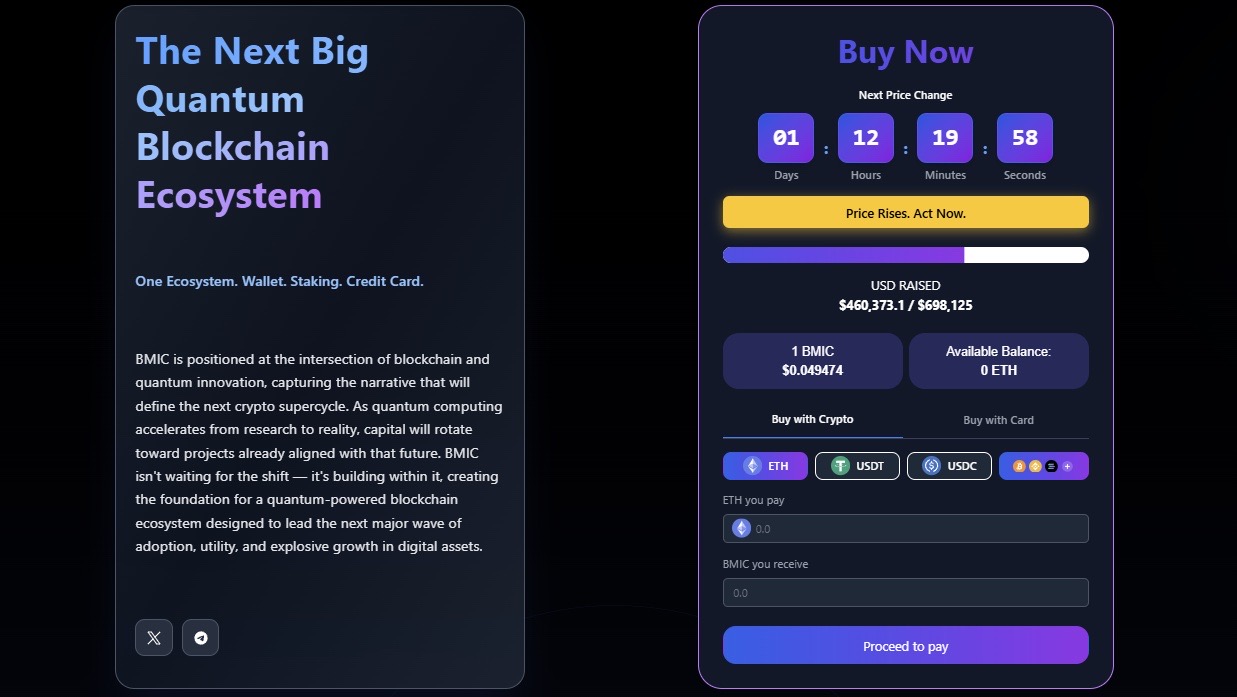
With the current price at $0.049474, positioning remains near the lower boundary of the pricing curve. In previous cycles, early-stage infrastructure plays have delivered disproportionate returns once broader adoption follows.
Utility drives demand. Wallet features, enterprise APIs, compute access, staking rewards, governance participation, and revenue-linked burn events connect token supply to real services. The deflationary model includes strategic burns tied to network activity.
Governance activation enables token holders to vote on protocol parameters. This introduces long-term alignment and community participation beyond speculation.
For investors reviewing altcoins to buy during uncertain markets, a cryptocurrency with capped supply, real utility, and early-phase pricing presents a structured entry thesis.
Positioning Before the Quantum Breakout
The quantum timeline may vary, but preparation windows are narrowing. Blockchain systems built for classical computing must eventually adapt or risk exposure.
BMIC builds with post-quantum standards from inception. It integrates wallet protection, staking security, payment infrastructure, AI optimization, enterprise APIs, and decentralized compute access into a unified ecosystem.
The live crypto presale offers access before later pricing tiers activate. Structured increases reward early entry. Supply is fixed. Burn events reduce circulating tokens over time. Utility extends beyond storage into enterprise and compute infrastructure.
Among the best cryptos to buy for protection against quantum threats in the coming years, $BMIC aligns directly with a structural technological transition. As quantum computing advances, infrastructure prepared for that era may define the next Web3 expansion cycle.
For any of those looking for the best altcoin to buy before a potential quantum breakout, early participation in BMIC’s presale offers positioning at the beginning of a new technological chapter.
Meet the future of quantum-secure Web3 with BMIC:
Presale: https://bmic.ai/
Social: https://x.com/BMIC_ai
Telegram: https://t.me/+6d1dX_uwKKdhZDFk