

 Some of the links on this site may be affiliate links. ICOBench may receive advertising commissions when users visit recommended platforms via our affiliate links, at no additional cost to you. All recommendations are based on a comprehensive review process.
XRP just lost 7% in a week, Cardano dropped 10%, and the sell-off reflects weakening market sentiment rather than a single macro trigger. Most investors still see it as another routine dip, but that misses a deeper issue. The real risk is sentiment of course, but what about cryptographic obsolescence? Most top altcoins aren’t prepared for what’s ahead.
BMIC ($BMIC) launched with a direct answer: quantum-resistant infrastructure that protects assets before traditional encryption fails.
The crypto presale opened at $0.049474 per token. Early buyers see what’s happening. BMIC isn’t waiting to patch vulnerabilities later. It’s solving them now, before most projects even acknowledge the problem exists.
XRP: Strong Payments, Weak Cryptographic Defense
XRP remains one of the fastest settlement networks in crypto. Transactions finalize in 3 to 5 seconds. Fees stay under a penny. Ripple’s On-Demand Liquidity product moves real money across borders, and the partial SEC win cleared up regulatory concerns in the U.S. Banks trust XRP because it works.
But the recent price chart tells a different story. XRP broke down from $2.06 early in the week and failed multiple recovery attempts. Each bounce produced lower highs. The token is now stuck around $1.91, with resistance at $1.95 to $2.00 and support barely holding at $1.88. Technical structure favors another leg down toward $1.82 unless buyers step in with real volume.
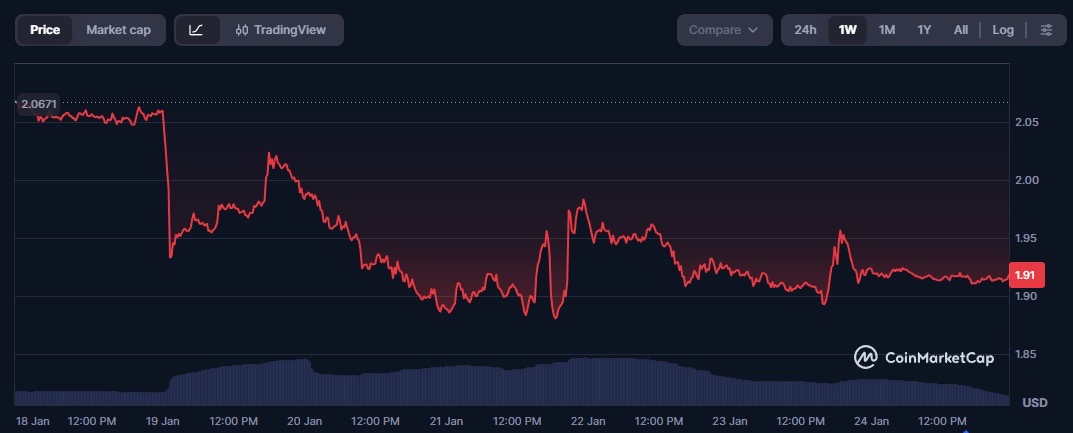
Source: CoinMarketCap/XRP
The bigger issue is cryptographic. XRP runs on classical signatures that quantum computers will break. Upgrading a live global payment network to post-quantum standards means downtime, migration risk, and coordination across thousands of nodes. That’s not a patch. It’s a complete overhaul.
Speed doesn’t matter if the foundation cracks. XRP will need to address this eventually, and the longer it waits, the harder the fix becomes.
Cardano: Rigorous Development, Same Vulnerability
Cardano built its reputation on formal verification and peer-reviewed research. Ouroboros’ consensus is mathematically proven. Smart contracts run on Haskell, which catches bugs at compile time instead of runtime. The extended UTXO model ensures deterministic execution. Cardano ships slowly, but it ships correctly.
Price action shows weakness. ADA broke down from $0.40 and couldn’t recover. It tried bouncing to $0.372, then $0.368, but sellers pushed it back each time. The token now sits at $0.358, testing support at $0.352. A break below that level opens the door to $0.345 or lower. Volume remains low on every rally attempt, which signals distribution instead of accumulation.
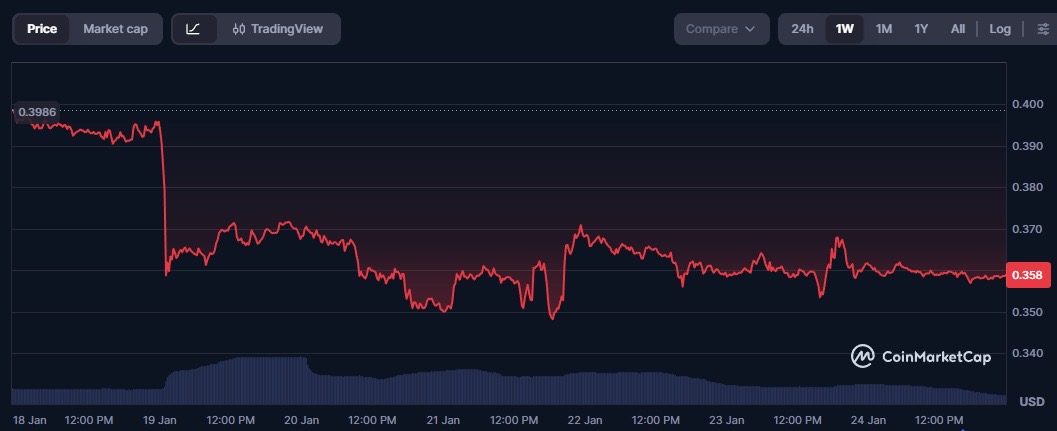
Source: CoinMarketCap/Cardano
Cardano’s academic approach is admirable, but it doesn’t solve quantum risk. The protocol still relies on cryptography that quantum machines will crack. Retrofitting post-quantum algorithms into a formally verified system introduces new complexity, new audit requirements, and new attack surfaces. That contradicts the entire philosophy Cardano was built on.
Formal verification means nothing if the underlying math gets broken. Cardano will have to choose between speed and safety when quantum computing arrives. BMIC doesn’t face that tradeoff because it started quantum-resistant.
BMIC: Best Altcoin to Buy for Quantum-Native Security
BMIC built the first wallet with signature-hiding smart accounts on ERC-4337 and PDA architecture. Public keys never appear on-chain. That removes the main target quantum computers will attack. Hybrid post-quantum signatures upgrade automatically as global standards change, so the platform stays protected without manual migrations.
The wallet is one piece. BMIC also offers quantum-secure staking, where validator keys stay hidden inside signature-private infrastructure. Stakers don’t expose themselves to future attacks. The quantum-secure credit card system uses PQC authentication and private routing to stop cloning and key-recovery exploits before they happen.
Enterprises get access through Quantum Security-as-a-Service APIs. Banks, fintechs, and healthcare providers can plug in custody, key management, and encrypted messaging without rebuilding their systems. AI monitors everything and catches problems before they escalate.
The roadmap includes a Quantum Meta-Cloud linking multiple quantum hardware providers into one decentralized network. No vendor lock-in. No corporate control. BMIC acts as both a security layer and a compute gateway as AI needs to expand. The crypto presale opens early access before enterprise adoption accelerates.
BMIC Token: Deflationary Economics and Real Utility
The presale runs 50 phases starting at $0.049474 per token. Total supply is capped at 1.5 billion. Here’s the breakdown: 50% presale (750M), 12% rewards and staking (180M), 10% liquidity and exchanges (150M), 10% private sale (150M), 9% ecosystem reserve (135M), 6% marketing (90M), 3% team (45M).
The token model runs on deflationary mechanics. Part of platform revenue funds buybacks and burns. As usage grows, supply contracts. BMIC is required to access wallet features, enterprise APIs, and compute workloads. Staking rewards participants and strengthens the network through quantum-secure validator setups.
The roadmap breaks into clear stages. Phase 1 builds the wallet and embeds post-quantum cryptography. Phase 2 releases the alpha and starts institutional pilots with QSaaS APIs. Phase 3 launches the beta with governance activation and the first burn events.
Phase 4 brings the Quantum Meta-Cloud online and activates burn-to-compute, converting tokens into compute credits. Phase 5 deploys the mainnet with decentralized governance, AI security updates, and enterprise rollout across finance, insurance, and healthcare.
Presale buyers lock in the lowest price before the next tier. This is the crypto to buy before quantum threats hit the news cycle.
Why BMIC Has the Advantage
XRP delivers speed and institutional adoption. Cardano brings formal verification and rigorous development. Both are strong in their categories. But neither one was built quantum-resistant from the start. BMIC was.
It secures wallets, staking, and payments without exposing public keys. Enterprises integrate quantum security without expensive overhauls. The deflationary token model and compute utility create sustained demand. The roadmap scales from wallet launch to full quantum infrastructure without needing hard forks or protocol rewrites.
Anyone searching for the best crypto to buy in 2026 should ask what happens when quantum computing goes operational. Most networks will rush to patch their code. BMIC already handled that part. The crypto presale is live at $0.049474 per token. Early buyers lock in better pricing before the next phase. That window closes fast.
Discover the future of quantum-secure Web3 with BMIC:
Presale: https://bmic.ai/
Social: https://x.com/BMIC_ai
Telegram: https://t.me/+6d1dX_uwKKdhZDFk