


 Some of the links on this site may be affiliate links. ICOBench may receive advertising commissions when users visit recommended platforms via our affiliate links, at no additional cost to you. All recommendations are based on a comprehensive review process.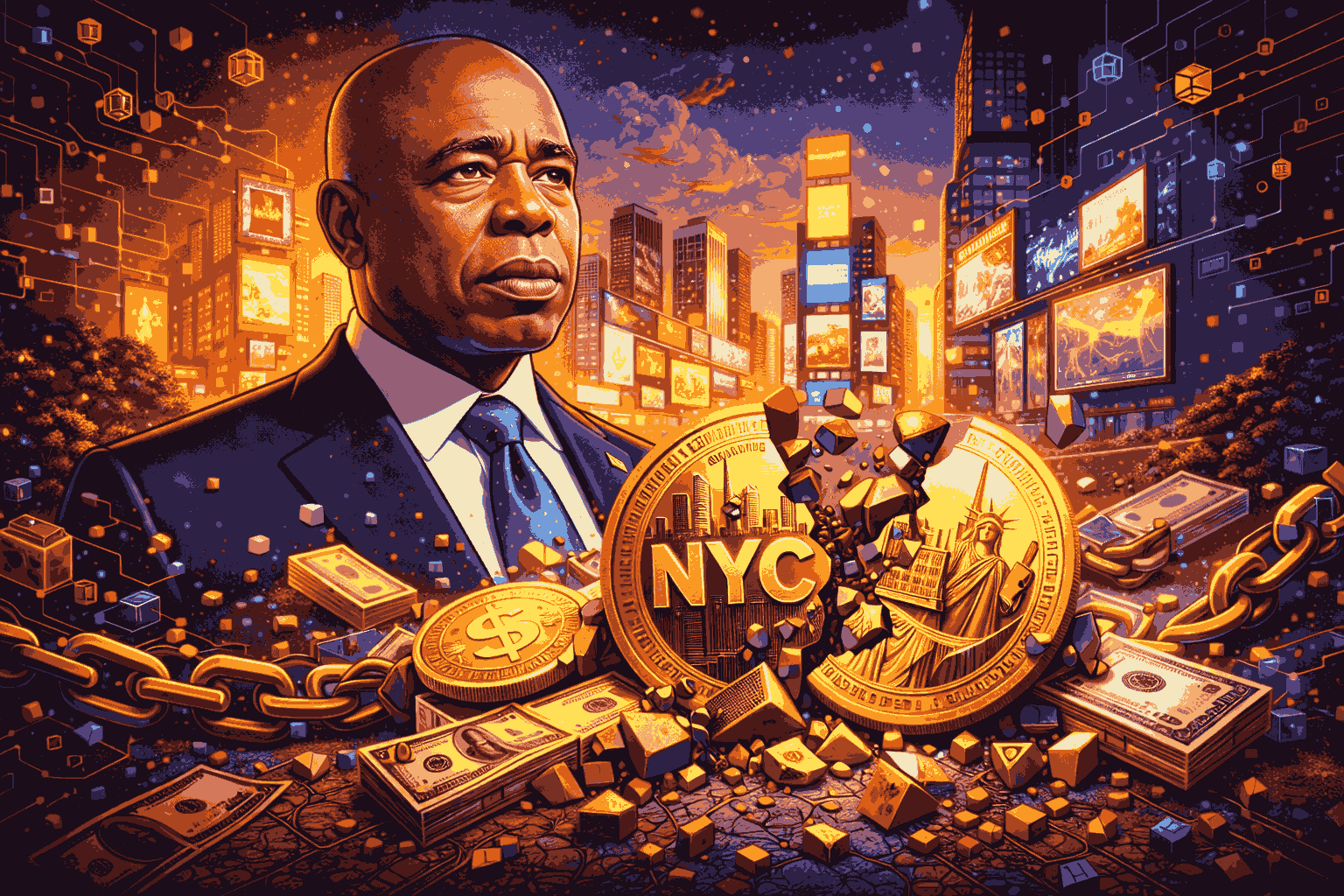
Former New York City Mayor Eric Adams announced the launch of his own cryptocurrency token, NYC, on July 12. However, the token suffered a sharp price collapse almost immediately after going live, triggering allegations of market manipulation and a potential rug pull.
Another week, another memecoin… and this one’s also wrapped in politics.
Former NYC mayor Eric Adams launched NYC Token on Solana, aiming to fund anti-hate initiatives and crypto education.
But things unraveled fast:
◢ In 30 mins, price went from $0.47 to $0.10
◢ Market…— Onur 🍌🦍 (@0xc06) January 13, 2026
NYC Token Plunges After Brief Surge to $600 Million Valuation
Roughly 12 days after completing his four-year term as mayor, Adams unveiled the NYC meme token at a press conference in Times Square. The token was issued on the Solana (SOL) blockchain.
During his tenure, Adams had repeatedly positioned New York as a future “crypto capital.” He stated that the NYC token was intended to support blockchain education initiatives and efforts to combat antisemitism.
According to market data, the token surged immediately after launch, briefly reaching $0.58 per token, with an estimated market capitalization between $540 million and $600 million.
Within minutes, however, the price collapsed to around $0.13, eventually pushing the market cap below $100 million, resulting in significant losses for many investors.
Suspicious Liquidity Movements Flagged by Blockchain Analysts
Blockchain analytics firm Bubblemaps identified questionable on-chain activity linked to wallets associated with the token’s issuer.
One wallet, labeled “9Ty4M,” reportedly provided one-sided liquidity on the decentralized exchange Meteora. At the price peak, the wallet withdrew approximately $2.5 million in USDC, not USDT, before the token price dropped more than 60%.
After the crash, about $1.5 million was reportedly re-injected into liquidity pools, while the remaining $1 million remains unaccounted for, according to Bubblemaps.
Token distribution data also revealed extreme concentration. The top five wallets controlled roughly 92% of the total supply, with a single wallet holding approximately 70%, significantly increasing the risk of abrupt price collapses from limited sell pressure.
Retail Investors Suffer Heavy Losses
The sharp volatility resulted in substantial losses for retail participants. On-chain data from Solscan shows that one wallet purchased approximately $745,000 worth of NYC tokens, only to sell them less than 20 minutes later, realizing a loss of roughly $473,000.
Promotional posts on Adams’ X (formerly Twitter) account were subsequently flagged with Community Notes warning of a possible rug pull.
The project team stated that a “partner needed to rebalance liquidity,” but did not disclose detailed transaction records.
Nicolas Vaiman, co-founder of Bubblemaps, described the incident as a “clear rug pull,” estimating that developers may have extracted around $1 million in profit.
The incident adds to a growing list of celebrity-linked crypto projects that have ended in controversy, underscoring the importance of transparency and risk assessment for cryptocurrencies investors.