





 Some of the links on this site may be affiliate links. ICOBench may receive advertising commissions when users visit recommended platforms via our affiliate links, at no additional cost to you. All recommendations are based on a comprehensive review process.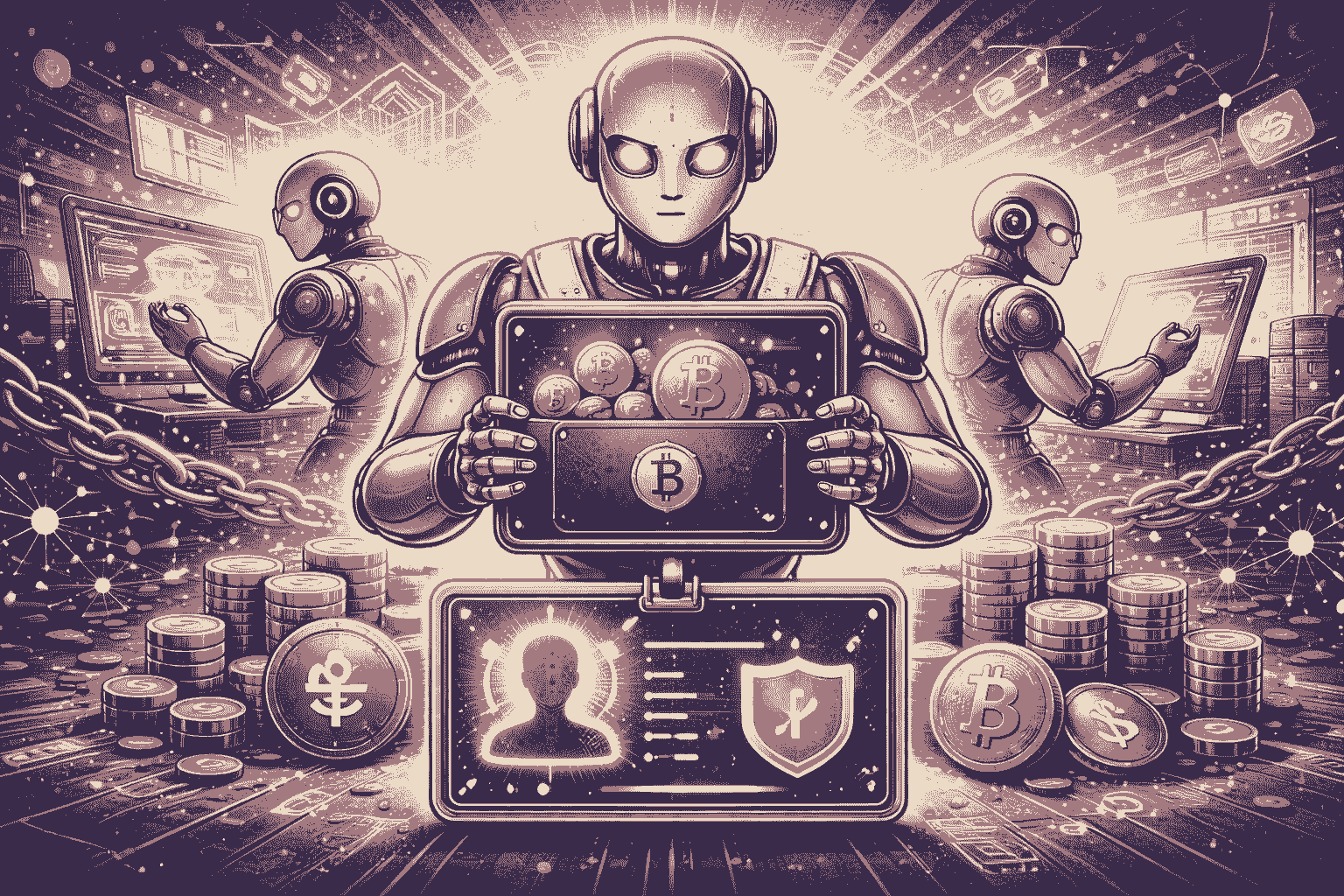
As 2026 approaches, the average user on a decentralized finance (DeFi) platform is no longer a human sitting behind a screen. Instead, it is an autonomous artificial intelligence agent. These next-generation entities do more than execute predefined commands: they control their own crypto wallets, manage on-chain treasuries, and are now required to declare a verified digital identity through a new framework known as Know Your Agent (KYA).
In financial services, non-human identities (bots, APIs, automated creds) already outnumber human employees 96-to-1 — but they're still unbanked ghosts with no real access.
The next bottleneck for the agent economy isn't smarter models, it's identity.
KYA (Know Your Agent) is…
— NexusHub (@nexushubcore) December 31, 2025
The Rise of Algorithmic Whales and Autonomous Wallets
The DeFi landscape has been radically reshaped by networks of autonomous AI agents, particularly those developed by the Artificial Superintelligence Alliance (ASI). These agents can seamlessly navigate lending protocols, yield farming strategies, and arbitrage opportunities with a level of efficiency that has rendered human trading increasingly obsolete.
Enabled by account abstraction and programmable smart contracts, AI agents can now legally hold cryptocurrencies in their own name, effectively operating as independent economic entities on the blockchain.
This shift has been accelerated by the direct integration of large language models (LLMs) with blockchain APIs. Research published by Fetch.ai shows that these agents operate continuously, optimizing strategies in real time based on every market movement. By 2026, the amount of capital managed by AI agents is expected to surpass that of traditional hedge funds, giving rise to a new class of “algorithmic whales” driven purely by mathematical logic rather than human emotion.
Know Your Agent (KYA): A New Trust Standard for Web3
The explosive growth of high-performance trading bots has forced regulators and DeFi protocols to respond in order to prevent market destabilization. This response has taken shape in the form of Know Your Agent (KYA).
Under this emerging standard, any AI agent interacting with institutional liquidity pools or tokenized real-world assets (RWAs) must verify its origin and disclose the identity of its creator or legal owner. This verification is typically issued as a cryptographic credential, often stored as a non-transferable token (SBT), linking each AI decision to a clearly defined legal responsibility.
The need to distinguish between humans and machines has also propelled projects such as Worldcoin (Tools for Humanity) into a central role within global Web3 infrastructure. Its Proof of Personhood model now acts as a gatekeeper: users must either prove they are human to access certain benefits, or register formally as an AI agent under KYA to operate in professional DeFi markets.
Without this verification, AI agents in 2026 are excluded from the most secure and institutionally trusted protocols, reducing the risk of large-scale market manipulation by anonymous bot networks.
AI Financial Supremacy and the Role of Blockchain
The most disruptive development lies in the scale of wealth accumulation achieved by these AI agents. By exploiting micro-arbitrage opportunities invisible to human traders and compounding gains continuously, AI-driven strategies consistently outperform retail investors and many traditional funds.
Blockchain technology has become the essential trust layer for this emerging economy. It remains the only infrastructure capable of immutably and transparently recording AI-executed transactions. Ethereum co-founder Vitalik Buterin has previously described this synergy, arguing that crypto defines the rules of the game while AI produces the most effective players.
This convergence is explored in depth in recent Ethereum Foundation research on the intersection of artificial intelligence and cryptography. The findings highlight how AI delivers scalable decision-making, while blockchain provides verifiable execution.
Outlook: The First Non-Human Digital Economy
In conclusion, 2026 marks the beginning of a new era in which the digital economy is increasingly dominated by artificial intelligences whose wealth is secured by code. As autonomous agents become the primary actors in DeFi, blockchain emerges as the foundational infrastructure of the world’s first non-human economy.