

 Some of the links on this site may be affiliate links. ICOBench may receive advertising commissions when users visit recommended platforms via our affiliate links, at no additional cost to you. All recommendations are based on a comprehensive review process.
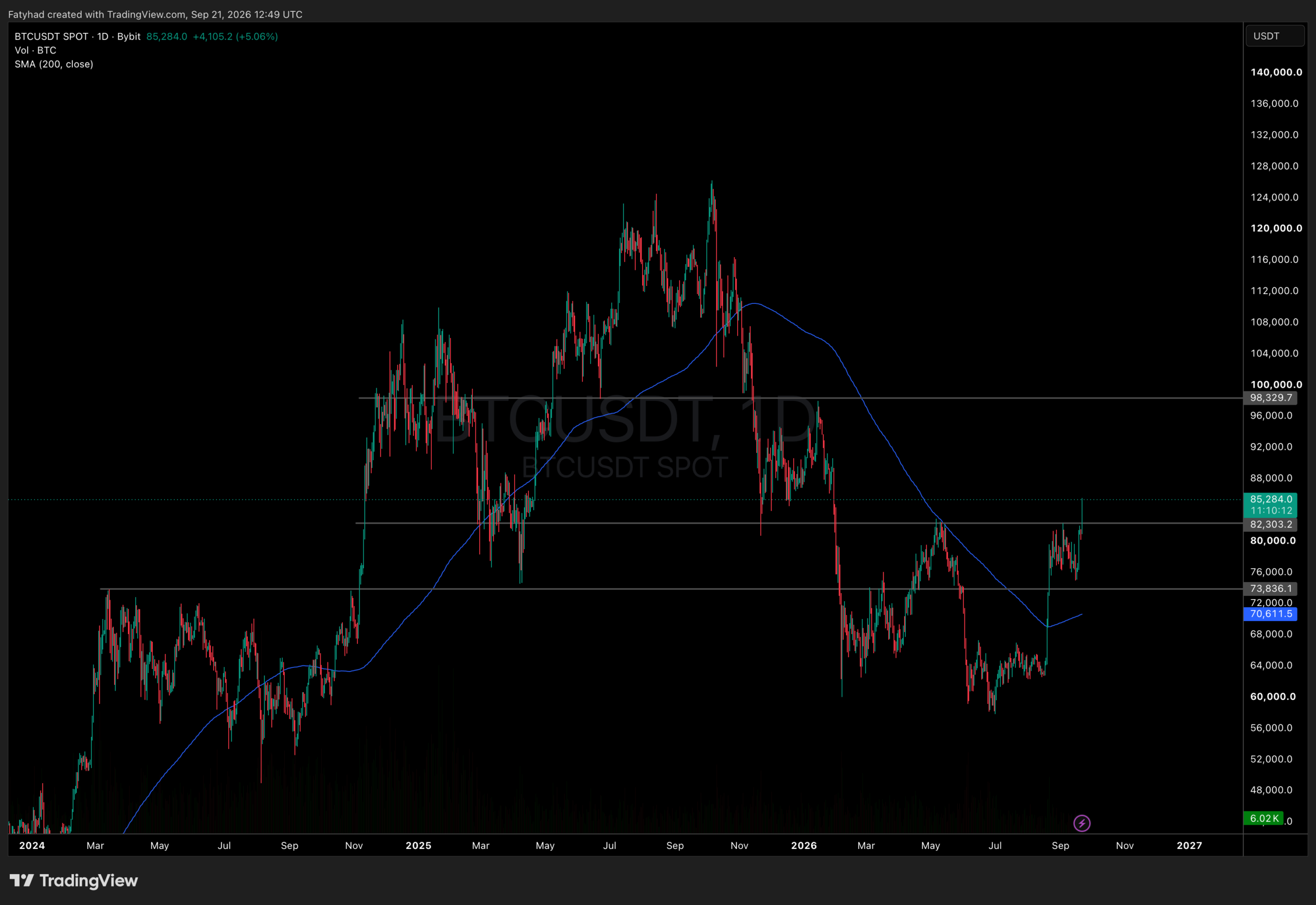
Bitcoin has pushed through the $82,000 resistance that capped last week’s recovery, trading at $84,874 on Monday, up 5.5% in 24 hours. The rally lifts Bitcoin’s market capitalization to about $1.7 trillion, and 24-hour trading volume has risen almost 75% to $37.8 billion, a sign that the breakout has broad participation rather than thin-market drift.
The move marks a sharp turnaround from last week, when BTC slipped below $76,000 after the Federal Reserve raised interest rates and the Senate failed to advance the CLARITY Act. Neither development would normally favor risk assets, yet Bitcoin has now climbed more than $8,000 from its lows. Fresh market attention on draft rules from the Commodity Futures Trading Commission added to the upside momentum on Monday.
This is why Crypto is pumping.
The CFTC and SEC set the rules for institutional capital to move on chain.
US sellers are about to realize the Clarity Act isn't the end all be all.
The rest of the World and the US regulatory bodies are pushing ahead with the tokenization of… https://t.co/iNG8iDG4zk
— Mark (@markchadwickx) September 18, 2026
You’re Still Early: 10 AI Agent Coins That Could Win Big Next Bullrun
Bitcoin Breaks $82K Resistance: ETF Demand Flips Back to Inflows
The recovery has coincided with a clear reversal in spot Bitcoin ETF flows. US-listed funds recorded net outflows on most trading days between September 8 and September 16, including redemptions of roughly 5,760 BTC on September 15 and 3,910 BTC on September 16.
That trend turned on September 17, with net inflows of about 2,090 BTC, led by BlackRock’s IBIT. Demand accelerated on September 18, when the funds took in around 5,670 BTC, or roughly $433 million. Fidelity’s FBTC accounted for the largest share at about 4,070 BTC, while IBIT added around 1,420 BTC. Grayscale’s GBTC, a consistent source of selling earlier in the month, saw no outflows on either day.
Cumulative net inflows into spot Bitcoin ETFs now stand at about $55.6 billion, or roughly 695,700 BTC, and total net assets across the funds are close to $98.8 billion. The return of steady institutional buying helps explain why Bitcoin was able to absorb last week’s negative macro and policy headlines.
Trade Securely on MEXCFed Hike and CLARITY Act Setback Fail to Cap the Rally
JUST IN 🚨: Bitcoin $BTC blasting 📈 📈 Bears in shambles!! pic.twitter.com/sz2cEG90Gi
— Barchart (@Barchart) September 21, 2026
The Federal Open Market Committee voted 12-0 on September 16 to raise the federal funds target range by 25 basis points to 3.75%–4.00%. Higher rates tighten financial conditions and make cash and bonds more attractive relative to speculative assets. Bitcoin’s rebound does not mean it has become immune to those pressures, but it shows that crypto-specific drivers such as ETF flows, institutional positioning and derivatives activity can outweigh macro forces in the short term.
In Washington, the Digital Asset Market CLARITY Act fell short of a key procedural vote. The bill, designed to create a legislative framework for the US crypto industry and divide oversight between the SEC and the CFTC, received 49 votes in favor and 50 against, well below the 60 needed to advance. A motion to reconsider keeps the measure alive, but its path forward is uncertain.
With $82,000 now cleared, that level becomes the first area of support to watch. Holding above it would strengthen the case for a push toward $86,000 and potentially the highest prices since January. A drop back below $82,000, by contrast, would suggest the breakout lacked conviction and leave the recovery vulnerable to renewed macro pressure.
Don’t Miss: New Binance Listings That Could Erupt This Year