




 Some of the links on this site may be affiliate links. ICOBench may receive advertising commissions when users visit recommended platforms via our affiliate links, at no additional cost to you. All recommendations are based on a comprehensive review process.
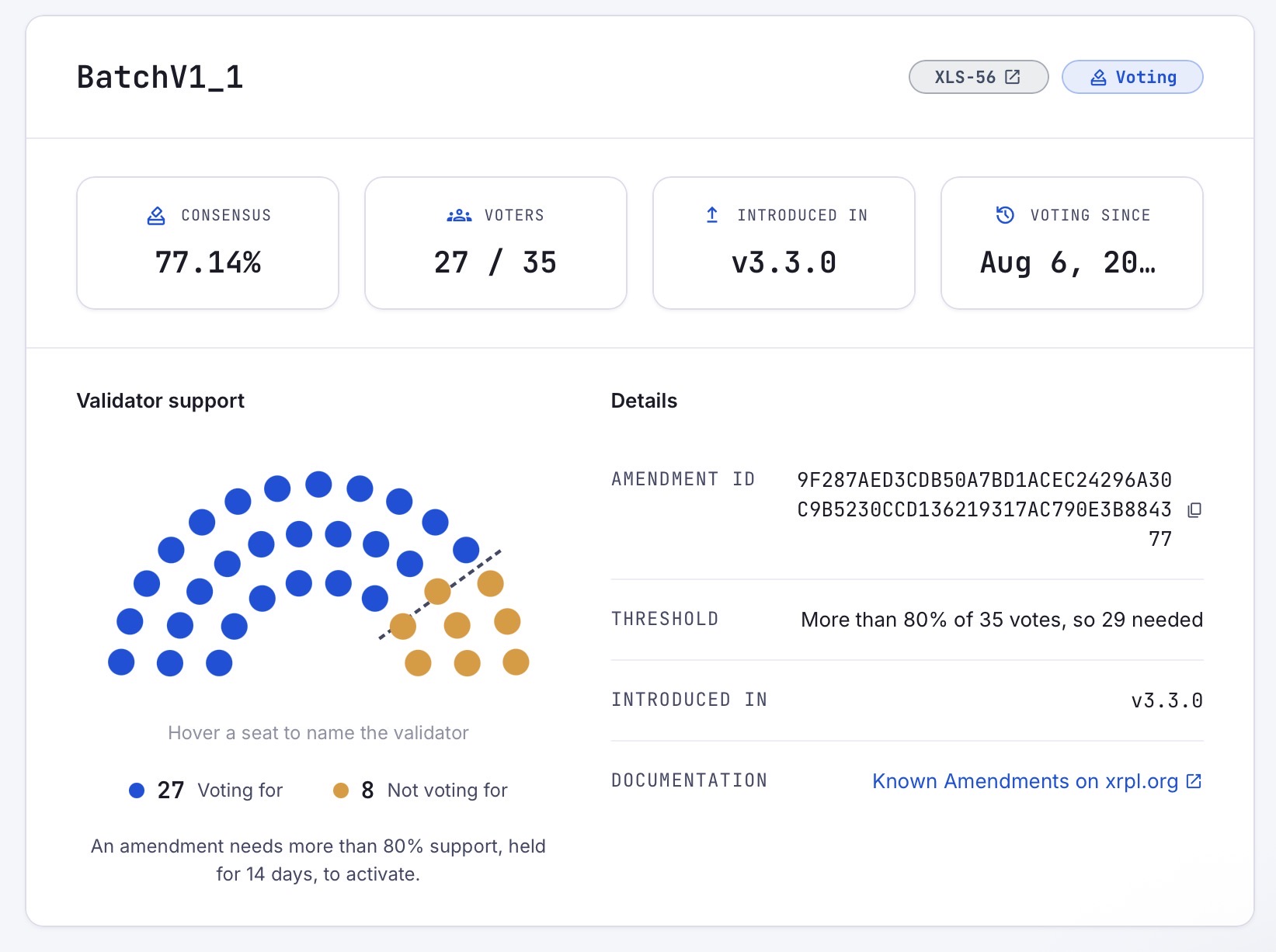
Following today’s XRP news, the XRP Ledger’s Batch V1.1 amendment had support from 27 of 35 trusted validator votes in a Tuesday snapshot, or around 77%. That left the proposal one vote short of the 80% threshold required to begin a 14-day activation countdown.
If activated, the feature would allow users and applications to bundle as many as eight linked transactions into one operation. These bundled transactions would be atomic, meaning they would either succeed together or fail together.
The design is intended to prevent partial transfers in multi-step activities such as token swaps, customer payments, and platform-fee transfers.
The Batch V1.1 amendment shipped in xrpld 3.3.0 and is now up for voting.
After the v1.0 signature bug was caught in February (pre-Mainnet, no funds at risk), we rebuilt it: root-cause fix, 4 senior reviewers, a Sherlock attackathon, and audits from Halborn and Common Prefix. We…
— Mayukha Vadari (@msvadari) September 14, 2026
Don’t Miss: The Secret Meme Coins Smart Money Are Stacking For Next Year
Would Batch Upgrade Make Linked Transactions Atomic?
One additional validator vote would start the two-week countdown toward mainnet activation. Support must remain above the 80% threshold for the full 14 days before the amendment can take effect, while validators can change their votes during that period.
Atomic execution could address one-sided outcomes in a token swap. Rather than one party sending funds while the other transfer fails, both linked transfers could be completed together or not completed at all. Wallets and marketplaces could also combine a customer payment with a platform fee, so the two transfers are processed in the same operation.
RippleX, Ripple’s developer arm, has said commercial projects intending to use Batch are under contract or in development, although it has not named those companies. Batch V1.1 shipped in the xrpld 3.3.0 software release but has not yet gone live on the main network because it remains subject to the validator vote.
XRP News Today: Security Fixes Put XRPL Governance Under the Microscope
Adding to XRP news today, the current vote follows the withdrawal of an earlier Batch version before it reached the live network. Researchers found a flaw in the original proposal that could, under certain conditions, have allowed an attacker to include transactions from another person’s account without approval. That version never went live.
Developers replaced the feature in the XRP Ledger’s 3.3.0 software release and subjected the new version to further internal reviews, outside audits and public bug hunting.
Ripple engineer Mayukha Vadari said the work after the v1.0 signature bug included a root-cause fix, four senior reviewers, a Sherlock attackathon, and audits from Halborn and Common Prefix.
A later review identified 11 issues involving signatures, authorization checks, and bugs that could crash servers. One issue was rated critical by Common Prefix. According to the security firm’s audit, the flaw could have allowed an attacker to reuse a user’s signed permission to execute more transactions than intended.
RippleX said the revised implementation was reviewed by four senior engineers and examined through audits from Halborn and Common Prefix, a public security contest, and automated testing before it returned to validators for consideration.
Don’t Miss: ETF Experts Predict The Next Crypto to Explode in 2026
The 14-Day Countdown Is the Next Decision Point
Nothing changes on the XRP Ledger unless another trusted validator supports the amendment and the threshold is reached. If that occurs, the 14-day clock begins. Support must stay above 80% throughout the entire period, or the countdown resets.
Until then, Batch V1.1 remains included in the 3.3.0 software release but inactive on the main network. The amendment’s progress now depends on the ledger’s governance process and whether validator backing can remain above the required threshold long enough for activation.