




 Some of the links on this site may be affiliate links. ICOBench may receive advertising commissions when users visit recommended platforms via our affiliate links, at no additional cost to you. All recommendations are based on a comprehensive review process.
Google Gemini AI predicts a solid surge for Cardano. By the end of 2026, the bull case envisions ADA climbing toward $1.00 to $1.25, driven by the Ouroboros Leios upgrade, which will deliver more than 1,000 transactions per second and is due for release in December.
CME futures are cited as a key factor in legitimizing ADA as an institutional asset, alongside potential US ETF approval. Stablecoin liquidity through USDCx is expected to fuel DeFi growth on the network.
Charles Hoskinson’s RealFi push and whale accumulation are both named as sources of confidence for the bull case. Real-world asset integration through an actual named initiative adds specificity that some purely technical roadmaps lack.
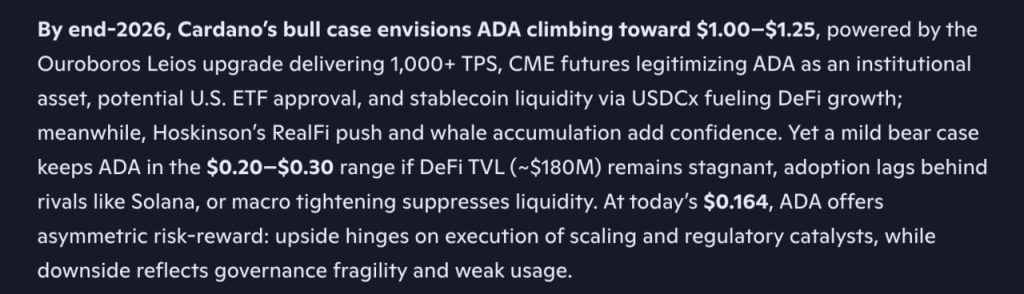
The bear case is comparatively modest but grounded in real numbers. A mild bear scenario keeps ADA in the $0.25 to $0.30 range if DeFi TVL, currently around $180M, remains stagnant, adoption lags behind rivals like Solana, or macro tightening suppresses broader liquidity.
At today’s $0.218, Google Gemini AI predicts the setup as offering asymmetric risk-reward. Upside hinges on execution of the scaling roadmap and regulatory catalysts landing, while downside simply reflects governance fragility and weak usage continuing as is.
Cardano Price Prediction: ADA Is Down Roughly -92% From Its Late 2024 Peak
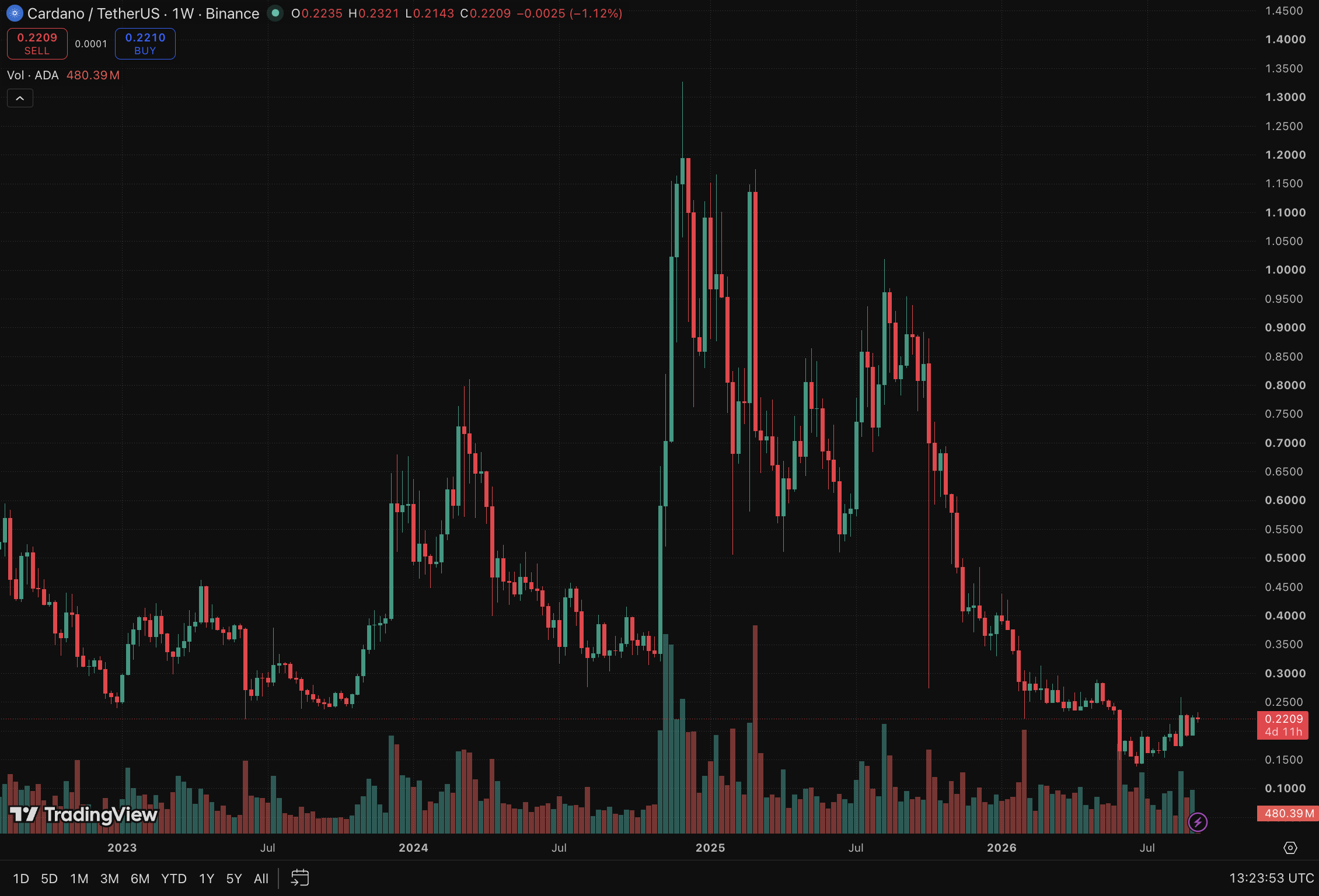
Price closed at $0.218, up +0.8%, within a range of $0.190380 to $0.228970. This slight gain follows one of the longest declines in ADA’s recent history.
After peaking at $1.32 in December 2024, ADA fluctuated between $0.55 and $0.95 through most of 2025. A significant drop occurred in October 2025, with prices plunging from above $0.85 to below $0.55. Since then, ADA has steadily declined, briefly stabilizing near $0.29 in May 2026 before falling again.
Currently, the price hovers around $0.21, testing strong support. Resistance is at $0.225, then $0.29, and finally near $0.55. Momentum remains flat, with ADA needing to reclaim $0.29 for a bullish outlook, as it has not closed above this level since May.
Don’t Miss: The Secret Meme Coins Smart Money Are Stacking For Next Year
LiquidChain Highlighted by Google Gemini AI as a High Upside Presale Opportunity
Liquid Chain (LIQUID) project operates at Layer 3, integrating Bitcoin, Ethereum, and Solana into a unified execution environment. This lets a single deployment interact with all three networks, reducing complexity and bridging overhead.
It addresses four key failure points: the Unified Liquidity Layer eliminates liquidity silos, Single-Step Execution cuts multi-transaction costs, Verifiable Settlement minimizes counterparty risk, and the Deploy-Once model enables a single codebase for all networks.
The presale is live at $0.014953 per $LIQUID token, with over $960,000 raised so far.