




 Some of the links on this site may be affiliate links. ICOBench may receive advertising commissions when users visit recommended platforms via our affiliate links, at no additional cost to you. All recommendations are based on a comprehensive review process.
Cutting 18.9 million tokens out of future supply is not a marketing move. That decision underpins the latest Grok AI price prediction, where the model predicts Solana heading for $155 to $210 by 31 December 2026, with a realistic base case near $175.
The late-August governance vote doubled SOL’s disinflation rate from 15% to 30%. Over six years, which trims roughly 18.9 million tokens of issuance. The timing is the interesting part. Float tightens exactly as demand climbs rather than during a quiet stretch.
Alpenglow is the technical half. Slated for Agave 4.3 in October, it aims to cut finality from about 12.8 seconds to around 150 milliseconds.
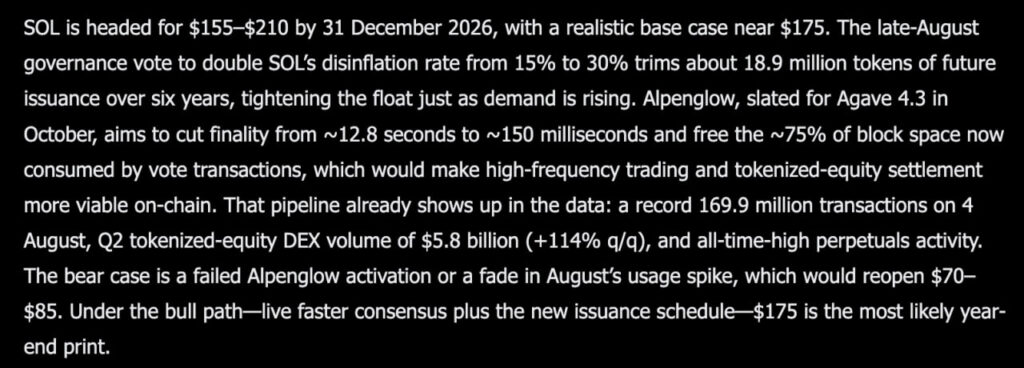
It also frees the roughly 75% of block space now consumed by vote transactions. That capacity makes high-frequency trading and tokenized-equity settlement genuinely viable on-chain. Usage is already running ahead of the upgrade. A record 169.9 million transactions cleared on 4 August alone.
The financial rails are growing too. Q2 tokenized-equity DEX volume hit $5.8 billion, up 114% quarter on quarter, alongside all-time-high perpetuals activity. The bear case has two triggers. A failed Alpenglow activation or a fade in August’s usage spike would reopen $70 to $85.
Under the bull path, $175 is the most likely year-end print.
Solana Price Prediction: Elon Musk Grok AI Predicts Faster Blocks and Fewer Coins
The weekly chart shows two complete cycles. Solana price ran from $20 in 2023 to $295 by January 2025, then repeated a similar arc into a $255 peak in September 2025.
The unwind that followed was severe. February 2026 broke the structure, dropping the price to $67 within weeks.
March through July delivered a long weekly base between $70 and $95. That accumulation lasted roughly six months.
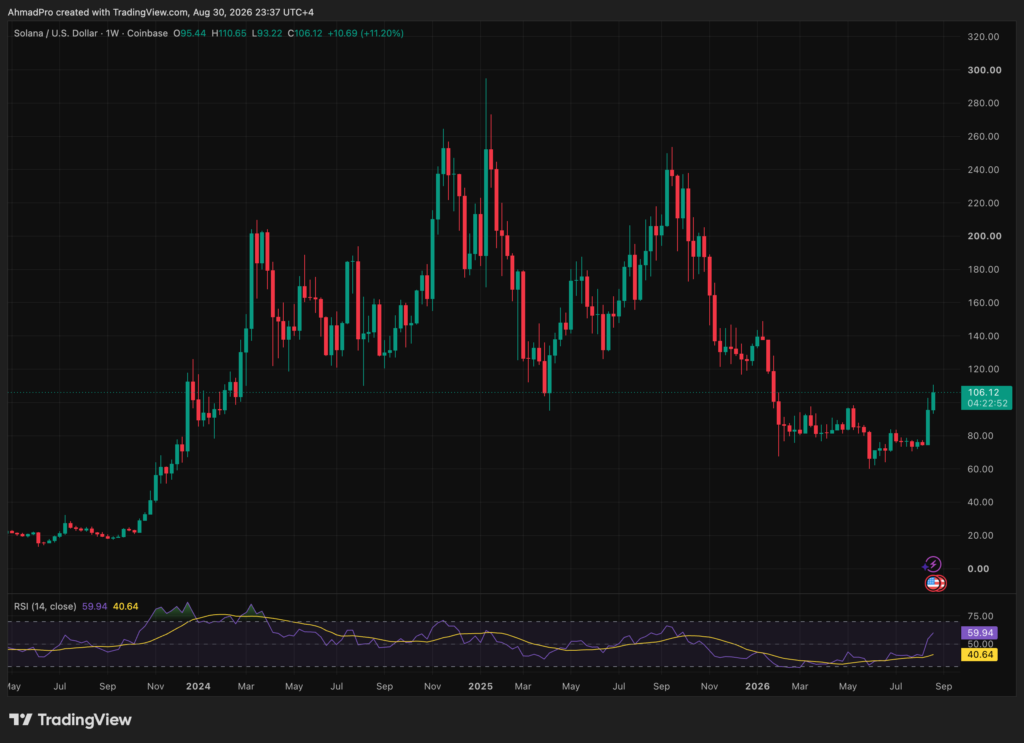
The most recent candle ended it emphatically. Solana closed at $106.12, up $10.69 for a weekly gain of 11.20%, with a range from $93.22 to $110.65.
Closing near the weekly high signals real conviction. Resistance sits at $110.65, then $125, then the $145 shelf from January. Support runs through $93.22 and $85, with the $70 low as the structural floor.
Weekly RSI reads 59.94 against a signal line at 40.64. The 19-point gap is wide while the reading itself sits just below 60. That combination leaves headroom. Momentum has turned decisively without the indicator reaching levels that usually precede a stall.
October delivery is what carries this forward. Ship Alpenglow and $175 becomes the reasonable target.
Solana Is Showing What Faster Infrastructure Can Do. Bitcoin Hyper Wants to Bring That Advantage to BTC.
Solana’s latest thesis is no longer just about speculation. Faster finality, more usable blockspace, and tighter supply are creating an infrastructure case for why more capital could move onto the network.
Bitcoin Hyper is applying that same execution-first logic to Bitcoin.

The project uses the Solana Virtual Machine to bring high-speed transactions, ultra-low fees, and smart contract functionality into a Bitcoin Layer 2 environment. Its Canonical Bridge is designed to move BTC into that ecosystem, while HYPER powers gas, staking, and governance across the network.
The opportunity is straightforward: Bitcoin already has the capital and security. What it lacks is the kind of fast, programmable execution layer that has helped Solana expand into trading, DeFi, and tokenized assets.
Bitcoin Hyper’s presale has already raised more than $33 million, with buyers currently able to stake HYPER for yields of up to 36% APY ahead of the planned 2026 launch.
Don’t Miss: ICOBench Experts Call the Next 1000x Crypto Coins for 2027