


 Some of the links on this site may be affiliate links. ICOBench may receive advertising commissions when users visit recommended platforms via our affiliate links, at no additional cost to you. All recommendations are based on a comprehensive review process.
An 8x call on a coin down 80% sounds absurd until you read the roadmap behind it. Google Gemini AI predicts Cardano will reach $1.50 to $2.50 by late 2026, and its price prediction leans on a stack of upgrades rather than hype.
The centerpiece is the full activation of the Voltaire governance era. That hands management of a massive community treasury directly to ADA holders.
Three technical catalysts sit alongside it. Hydra L2 state channels scale off-chain throughput while Ouroboros Leios upgrades mainnet transaction speeds.
Midnight is the third, a privacy-focused sidechain built for enterprise and private DeFi utility. Its commercial rollout is what Gemini sees converting research into revenue.
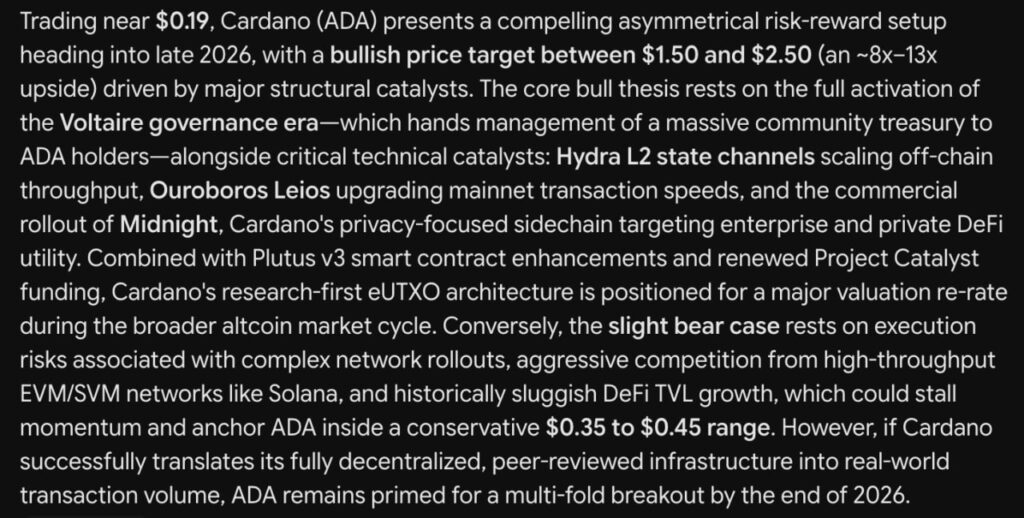
Plutus v3 smart contract enhancements and renewed Project Catalyst funding round out the thesis. Gemini frames the eUTXO architecture as positioned for a major valuation re-rate.
The bear case is described as slight rather than severe. Complex network rollouts carry execution risk, and delays are common at this scale.
Aggressive competition from high-throughput rival architectures adds pressure. Historically sluggish DeFi TVL growth is the third drag on the story.
Should those weigh in, Gemini sees momentum stalling and ADA anchored inside a conservative $0.35 to $0.45 range.
Cardano Price Prediction: ADA Treasury Bet And The Climb Out Of Nineteen Cents
Look at the daily chart, and the damage is obvious. ADA peaked above $1.00 in August 2025 and spent the following year giving it all back.
November and February brought the steepest legs down. The price fell from $0.60 to roughly $0.23 over those two stretches. Spring offered a pause near $0.25 that failed in June. That breakdown carved out a low around $0.145.
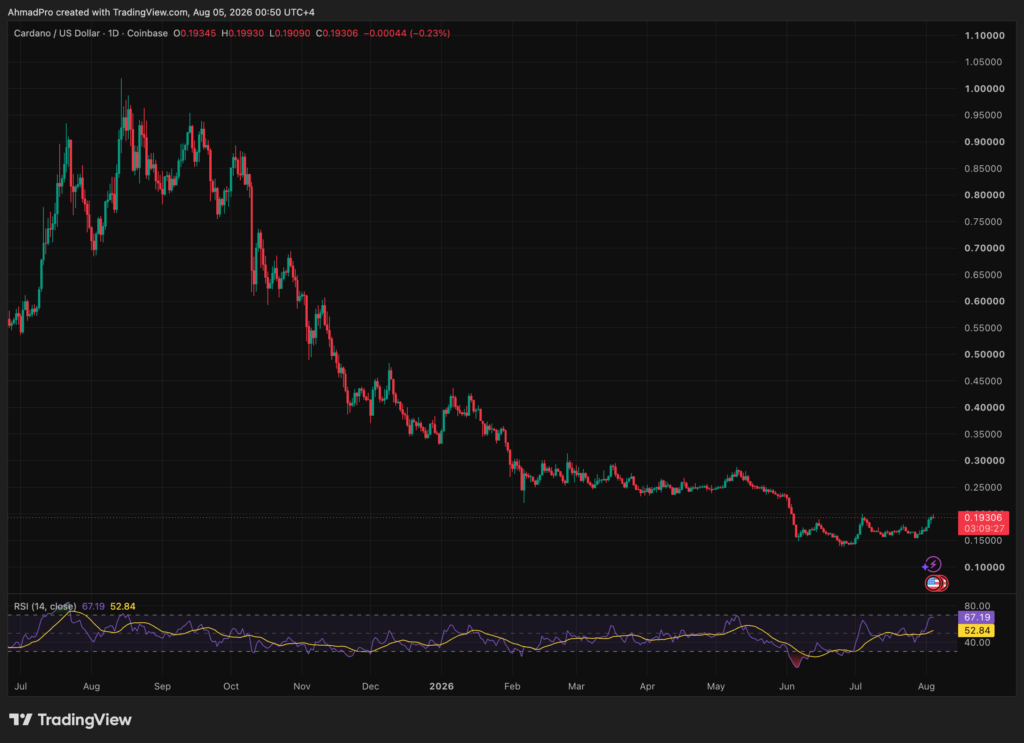
What followed is more interesting. Buyers have built a rising base through July, lifting ADA price back toward $0.19 without any sharp rejection. The close sits at $0.19306, down 0.23% on the day. The session ranged between $0.19090 and $0.19930.
Support now rests at $0.17 and then $0.145 at the June bottom. Resistance begins at $0.20 and thickens near $0.25.
RSI reads 67.19 with its signal line trailing at 52.84. That gap of more than 14 points is wide, and it flags a strong burst of recent buying.
The oscillator approaches overbought without reaching it. Momentum has flipped decisively in favor of buyers for the first time since spring. Gemini’s target sits far above this base, so the near-term test is simpler. Clearing $0.20 and holding it would give the roadmap something to build on.
EXPLORE: Best Memecoins Presales to Watch in July
Gemini AI Predicts LiquidChain is the Next 1000x Potential Crypto
The cross-chain tax is one of the most accepted inefficiencies in crypto. Accepted because nobody has eliminated it, not because it has to exist.
Isolated pools that cannot see each other. Bridges that handle routine volume collapse precisely when congestion peaks. Slippage is extracted before a transaction even reaches its destination.
The infrastructure connecting Bitcoin, Ethereum, and Solana was never designed as a unified system. It accumulated over the years, built by separate teams with no shared architecture and no intent to function as one. The friction is not a flaw. It is the inevitable output of systems that were never meant to work together.
Patches have not fixed it because the problem is not the implementation. It is the architecture. Every new bridge, every routing aggregator, every cross-chain solution treats the symptom while the root cause sits completely untouched.
LiquidChain replaces the root cause.
The project operates at Layer 3, above all 3 networks, collapsing their isolated liquidity systems into one unified execution environment. A single deployment reaches Bitcoin, Ethereum, and Solana simultaneously. No fragmented codebases across separate chains. No bridging overhead extracted from every cross-ecosystem interaction.
4 specific failure points get dismantled. The Unified Liquidity Layer collapses the silos entirely. Single-Step Execution removes the multi-transaction overhead, inflating costs. Verifiable Settlement strips out the trust assumptions that create counterparty risk. The Deploy-Once model means one codebase reaches everywhere it needs to go.
Gemini AI predicts a full-blown launch. The presale is live at $0.01454 per $LIQUID token with over $900,000 raised so far.