


 Some of the links on this site may be affiliate links. ICOBench may receive advertising commissions when users visit recommended platforms via our affiliate links, at no additional cost to you. All recommendations are based on a comprehensive review process.
Bitcoin was introduced as electronic cash, yet its success has come from being held rather than spent. The network proved that digital scarcity could exist without a central issuer – but its limited capacity made everyday payments increasingly awkward as adoption grew. Bitcoin now settles immense value securely, though its base layer still processes only around seven transactions per second.
That unfinished work has become more visible as Ethereum and Solana expand into trading, lending, gaming, and programmable finance. Bitcoin remains the largest crypto asset, but much of the experimentation happens elsewhere.
Bitcoin shouldn’t change – it has won the digital gold narrative, and it does not need to become Solana. But one thing it could have is a faster environment for its capital to move. That is the idea pursued by Bitcoin Hyper (HYPER), a Bitcoin Layer 2 combining BTC settlement but using the Solana Virtual Machine for transfers – basically making payments near-instant and costing less than a cent.
HYPER has raised an incredible $32.9 million, is currently priced at $0.01368, and token holders can stake at 36% APY. The scale of the raise shows an appetite to restore Bitcoin to its original purpose.
How Bitcoin Hyper Turns Value Into Capital
Bitcoin’s conservative design is why the network has survived for so long – changes arrive slowly, transaction history is effectively impossible to alter, and users do not need to trust a bank to verify ownership. But these strengths are less helpful when someone wants to make a small payment, trade on a decentralized exchange, or interact with a smart contract.
Bitcoin Hyper proposes separating those jobs, with Bitcoin’s base chain remaining the settlement layer, and routine activity moving to a faster Layer 2. Transactions are executed through an integrated Solana Virtual Machine and periodically anchored to Bitcoin, reducing the amount of work placed directly on the main network.
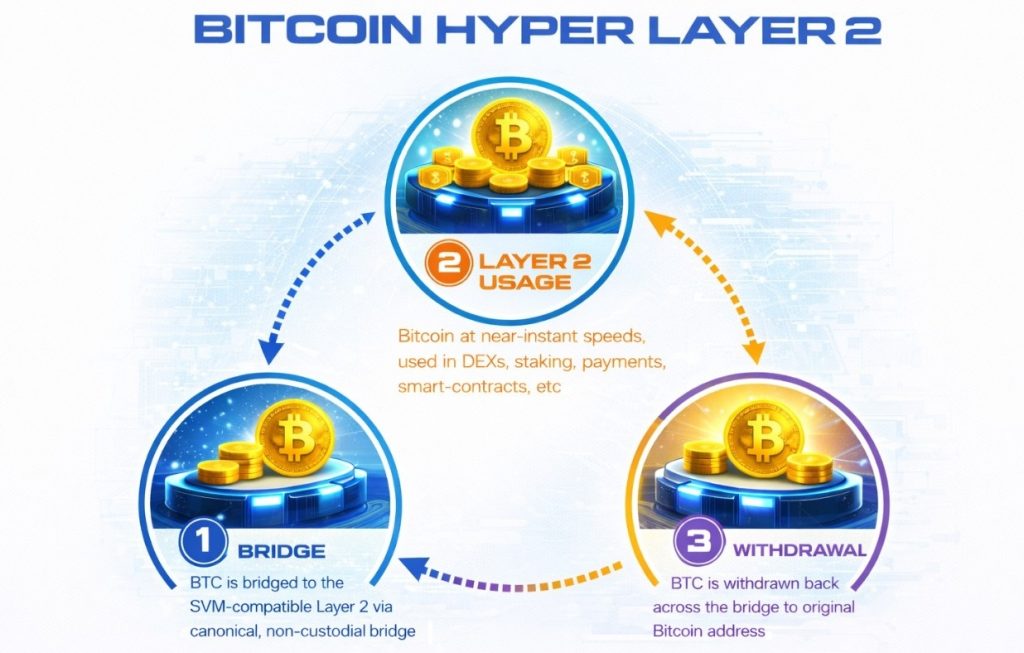
This structure can support payments that settle without waiting for Bitcoin’s usual confirmation process and also create room for swaps, lending markets, staking products, games, and other applications written in Rust. Gas fees are paid in HYPER, giving the token a role similar to ETH’s elsewhere.
The design borrows speed from Solana without trying to move Bitcoin itself onto another blockchain, and Bitcoin remains where final ownership is recorded.
Could HYPER Be the Best Crypto to Buy for Bitcoin’s Next Chapter?
The strongest case for HYPER begins with the amount of dormant capital already held in Bitcoin. While Ethereum and Solana Layer 2 projects compete for users within active application ecosystems, Bitcoin Hyper is approaching a market in which the largest asset has comparatively little native programmable infrastructure.
The $32.9 million presale provides early evidence that investors understand the opportunity. It also gives Bitcoin Hyper a sizeable community before its planned mainnet launch – networks are more useful when developers expect users to arrive and users expect applications to exist.
When you’re this early,
Even the moon feels uncrowded. 🌕⚡️https://t.co/VNG0P4GuDo pic.twitter.com/mrO94UTw6s
— Bitcoin Hyper (@BTC_Hyper2) July 10, 2026
As of today, Bitcoin controls more than half of crypto’s total market value, while demand for fast on-chain execution moves elsewhere. HYPER asks: Why not have both in the same place?
HYPER’s 36% staking APY may reward early participation, although the rate can change as more tokens enter the staking pool. The larger opportunity depends on mainnet delivery, bridge security, and whether developers choose to build useful applications after launch.
Bitcoin’s Original Ambition Is Still Alive
Bitcoin became digital gold because it was exceptionally good at protecting value, but that description was never meant to limit its usefulness.
Bitcoin Hyper suggests that the next phase is making BTC mobile again: fast enough for payments, programmable enough for applications, and still anchored to the network that introduced decentralized money.
Should the team deliver the bridge, execution layer, and developer infrastructure described in its roadmap, HYPER can become part of a long-delayed return to Bitcoin’s first ambition.