


 Some of the links on this site may be affiliate links. ICOBench may receive advertising commissions when users visit recommended platforms via our affiliate links, at no additional cost to you. All recommendations are based on a comprehensive review process.
The cryptocurrency market has experienced major volatility so far this year. Digital asset prices are now being influenced by a wide range of bullish and bearish factors, from the SEC’s declaration that many cryptos are commodities to the ongoing war in Iran, the latest U.S. inflation data and economic reports, and the Federal Reserve’s hesitant position regarding interest rate cuts.
This makes AI an essential tool for modern traders and investors, as LLMs like Google’s Gemini can quickly filter out the noise, provide real-time summaries of key data points, and enable more objective and less emotional trading decisions.
For this article, we used Gemini to forecast the prices of XRP, Ethereum, and Cardano for the end of this year. To add an extra test, we also asked for a prediction for Bitcoin Hyper (HYPER), which is due to launch its token after its presale ends during the next few months. Taking HYPER’s lower market cap into account (with $32 million raised in the presale so far), Gemini predicted 50x gains for the token, indicating significantly higher potential upside than mainstream cryptocurrencies.
XRP (XRP)
In Gemini’s view, “the charts for XRP are currently telling a story of massive coiled energy.” The AI also noted that “as of March 2026, we have finally moved past the ‘Regulation by Enforcement’ era,” and explained that “the landmark joint interpretation by the SEC and CFTC on March 17 officially classified XRP as a digital commodity.”
In short, the SEC has now “removed the structural ceiling that suppressed this asset for over half a decade.” Gemini described this move as “a green light for the world’s largest pools of capital – pension funds, sovereign wealth funds, and massive wirehouses – to finally allocate without fear of compliance blowback.”
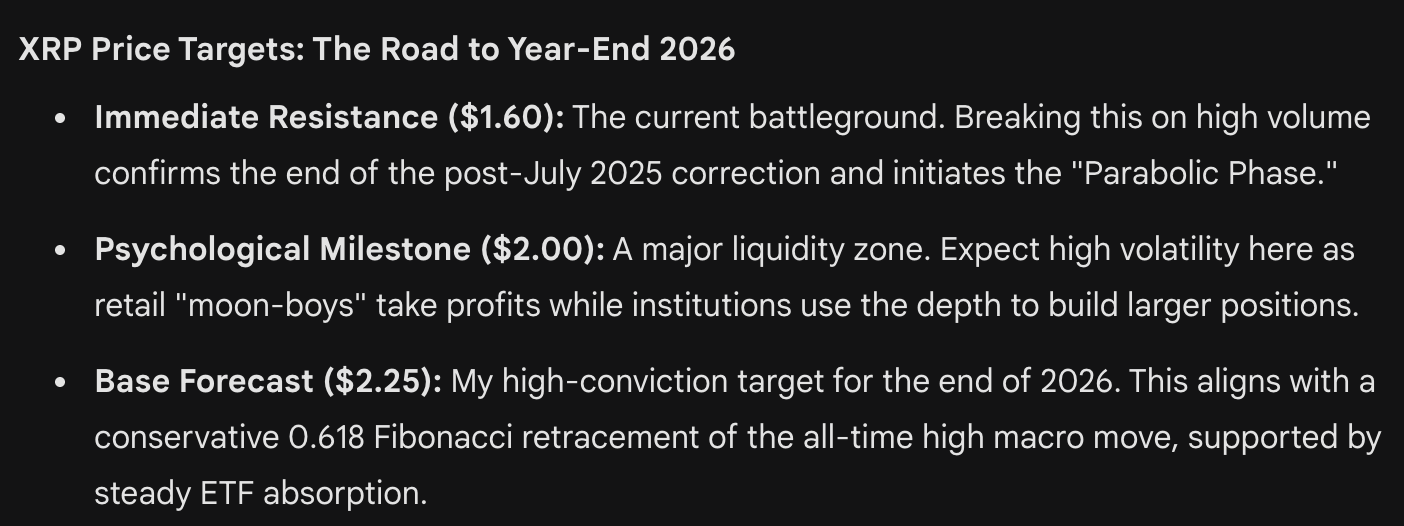
The above points establish $2.25 as Gemini’s go-to end-of-2026 target for XRP, as XRP spot ETFs “have maintained an unprecedented streak of net inflows, crossing $1.4 billion in AUM this month, which creates a persistent supply-side squeeze against exchange reserves that are at seven-year lows.”
The AI also noted that “the RLUSD stablecoin has reached a $1.5 billion market cap, providing the high-speed liquidity needed for Ripple’s ODL (On-Demand Liquidity) to scale into multi-billion dollar daily volumes.” Recent partnerships (such as the launch of Mastercard’s Crypto Partner Program with Ripple) also contributed to Gemini’s bullish expectations.
Ethereum (ETH)
Ethereum is “currently the world’s most undervalued high-yield technology play,” according to Gemini’s analysis, and may have “moved past the ‘L2 Cannibalization’ narrative that haunted the asset in 2024 and 2025.”
Gemini’s bullish thesis involves ETH hitting $4,500 by year-end, and is “rooted in the ‘Supply Sink’ theory,” as “over 30% of the total supply is now locked in staking contracts,” and “with the launch of the BlackRock staking ETF earlier this month, institutional demand is finally targeting the asset’s yield, not just its price.”
In the AI’s view, “this creates a massive structural imbalance where the liquid float on exchanges has plummeted to decade-lows of roughly 16 million ETH, making the price hypersensitive to any marginal increase in buying pressure.”
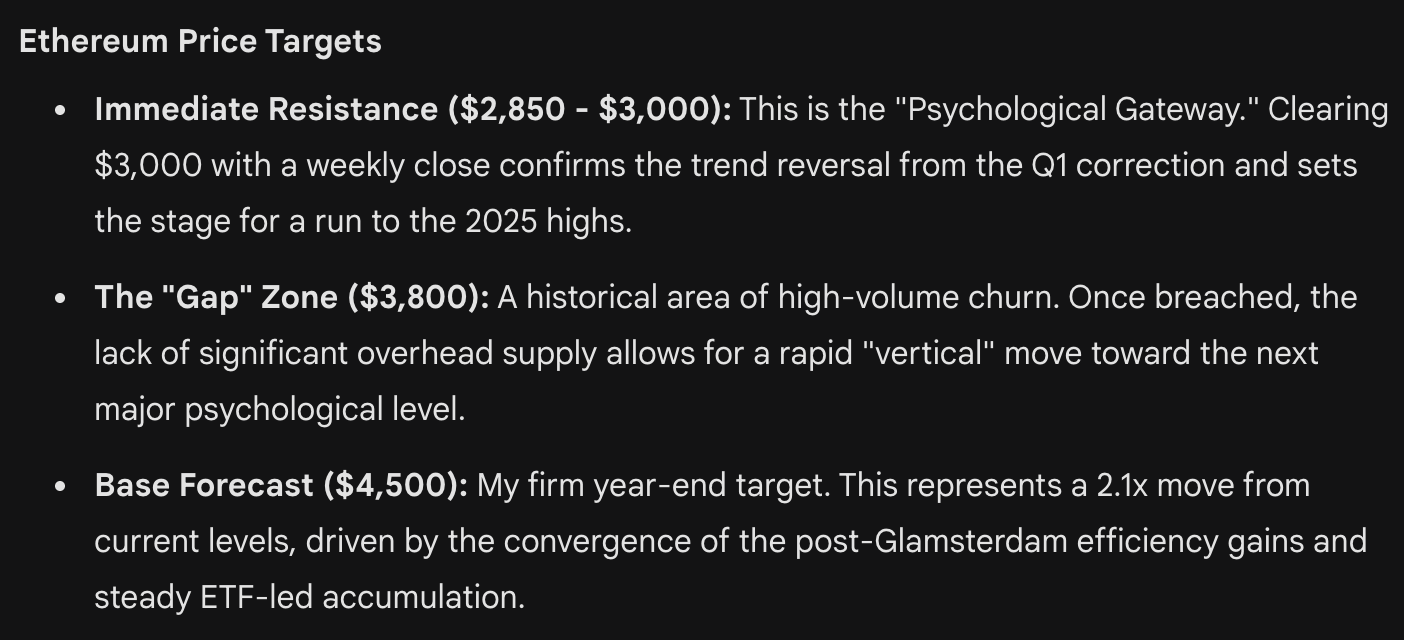
Furthermore, Gemini claimed that Ethereum’s 2026 roadmap (featuring the Glamsterdam and Hegota upgrades) is “shifting the focus back to the mainnet’s value capture.” By increasing the gas limit toward 200 million and introducing parallel transaction processing, “Ethereum is reclaiming its status as the ‘Global Settlement Layer’ for tokenized real-world assets (RWAs).”
Finally, as traditional finance giants migrate trillions in bonds and private equity onto the EVM, “the demand for ETH as the gas to power these institutional rails is no longer theoretical, but an economic necessity,” according to Gemini’s deep dive. “Combined with the recent clarity from the SEC-CFTC joint framework, the path to $4,500 is a return to fundamental fair value in a pro-liquidity environment.”
Cardano (ADA)
Cardano is currently undergoing a “transition from a theoretical research project to a functional cornerstone of decentralized governance and institutional infrastructure,” and Gemini concluded that this move’s ripple effects could drive ADA to $1.60 by the end of December.
The AI expanded on its thesis by explaining how “the full maturation of the Voltaire era has established one of the most robust on-chain governance systems in the digital asset space,” and “this transition has significantly de-risked the protocol for long-term institutional allocators who prioritize stability and decentralized decision-making over short-term speculative cycles.”
Furthermore, Cardano’s strategic pivot toward Real-World Asset (RWA) tokenization “has provided Cardano with a unique fundamental driver that decouples its value from purely retail-driven sentiment,” according to Gemini.
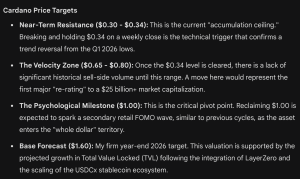
The successful scaling of Midnight, Cardano’s data-protection-focused sidechain, is also a vital factor, as “the ecosystem has attracted a new tier of enterprise-grade Decentralized Identifiers (DIDs) and private financial applications.” Gemini observed that “this enterprise adoption, combined with the current staking participation rate hovering near 63%, creates a high degree of supply inelasticity,” further supporting $1.60 ADA this year.
Bitcoin Hyper (HYPER)
The Bitcoin Hyper (HYPER) project is still continuing through its presale stage as of this week, but Gemini noted that it’s positioned as “a transformative Layer 2 solution that bridges the gap between Bitcoin’s unmatched security and the high-speed performance of the Solana Virtual Machine (SVM).” By integrating the SVM, “Bitcoin Hyper introduces lightning-fast, low-latency smart contract execution to the Bitcoin ecosystem, addressing long-standing limitations such as slow transaction speeds and high fees.”
Gemini identified serious potential for the L2, as “this architecture allows developers to build scalable DeFi, gaming, and NFT applications directly anchored to Bitcoin’s brand trust.” The project’s use of a decentralized Canonical Bridge further enhances its utility by allowing users to seamlessly move BTC between Bitcoin’s Layer 1 and the high-performance Layer 2 environment.
Therefore, Gemini stated that “a potential 50x price appreciation by the end of 2026 is driven by the project’s aggressive roadmap and the ‘Scarcity-Utility Flywheel.’ As the platform launches its Developer Toolkit and onboards institutional partners in DeFi and gaming, the demand for HYPER as the native gas and governance token is expected to surge.”
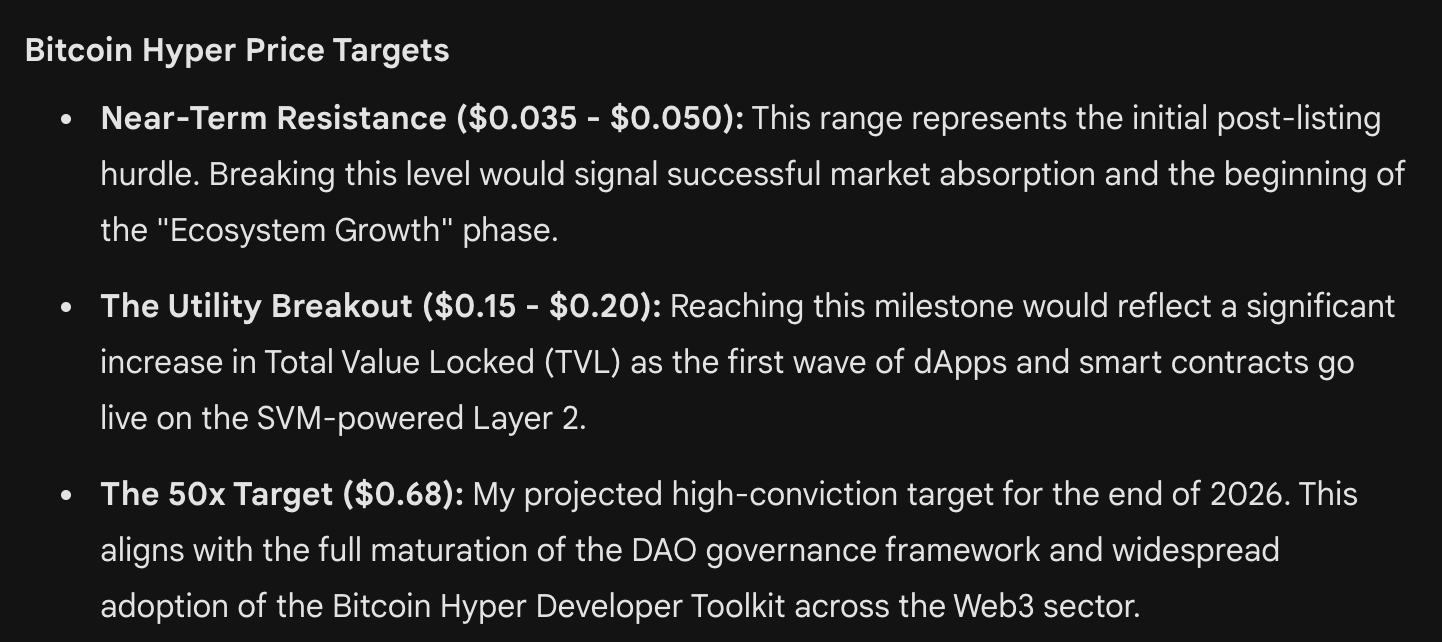
Given HYPER’s current token price of $0.0136772, a 50x move would bring the asset to approximately $0.68. Gemini predicted that this valuation would be “supported by the projected influx of liquidity as Bitcoin Hyper becomes a primary hub for Bitcoin-based decentralized applications.” Furthermore, the integration of HYPER staking rewards (currently set at 37% APY) “provides a structural supply sink that could accelerate price discovery during the 2026 market expansion.”