

 Some of the links on this site may be affiliate links. ICOBench may receive advertising commissions when users visit recommended platforms via our affiliate links, at no additional cost to you. All recommendations are based on a comprehensive review process.
Crypto in 2026 looks very different than it did just a few years ago. The market has matured, capital has become more selective, and security is no longer treated as a secondary feature. High-profile hacks, wallet drainers, and infrastructure failures have changed how investors evaluate risk.
Today, the strongest opportunities are not the loudest narratives, but projects building durable foundations.
That change explains why the BMIC crypto presale is becoming popular these days. BMIC is positioning itself as security infrastructure for the next era of Web3. For investors filtering through dozens of altcoins to buy, BMIC stands out as a project designed to still matter years from now, not just during the next market cycle.
What is BMIC and why it is different
BMIC is building the first complete quantum-secure finance stack. Rather than focusing only on asset storage, BMIC combines a wallet, staking system, and payment layer under a single security model. Every part of the platform is protected by post-quantum cryptography and signature-hiding smart accounts, eliminating weaknesses that traditional wallets still expose.
One of BMIC’s core advantages is zero public-key exposure. Most wallets reveal public keys on-chain with every transaction, creating a long-term attack surface. BMIC removes this entirely by using smart account architecture that never exposes classical keys. This design directly addresses future “harvest now, decrypt later” threats that legacy systems cannot fix retroactively.
BMIC is also quantum-native from day one. It is not retrofitting older systems with patches. The platform is built for a future where cryptographic standards evolve, avoiding forced migrations or emergency upgrades later.
AI plays a critical role across the ecosystem. BMIC uses AI to monitor activity, detect threats, and optimize cryptographic performance. This ensures post-quantum security remains usable at scale while adapting automatically as standards update. Users benefit from stronger protection without increased complexity.
Beyond retail users, BMIC offers Quantum Security-as-a-Service. Banks, fintechs, healthcare providers, and governments can integrate post-quantum key management, secure communications, and custody without rebuilding existing infrastructure. This enterprise focus expands adoption far beyond typical wallet platforms.
BMIC also looks ahead with its Quantum Meta-Cloud roadmap. This layer aims to decentralize access to future quantum compute resources, preventing corporate gatekeeping and creating fair, transparent participation in next-generation compute markets.
BMIC crypto presale and tokenomics explained
The structure of the crypto presale shows BMIC’s long-term vision. The total token supply is fixed at 1,500,000,000 BMIC and cannot be increased. Of this, 50% is allocated to the public presale, ensuring broad distribution and community participation.
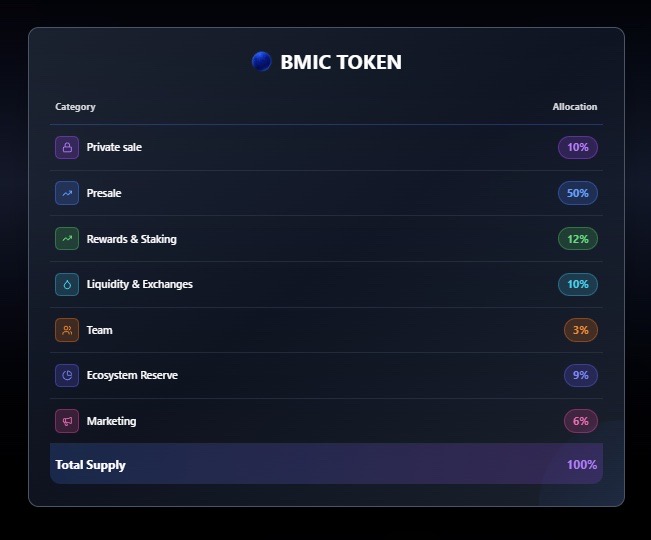
The remaining allocation supports sustainable growth. Rewards and staking receive 12%, liquidity and exchanges 10%, ecosystem reserve 9%, marketing 6%, and only 3% is reserved for the team. This distribution minimizes insider concentration and aligns incentives toward users and network expansion.
The presale is structured across multiple phases with gradually increasing prices. Tokens start near $0.048 and rise toward $0.058, representing a controlled 20% range from the first to final phase. Importantly, the planned launch price will be higher than the last presale tier, structurally rewarding early participants.
At the time of writing, the BMIC presale has raised over $350,000; early confidence from investors who prioritize infrastructure and security. Contributions are accepted in ETH, USDT, and USDC on Ethereum.
Token utility extends beyond speculation. BMIC tokens are used for wallet features, quantum-secure staking, payment authentication, enterprise APIs, governance participation, and future compute access. A deflationary model ties buybacks and burns to real platform usage, reinforcing long-term value dynamics.
Why BMIC is the best crypto to buy now
Looking for the best crypto to buy in 2026 requires a different mindset than previous cycles. The strongest projects are those solving problems that cannot be ignored or postponed. Security, identity protection, and transaction integrity fall into that category.
BMIC stands out among altcoins to buy because its relevance increases over time rather than fading. As threats evolve, BMIC’s architecture remains intact. While many platforms will be forced to redesign or migrate, BMIC is already built for that future.
Unlike trend-driven tokens, BMIC’s demand is tied to real services. Wallet usage, staking, payments, enterprise adoption, and compute access all rely on the same token economy. This creates multiple demand vectors instead of a single speculative narrative.
Discover the future of quantum-secure Web3 with BMIC:
Presale: https://bmic.ai
X (Twitter): https://x.com/BMIC_ai
Telegram: https://t.me/+6d1dX_uwKKdhZDFk