


 Some of the links on this site may be affiliate links. ICOBench may receive advertising commissions when users visit recommended platforms via our affiliate links, at no additional cost to you. All recommendations are based on a comprehensive review process.
The crypto market spends most of its time reacting to visible risks. Price swings, regulations, hacks, and exchange failures dominate headlines. Yet one of the biggest threats to digital assets is quietly approaching in the background.
Quantum computing is advancing faster than many investors expect, and when it reaches maturity, today’s wallet security model breaks at a fundamental level.
That shift is already shaping how long-term builders think about infrastructure. BMIC ($BMIC) enters the market with a clear premise: crypto security needs to be redesigned before the quantum threat arrives, not after. With its presale now live and more than $330,000 already raised, BMIC positions itself as a project built for what comes next, not what worked in the past.
The problem crypto wallets were never designed to solve
Most crypto wallets rely on exposed public keys and classical cryptography. Every transaction reveals information that future quantum computers can exploit through so-called harvest-now, decrypt-later attacks. Even if quantum machines are not yet powerful enough to break keys instantly, data collected today can be decrypted later once the technology matures.
This creates a structural risk for long-term holders, stakers, and anyone using crypto for payments. Traditional EOAs, hardware wallets, and even many “secure” wallets still leak the very information quantum systems will target first. Retrofitting post-quantum patches onto legacy designs does not solve the core issue. The architecture itself is outdated.

In bearish or uncertain markets, this kind of hidden risk matters more. Capital preservation becomes as important as growth, and security flaws that cannot be fixed later represent permanent exposure.
How BMIC approaches quantum security differently
BMIC is built as a complete quantum-secure finance stack from day one. Instead of focusing only on storage, it combines a wallet, staking system, and payment layer protected by post-quantum cryptography and signature-hiding smart accounts.
At the core of BMIC’s design is zero public-key exposure. By using ERC-4337-style smart accounts, hybrid post-quantum signatures, and private routing, BMIC removes the main attack surface quantum computers are expected to exploit. Transactions do not reveal classical public keys on-chain, which fundamentally changes the security model.
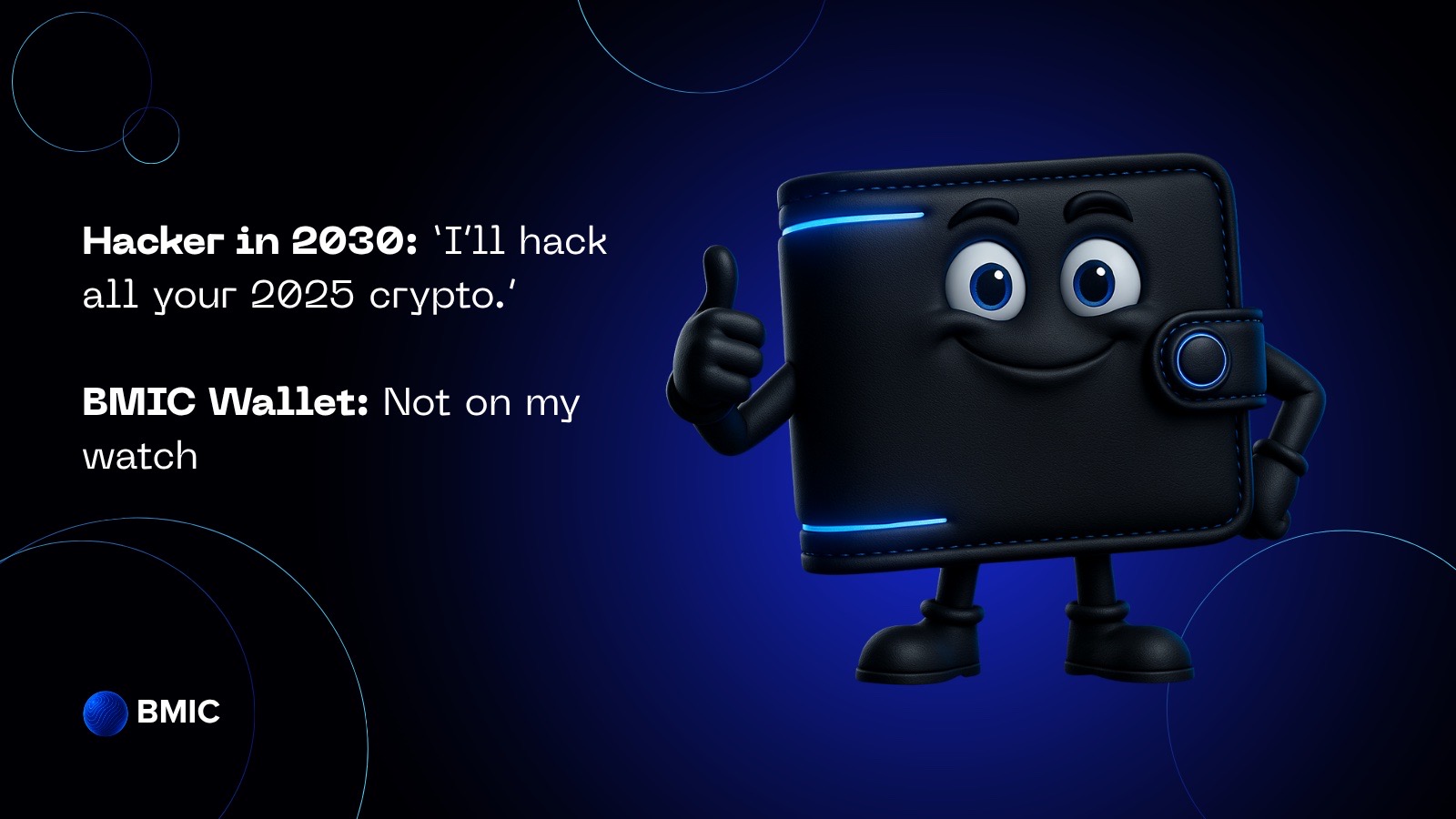
AI plays a supporting role by optimizing cryptographic performance, monitoring threats, and enabling seamless upgrades as standards evolve. Rather than forcing users to migrate or update manually, security improves in the background. Over time, BMIC also connects this infrastructure to its Quantum Meta-Cloud roadmap, designed to decentralize access to future quantum compute resources instead of placing them under corporate control.
BMIC presale and real token utility
BMIC’s crypto presale shows its long-term infrastructure focus. The total token supply is capped at 1,500,000,000 BMIC, with 750,000,000 allocated for public sale. The fundraising target is €40 million, structured across multiple pricing phases that gradually increase from $0.048485 to $0.058182, a 20% range designed to reward early participation.
At the time of writing, the presale has raised over $330,000, with the current BMIC price around $0.049. Contributions are accepted in ETH, USDT, and USDC on Ethereum. Importantly, the planned launch price is set above the final presale tier, creating a built-in incentive for early supporters without relying on unrealistic promises.
Token utility extends beyond speculation. BMIC is used for wallet features, quantum-secure staking, payment authentication, enterprise security APIs, compute access, governance, and a deflationary burn model tied to real platform usage. Demand is linked to services, not hype.
Why BMIC fits the “best crypto to buy” narrative differently
Many projects compete for attention by chasing short-term trends. BMIC takes a slower but more durable approach. It addresses a problem that cannot be solved later and cannot be ignored indefinitely. As quantum progress continues, wallet security will shift from convenience to necessity.
BMIC does not assume users will adapt. It removes the need for adaptation by building quantum resistance directly into the foundation. In an environment where trust in infrastructure matters more than narratives, that positioning stands out.
Quantum computing will not arrive with a warning bell. When the threat becomes obvious, it will already be too late for exposed systems. BMIC is designed around that reality, offering a quantum-secure alternative before the pressure hits.
For investors looking beyond the next market cycle, BMIC represents a different interpretation of what the best crypto to buy could mean. Not the loudest project, but one built to survive a future most wallets are unprepared for.
Discover the future of quantum-secure Web3 with BMIC:
Presale: https://bmic.ai
X (Twitter): https://x.com/BMIC_ai
Telegram: https://t.me/+6d1dX_uwKKdhZDFk