


 Some of the links on this site may be affiliate links. ICOBench may receive advertising commissions when users visit recommended platforms via our affiliate links, at no additional cost to you. All recommendations are based on a comprehensive review process.
 World Liberty Financial or WLFI has finally started trading on major platforms. Although the tokens were untradeable for roughly 11 months, from the public sale launch in mid-October 2024, the governance holders have voted and unlocked its tradability on secondary markets as well as P2P platforms.
WLFI wants to sync traditional finance (TradFi) and DeFi with products like a U.S. dollar stablecoin called USD1, lending, borrowing, and other blockchain-based financial services. Let’s explore its growth trajectory through a WLFI token price prediction.
WLFI Token ($WLFI) Price Prediction – Overview
| 💰 Ticker | WLFI |
| 🏛️ Industry | DeFi, Stablecoins, Governance, Traditional Finance Bridge |
| 🗓️ Founded | 2024 |
| 🖧 Blockchain | Ethereum (ERC-20), expanding cross-chain |
| 🏷️ Starting Price | $0.015 (Initial Token Sale Oct 2024), $0.308656 (Public Listing Sept 1, 2025) |
| 📈 Total Supply | 100,000,000,000 |
| ⚡ Utility | Governance voting, staking rewards, stablecoin ecosystem support (USD1), decentralized financial products |
WLFI Token Price Prediction (2026-2040)
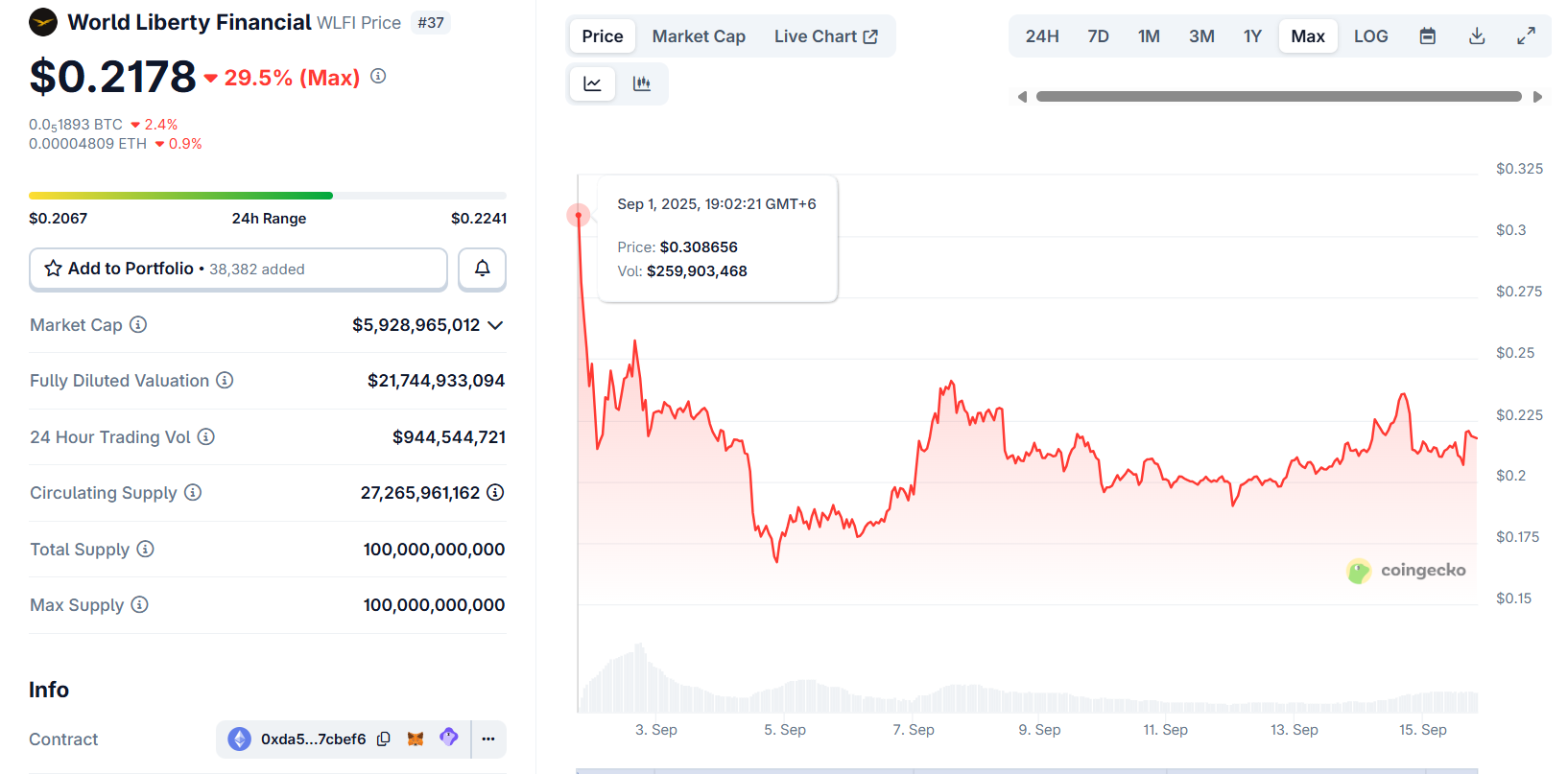
The WLFI token is currently seeing complex, volatile price movements and a critical consolidation range. As of September 2025, WLFI trades near $0.2088 to $0.216. The price is hovering just above key support levels around $0.20, with resistance seen at approximately $0.21 to $0.22. Buyers and sellers are in a near equilibrium, as seen from the symmetrical triangle consolidation patterns observed on multi-timeframe candlestick charts.
WLFI token officially launched on major CEXs. The token’s trading volume often exceeds $1 billion daily amidst growing market indecision. Still, its liquidity remains relatively high. A good trade volume and liquidity also indicate heightened institutional participation as well as active retail traders.
Key moving averages of the WLFI token, notably the 50-period and 200-period simple moving averages (SMAs), cluster around the $0.20 to $0.203 region. A confirmed break below this support area could precipitate further corrections, while a sustained hold may precede bullish momentum.
Momentum oscillators paint a nuanced picture. The Relative Strength Index (RSI) between 42 and 53 shows the market is neither overbought nor oversold but rather in a neutral to slightly bearish state. Correspondingly, the Bull Bear Power indicator remains slightly negative, denoting prevailing selling pressure. While not predominant, bearish pressure is there. Failure to breach resistance and a fall below the $0.20 support could open downside risk toward $0.1874.
On-chain governance activity is actually controlling WLFI’s price behavior. The community recently passed a buyback-and-burn plan with 99% approval. It’ll direct 100% of treasury liquidity fee proceeds toward reducing circulating supply.
WLFI token’s intraday price swings typically range between $0.03 and $0.06. For active short-term trading, this could be an opportunity. But it also remains prone to quick reversals. WLFI’s speculative trading dynamics are amplified by recent governance decisions, token buyback-and-burn initiatives, and social sentiment trends. Following the recent removal of Eric Trump from the World Liberty treasury, the token could see a tough road ahead.
WLFI Token Price Prediction 2025

By the end of 2025, WLFI may trade broadly within approximately $0.1488 to $0.1583. The token’s price outlook is subject to several critical operational and governance variables. Current market estimates from multiple expert sources suggest that the WLFI price will heavily depend on community engagement, project development, and market sentiment.
A significant factor that may affect WLFI’s potential appreciation is the recent buyback-and-burn proposal. This governance-approved initiative allocates 100% of treasury liquidity fees to repurchase WLFI tokens on the open market, which are then permanently burned.
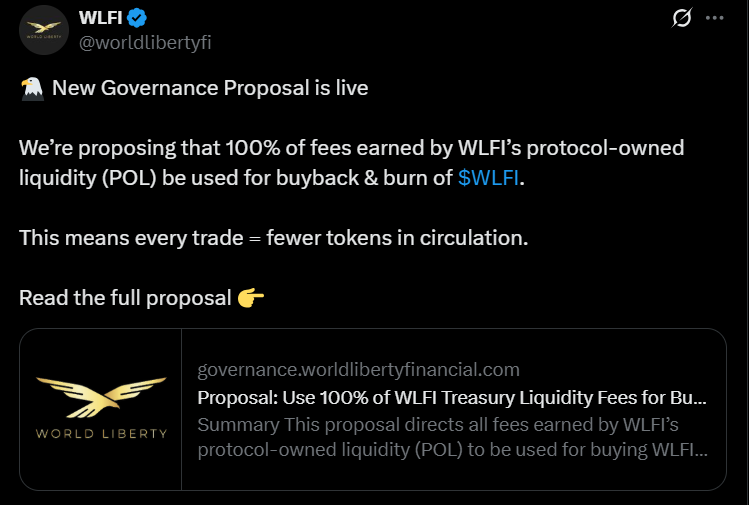
In theory, this creates a deflationary effect by reducing circulating supply. It may raise token value if demand remains steady or increases. Community voting shows overwhelming support exceeding 99% approval. While transparent on-chain execution of these burns adds credibility to the policy, the ultimate impact hinges on the volume of liquidity fees accrued. If fees are relatively small, buybacks may exert limited upward price pressure.
Technical analysis and market consensus point to near-term support around $0.18 to $0.20 and resistance approximately between $0.25 and $0.30. Sustained breakouts above this range could open corridors toward the higher price projections near $0.50, though this remains uncertain.
WLFI Token Price Prediction 2026

For 2026, WLFI token price predictions may reflect the ongoing uncertainty and dependency on project execution. Given the current circumstances, WLFI could trade as low as $0.15 to $0.25 in bearish scenarios, while more optimistic projections estimate WLFI might reach price levels up to $0.77 to $0.80 by the end of 2026.
Key factors that may drive price changes in 2026 include the planned rollout of staking functionality, which is currently under governance consideration. This staking mechanism will incentivize long-term holding by offering token emissions as rewards and amplifying governance voting power for stakers. In addition, yield staking pools and DeFi platform partner integration like Uniswap or PancakeSwap could improve WLFI’s liquidity.
Another important element is expanding USD1 stablecoin adoption and multi-chain support across Ethereum and Binance Smart Chain. Broader usage of USD1 in institutional settlements or DeFi applications could create sustained demand for WLFI.
However, a substantial portion of WLFI’s total supply (around 40% to 60% and including the Trump family holdings) is still subject to lockups and vesting schedules. Unscheduled or large-scale token releases from these holdings could introduce downward price pressure due to increased sell-side supply. Moreover, strong regulatory scrutiny and competitive pressures from established DeFi protocols present additional hurdles for sustained growth.
WLFI Token Price Prediction 2030

By 2030, WLFI may trade between $0.37 and $0.29. Some sources may suggest higher ranges. However, WLFI’s main success will depend on the USD1 stablecoin’s adoption and how effectively it can integrate traditional finance with decentralized protocols. USD1 seems to be a fiat-backed stablecoin that’ll keep a 1:1 peg with the US Dollar. But given the already established stablecoins and how much they control the market, it’d be very challenging.
Strategic future plans include cross-chain expansion to Solana and BNB Chain, rollout of staking and lending utilities, and a mobile app to bridge Web2 users into the DeFi ecosystem. These developments could empower token demand but also face execution risks. As for now, WLFI struggles to stay above $0.20. Increasing scrutiny on stablecoins and governance tokens could impact WLFI’s compliance cost.
WLFI Token Price Prediction 2040
By 2040, WLFI could become a major asset if USD1 succeeds as a stablecoin. It’ll also depend on market trends, the project’s innovative stance, governance, and many other parameters. We predict it may trade between $0.65 and $0.55.
However, the major concern remains that with its alarming price-swinging potential, only a small number of wallets hold nearly all of the WLFI tokens. It seems like a blatantly manipulative arrangement. Please be cautious and monitor its trajectory/development before investing.
WLFI Token Price Prediction Table (from 2026-2040)
Year
Maximum Price ($)
Minimum Price ($)
Average Price ($)
% Change (Max)
% Change (Min)
2025
0.1583
0.1488
0.1536
-48.70%
-51.78%
2025
0.3187
0.2451
0.2819
3.26%
-20.61%
2026
0.2759
0.2262
0.2510
-10.61%
-26.73%
2027
0.2331
0.2073
0.2202
-24.47%
-32.85%
2028
0.2812
0.2353
0.2582
-8.90%
-23.77%
2029
0.3293
0.2633
0.2963
6.68%
-14.69%
2030
0.3774
0.2914
0.3344
22.26%
-5.60%
2031
0.4074
0.3154
0.3614
31.98%
2.17%
2032
0.4374
0.3394
0.3884
41.70%
9.95%
2033
0.4674
0.3634
0.4154
51.42%
17.72%
2034
0.4974
0.3874
0.4424
61.14%
25.50%
2035
0.5274
0.4114
0.4694
70.86%
33.27%
2036
0.5526
0.4394
0.4960
79.04%
42.34%
2037
0.5779
0.4674
0.5226
87.22%
51.42%
2038
0.6031
0.4954
0.5492
95.41%
60.49%
2039
0.6284
0.5234
0.5759
103.59%
69.56%
2040
0.6536
0.5514
0.6025
111.77%
78.63%
WLFI Token Price Prediction: Key Regulators
WLFI is a governance token. It mostly stayed within close-knit wallets until recently. So, governance decisions will directly affect its price. Here’s what may happen:
As usual, regulatory changes could have a big impact on the WLFI token’s price. These’ll affect both WLFI’s governance token and the USD1 stablecoin. The U.S. SEC, CFTC, and the Financial Action Task Force (FATF) are some of the most powerful regulators in the world. Some changes with policies require following stablecoin laws, making sure reserves are clear, and following anti-money laundering (AML) rules.

Since the Trump family is directly involved in this project, it has already led to legislative scrutiny and bipartisan debate. This has made it harder or longer to pass new stablecoin regulations in the U.S.
The FATF’s travel rule enforcement and stricter KYC and AML procedures have made WLFI step up its compliance, which now includes regular identity checks and transaction monitoring. If a company doesn’t follow the rules, it could face big fines, being blacklisted, or being forced to leave major exchanges, all of which would have a direct effect on liquidity and price.
Also, because of cross-border regulatory fragmentation, WLFI could be legal in one place and illegal in another at the same time. This makes things even more uncertain for investors and users.
There is also a risk of regulatory arbitrage, and there are still questions about USD1’s reserve attestations. This makes WLFI more likely to suddenly lose value if authorities question its backing or governance.
Lastly, concentrated token holdings and governance cap mechanisms, which were partly put in place because of pressure from investors and regulators are worrying people about decentralization and future enforcement actions.
What is WLFI Token?
WLFI is an Ethereum-based governance token for the World Liberty Financial ecosystem, launched in October 2024. It was founded for decentralized decision-making over a suite of DeFi products. The most notable one is the USD1 fiat-backed stablecoin and associated financial services such as lending, borrowing, and marketplace payments.
The token was developed to bridge traditional finance (TradFi) and DeFi. Much like a U.S. dollar-based infrastructure (stablecoin) on-chain for institutions and retail users globally. However, there are powerful competitors like USDT or USDC already in the field.
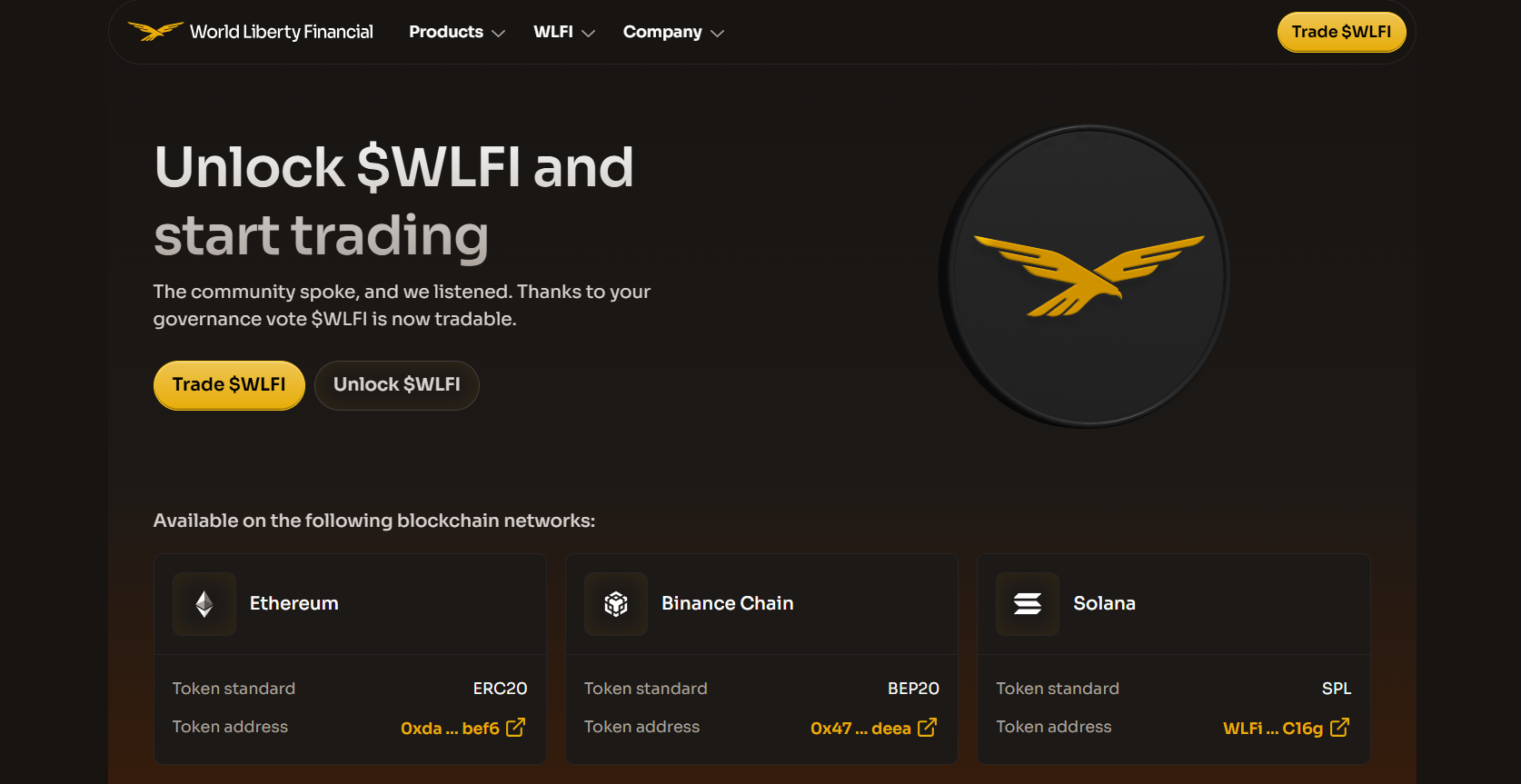
WLFI token holders receive one vote per token to participate in platform governance proposals such as liquidity allocation, fee policy, platform upgrades, and buyback/burn events. However, the token initially gave no economic rights like dividends or revenue sharing, and a large share remains locked up by founding entities (including the Trump family). So essentially, the voting power remains concentrated to a few wallets. Not really decentralized.
Notably, the WLFI token faced a policy-driven lockup period (post-launch), and the tokens only became tradable after nearly a year (via on-chain governance approval). While the project touts interoperability, KYC compliance, and reserve transparency with USD1, drawbacks include centralized supply management, non-transparent periodic reserve attestation for stablecoin backing, and exposure to significant U.S. and global regulatory scrutiny.
WLFI token also lacks direct utility for yield generation. Beyond its governance voting rights, high-profile ties risk politicizing market behavior or attracting adversarial regulatory attention. In technical terms, WLFI is structurally similar to major governance tokens but faces ongoing questions about the genuineness of its decentralization, the sustainability of its governance model, and its vulnerability to evolving regulatory pressures.
Tokenomics and Supply Distribution
WLFI’s tokenomics show that there are big risks with concentration. 33.51% of the tokens go to the team and advisors, 19.96% to treasury, 2.88% to liquidity, and 10% to community growth and incentives. Because of these allocations, insiders still control more than half of the supply, and the vesting and lock-up schedules have not yet been made public.
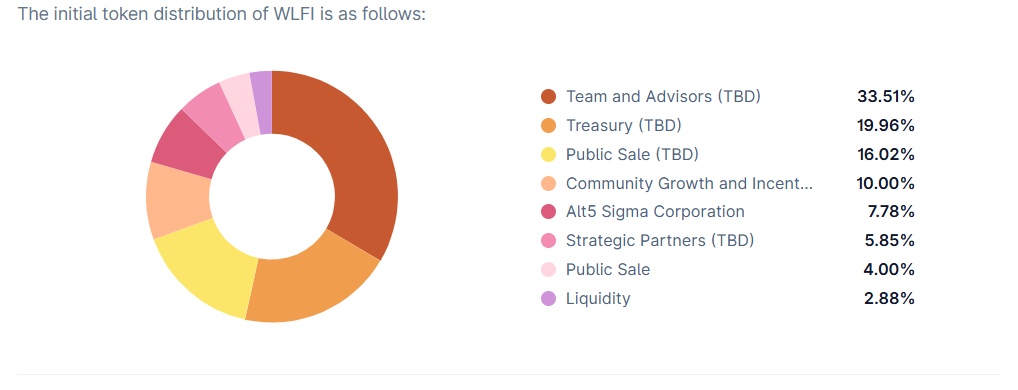
This makes it very easy for sudden sell-offs or manipulation of governance to happen if tokens held by the team or treasury are released or moved around. The small amount of liquidity—only 2.88%—also makes the market less deep and more likely to experience price shocks if big token holders decide to sell. The two public sale entries (16.02% and 4.00%) make it hard to know how much is actually in circulation and could hide more insider concentration.
Project Roadmap and Development Phases
Here’s what we’ve learned so far about the project’s plans:
- USD1 Stablecoin Integration: WLFI’s primary roadmap feature for 2025 is onboarding USD1 into major DeFi platforms, with cross-chain functionality extending to networks beyond Ethereum, including BNB Chain and potentially Solana. It intends to support broader usage of USD1 for payments and settlements in institutional and retail markets.
- Staking & Incentives Launch: WLFI plans to introduce governance-driven staking pools and expanded incentive programs for both community and institutional holders. They may launch in late 2025 or early 2026. They’ll encourage long-term holding and deeper community participation.
- Protocol Upgrades & New Products: The team intends to roll out upgraded smart contracts, improve audit standards, and launch new DeFi products, including lending and borrowing (integration with Aave V3) and an enhanced mobile experience for mainstream users.
- Treasury & Governance Expansion: A $1.5 billion public treasury initiative and advanced DAO mechanisms are planned. The team hopes it’ll lead to sustainable governance, transparently managed reserves, and improved voting systems.
- Institutional Focus & Regulatory Compliance: The roadmap puts strong emphasis on institutional adoption and regulatory preparedness, with ongoing compliance upgrades.
Some specific quarterly targets remain “to be announced,” indicating possible delays or a need to adapt to change as they arise.
WLFI Token Ecosystem and Token Use Cases
Possible WLFI use cases may include:
🗳️ Governance Voting: WLFI tokens grant holders the right to participate in decentralized governance decisions, including platform upgrades, parameter changes, and treasury management.
💰 Staking Incentives: WLFI can be staked in dedicated pools so that holders can earn rewards and increase their voting power in platform governance.
💵 Stablecoin Ecosystem: WLFI underpins the USD1 stablecoin infrastructure. It’ll provide governance for reserve management and supply mechanisms.
🏦 DeFi Products: As the native token, WLFI is used within lending, borrowing, and liquidity provision modules, including access to partnerships with protocols like Aave V3.
📱 Payments & Settlements: WLFI’s USD1 will support institutional and retail payments for settlement flows and cross-chain transfers.
🎁 Community Incentives: Some WLFI allocations are directed toward community growth, bug bounties, and ecosystem grants for developers building on the WLFI platform.
🌍 Multi-Chain Expansion: WLFI is expanding its utility to various chains (Ethereum, BNB Chain, Solana) for broader cross-chain governance.
WLFI Token Recent Developments and Risks
On September 1, 2025, the day it debuted on major exchanges, WLFI began its meteoric rise. Coins featuring the Trump family’s namesake as co-founders suddenly became available to everyone on Binance, OKEx, or Bybit, and a deluge of capital flowed into them. These political ties were bolstered by a substantial $550 million raised prior to going public.
The project’s paper valuation temporarily soared above $30 billion as the price ripped past $0.46, jumping from fractions of a cent. Classic FOMO (Fear Of Missing Out) gripped the market, sending prices soaring as investors raced to get in on the action. Trade volume surged to $4.46 billion in the first day alone.
Then came the unavoidable collapse, the euphoria short-lived. Nearly $0.179 was the ATL of the WLFI token. Why? Investors want their money, first and foremost. With gains of up to 2,000% allowed by the regulations, they simply started selling 20% of their stock at launch.
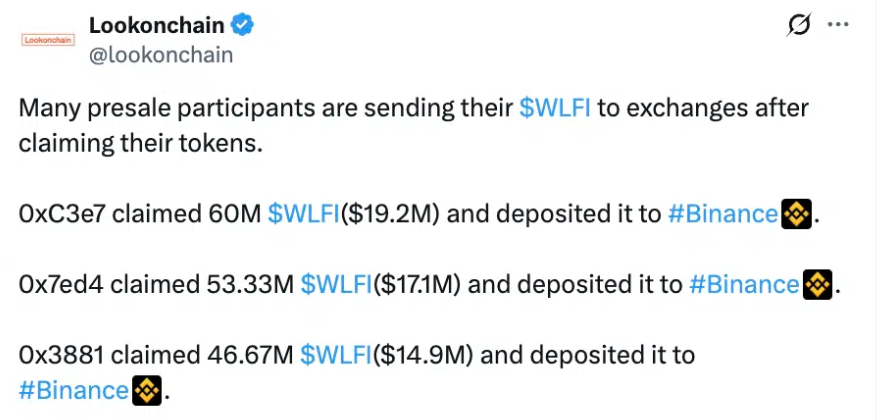
Investors in blockchain anticipated the major shifts. Large “whale” wallets were detected moving WLFI to exchanges shortly after introduction, a clear indication of an impending large sell-off. In this one deal, three pioneers sent 160,000,000 tokens—equivalent to $51,200,000 today—to a Binance wallet.
Why Buy WLFI Token – Advantages & Disadvantages
| Advantages | Disadvantages |
|---|---|
| ✅ Governance power over protocol decisions | ❌ High team and treasury concentration (33.51%, 19.96%) |
| ✅ Staking rewards and incentives | ❌ Only 2.88% allocated to liquidity (risk of low market depth) |
| ✅ Exposure to USD1 stablecoin ecosystem | ❌ Centralized governance risk due to large insider holdings |
| ✅ Potential for DeFi integrations | ❌ Vesting schedules and unlock timings are undefined |
| ✅ Access to community incentives & grants | ❌ Low public circulation volume |
| ✅ Multi-chain expansion opportunities | ❌ No direct revenue sharing or yield beyond incentives |
| ✅ Buyback & burn scheme supports scarcity | ❌ Transparency issues with reserve attestations |
| ❌ Price volatility from institutional or whale activity |
Should You Invest in WLFI Token?
The risk-reward profile of investing in WLFI tokens is not clear-cut, so you should look into it carefully. It can be used for governance in the growing USD1 stablecoin ecosystem, it can access planned staking rewards, and it has buyback-and-burn mechanisms that are meant to help with scarcity. Long-term usefulness may be even better with multi-chain expansion and the addition of WLFI to DeFi partnerships.
But think carefully about the big risks as well. The founding team controls more than 33.51% of the token supply, and the treasury gets another 19.96%. Sudden unlocks or changes in governance will certainly hurt price stability. The amount of liquidity available is small, which makes it more likely that prices will change quickly during big trades or when the market is volatile. Plus, no direct revenue sharing and problems with transparency around reserves may make the token even more speculative.
Top WLFI Token Alternatives
If you’re thinking about buying WLFI, carefully consider whether the company’s model and roadmap fit your risk tolerance and investment time frame. For more decentralization, liquidity, and clearer governance, you may want to compare WLFI to newer options in the space.
We have two great options for you:
Maxi Doge: The Strongest in the Doge family
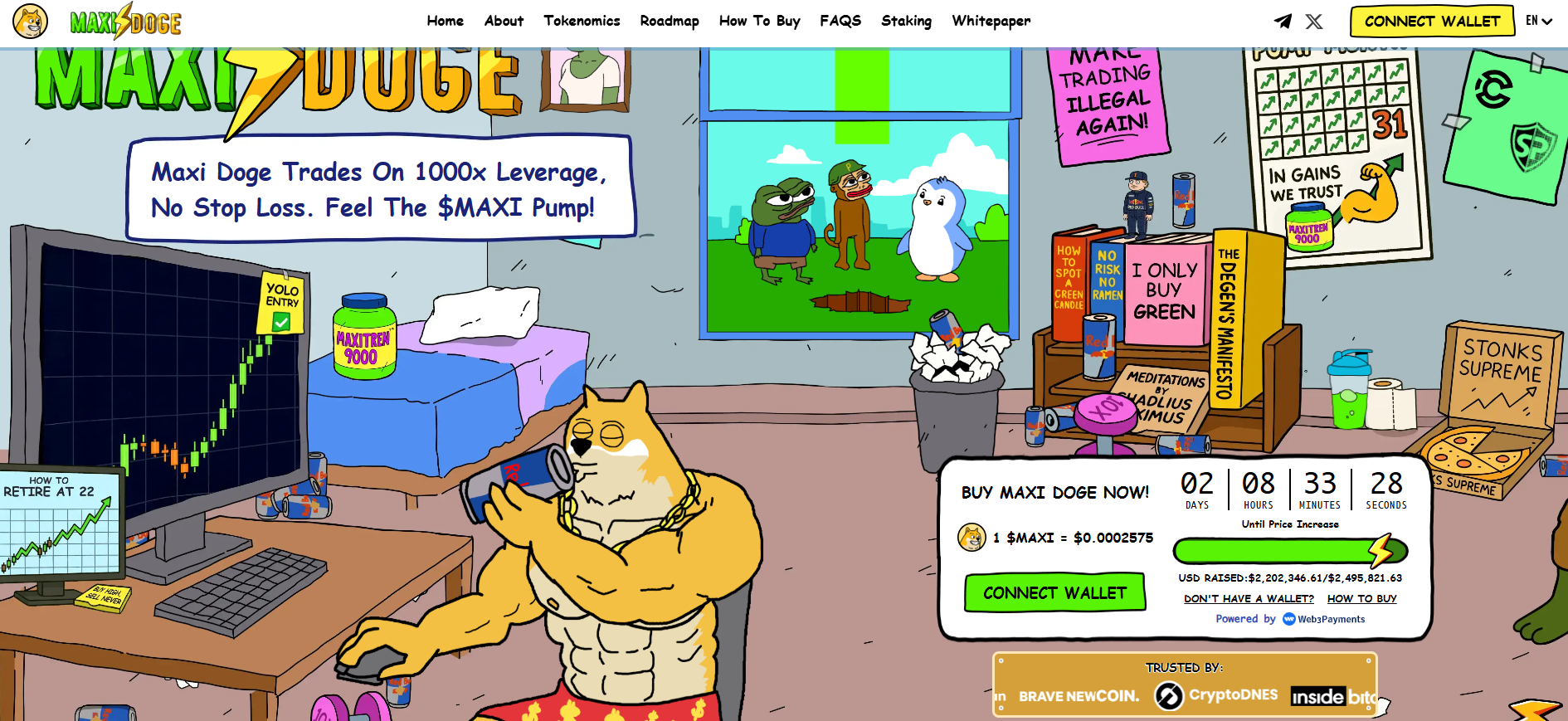
The new Ethereum-based meme coin Maxi Doge ($MAXI) combines cutting-edge blockchain technology with a lighthearted, user-generated approach. Also known as the “Gym bro” Doge, Maxi caused a stir when he used whales and raised $100,000 in minutes. So far, Maxi Doge has raised over $2.2 millions.
Maxi’s currently selling at around $0.0002575 per token. Click the link below for latest prices/presale phase.
Maxi plans to deepen its integration with Binance Smart Chain and Solana, among other prominent blockchains, and expand its chain of custody. The token’s price has increased by about 300% since its initial public offering (IPO), and according to price predictions, it might reach $0.0010 by 2030.
Maxi Doge’s staking system is designed to entice and keep early users with its extremely rewarding incentives. There are strong incentives for long-term commitment, as holders get 5% of tokens immediately and then an annual percentage yield (APY) exceeding 2500%. Analysts are favoring Maxi for a potentially higher ROI than $WLFI.
Maxi has set aside 25% of its token supply for the “MAXI Fund.” This is in addition to the staking rewards. You can take advantage of leveraged trading opportunities with tokens that are more than 1000x leveraged thanks to this fund’s support for listings on futures trading platforms.
Here’s how to buy Maxi Doge.
Tokenomics
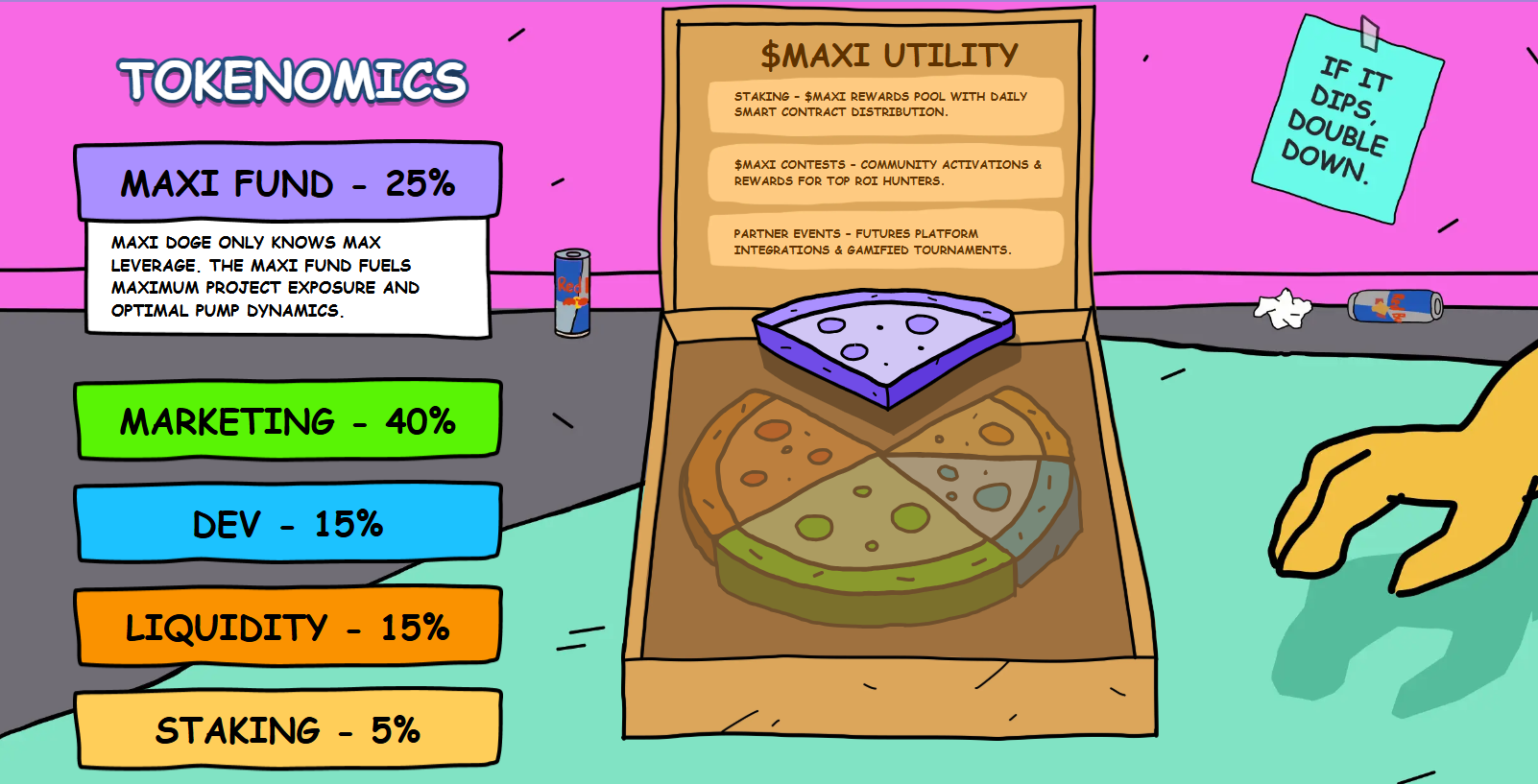
The total supply of Maxi Doge is fixed at 150,240,000,000 MAXI and no additional minting is allowed. Of this, a significant 40% allocation (over 60 billion tokens) is dedicated to the presale for broad community access without VC or private allocations. This structure might give early adopters a meaningful stake in the ecosystem.
Another 25% of the supply is reserved for the “Maxi Fund,” that’s planned to finance future partnerships, ecosystem development, collaborations, and community competitions, supporting ongoing project engagement and growth incentives. For liquidity provision on DEX and CEX platforms, 15% of tokens are set aside. These’ll help minimize slippage and rug-pull risk post-launch. The development team has been allocated 15% of the supply to support future platform upgrades, contests, and operational funding.
Staking is another core feature, with 5% of the total supply earmarked for staking rewards to incentivize holders for locking up their MAXI tokens over time.
Key Features
- Massive 1000x leverage options
- Combination of the “trading degen” and meme culture.
- Wants to be better than Dogecoin, a ripped Doge as a mascot
Bitcoin Hyper ($HYPER)
Bitcoin Hyper ($HYPER) is a technical model built on a Bitcoin Layer-2 network. It’s the first ever layer-2 network powered by the Solana Virtual Machine, which delivers microsecond execution, low fees, and full smart contract support—far beyond Bitcoin’s base chain capabilities.
$HYPER’s token supply is capped at 21 billion. It promotes high-yield staking (initial APY up to 150–399%), gas fees for transactions, and decentralized governance. Bitcoin Hyper raised over $16 million in presale, with initial pricing at $0.012925 and public offering at $0.0395.
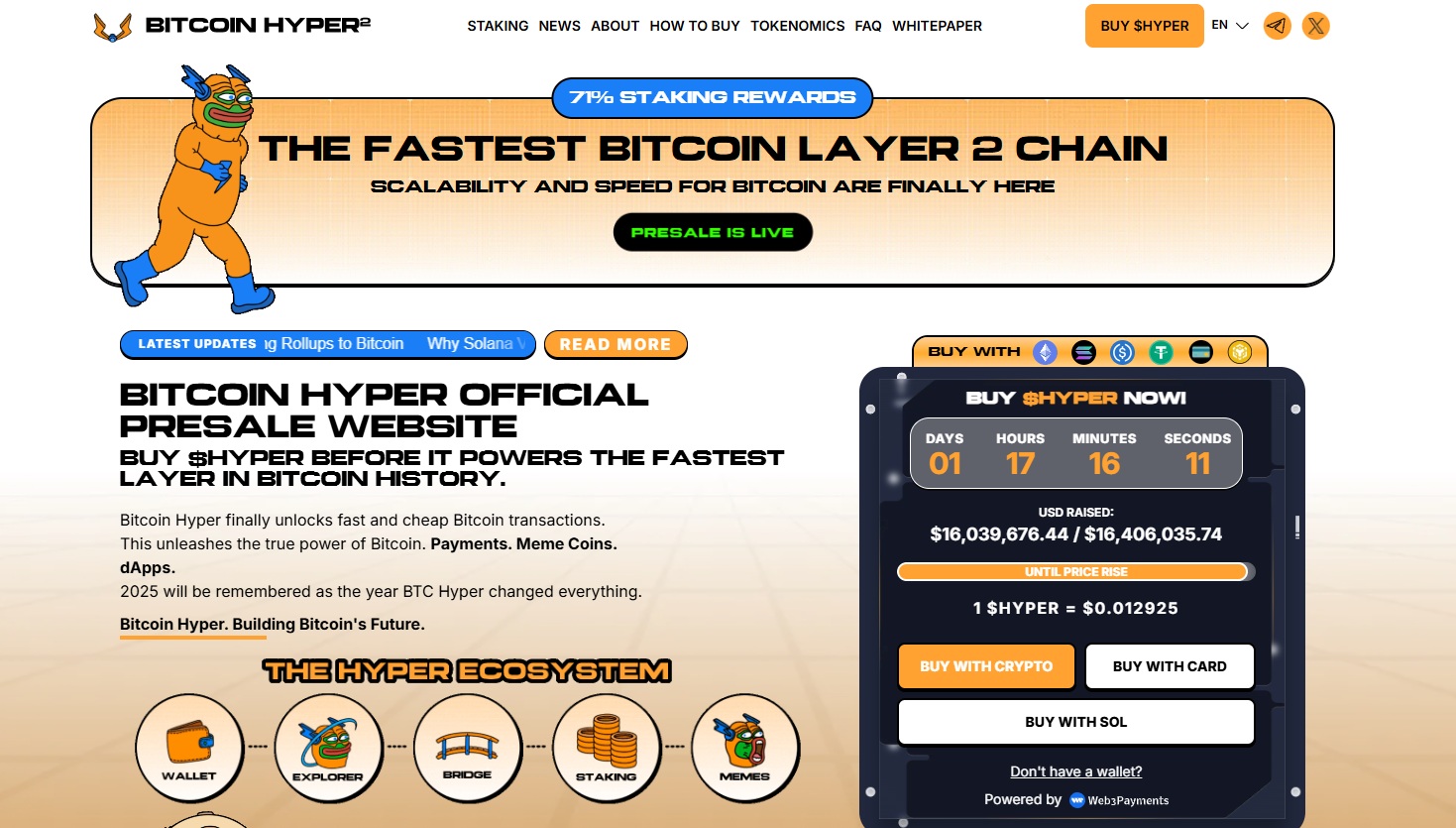
By 2030, price predictions estimate HYPER could see 200% growth from its IPO price, targeting $1.90–$3.05. It’s appealing to investors by adoption of DeFi, NFT, and RWA use cases, plus Bitcoin settlement security via Layer-2 bridging.
$HYPER’s roadmap details five phases: presale and staking, mainnet/SVM deployment, dApp integrations, governance transition, and ecosystem expansion. This model makes $HYPER a technically advanced alternative to WLFI, favoring scalable, community-driven, and utility-rich growth.
Learn how to buy Bitcoin Hyper.
Tokenomics
The Treasury uses its 25% stake in the $HYPER tokens to support campaigns that bring stakeholders together and boost the company’s growth. The marketing group targets individuals in Tier 1 global areas using sponsored and organic media campaigns, and they receive 20% of the budget.
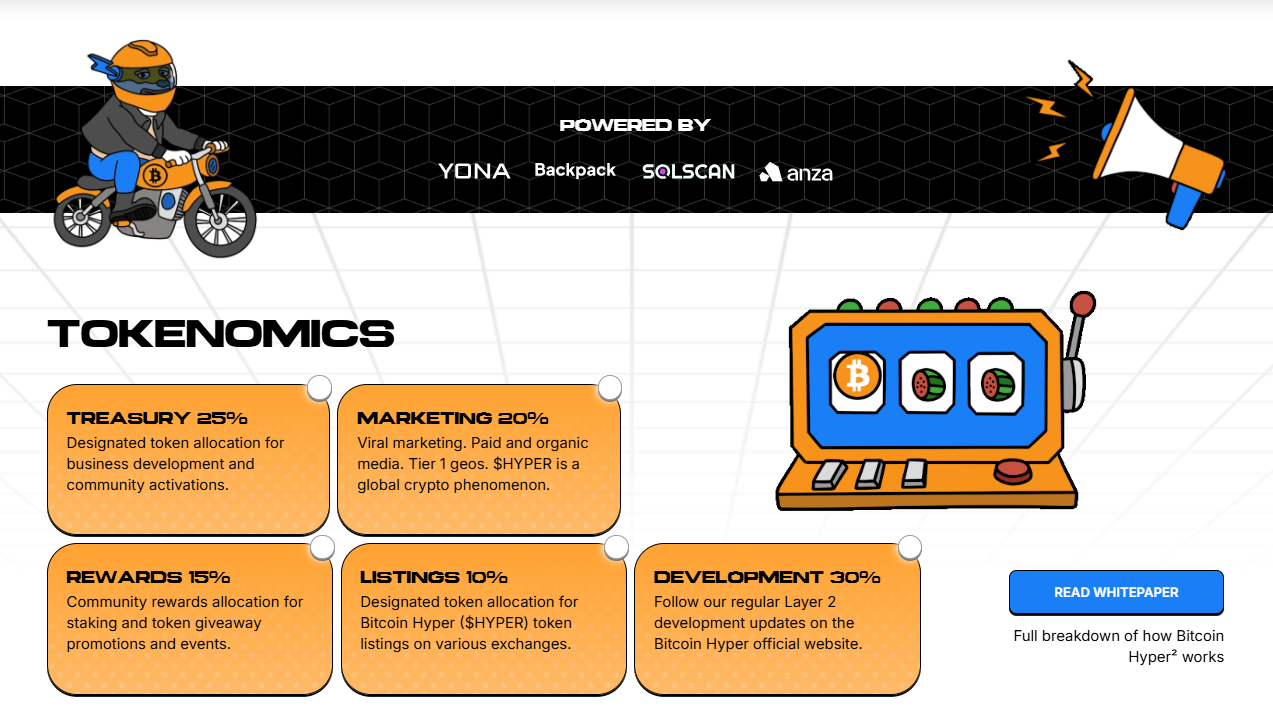
Community benefits, such as staking prizes, events, and giveaways, receive an additional 15% of tokens. Meanwhile, 10% will be reserved for listing $HYPER on many exchanges so that trading is more convenient.
A significant portion of the total token supply (30%) is reserved for the development of the Bitcoin Hyper Layer-2 solution. This solution is intended to enhance the speed and affordability of Bitcoin transactions.
The total quantity of $HYPER tokens will never be less than 21 billion.
Key Features
- The Solana Virtual Machine as a Layer 2 solution for Bitcoin
- You can stake with payouts above 150% APY
- It mixes DeFi and smart contracts.
- $Hyper uses Proof-of-Stake consensus mechanism for saving energy.
- Its trustless Bitcoin bridge works with other chains
Where to Buy WLFI Token ($WLFI)?
You’ll find the WLFI token on most major exchanges. Since September 1, 2025, it’s been available on major CEXs and DEXs. Major CEXs listing WLFI include Binance, Bybit, OKX, Gate, and KuCoin as spot trading pairs like WLFI/USDT and WLFI/USDC. For DEXs, WLFI is tradable on platforms using Ethereum and BNB Chain liquidity pools, such as Uniswap and DEXTswap, typically against WETH or stablecoins.
To purchase WLFI tokens, you’ll need a wallet first. The crypto wallet will let you convert fiats into stablecoins and then swap/trade with WLFI on the platforms. Best Wallet is one such wallet that swiftly integrates with major exchanges and works with a vast number of cryptos/tokens. The wallet supports 60+ currencies, dApps, over 330 DEXs fed by 30 bridges.
Here’s how to buy WLFI tokens using Best Wallet.
How to Buy WLFI Token – Step-by-Step Guide
Step 1: Install and Set Up Best Wallet
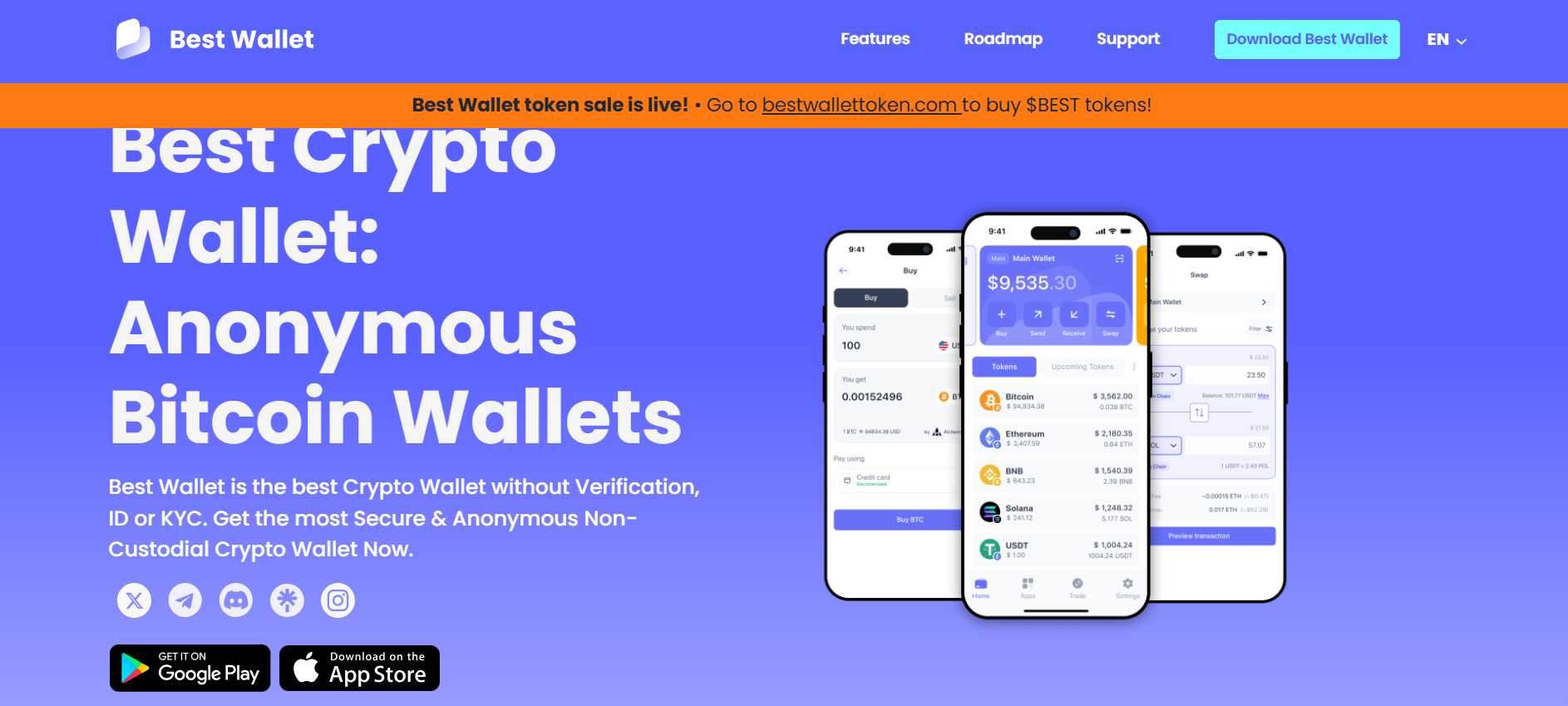
Best Wallet is a mobile-only wallet for now. So, you can get it from Google Play Store (Android) or the App Store (iOS) completely free. The wallet will soon feature web extension for browser integration as well. There’s also a link (button) below. Click on it and scan the QR with your mobile phone.
Visit Best Wallet and click “Download Best Wallet”. It’s easy to set up and won’t cost you a dime. Alternatively, you’ll find the wallet in the App Store or the Google Play Store on your mobile device.
Step 2: Fund Your Wallet
On decentralized exchanges (DEXs), you must use crypto-to-crypto swaps (typically ETH, USDT, or USDC). Buy stablecoins or another crypto from Best Wallet to swap with WLFI tokens. Since it’s a no-KYC wallet, no identity exposure risk remains.
You can also purchase WLFI tokens with fiat currency on several centralized exchanges (CEXs) using credit cards, bank transfers, Apple Pay, Google Pay, and other payment methods. Platforms such as Binance, MEXC, Gemini, and Trust Wallet support direct fiat on-ramps. However, it carries exposure risks and may lead to scams/frauds if your data leaks somehow.
Step 3: Receive $WLFI in Your Wallet
Once traded/swapped, WLFI should appear in your wallet in minutes (unless there’s network congestion). You can now trade $WLFI for other tokens from your wallet. If you use the Best Wallet ecosystem’s native ($BEST) token, you may be able to achieve lower gas fees.
WLFI Token Price Prediction – Conclusion
From our market assessment, public sentiment, and WLFI’s native structure, we’ve concluded that WLFI may be a risky endeavor right now. Contrary to the 100B total supply, it only has an estimated $27B circulating supply. Low community growth allocation and even lower liquidity. The fail-safe mechanisms seem poor for public investors.
Besides, about one-third of the tokens remain locked in the authority’s pocket. We may not be able to trust it as a fully decentralized option. Such a highly concentrated market tends to be whimsical, where token prices can significantly rise or drop in minutes. It’s highly speculative and unstable, as it is now.
On the flip side, presales like Bitcoin Hyper ($16 million raised) and Maxi Doge ($2.2 million raised) could net you a higher ROI. They’ve been earning community trust for a while and trying to achieve a sustained roadmap for growth. Positive public sentiments, non-centralized structures, and productive yet fun community build-ups could lead $MAXI and $HYPER to perform better than $WLFI.