Some of the links on this site may be affiliate links. ICOBench may receive advertising commissions when users visit recommended platforms via our affiliate links, at no additional cost to you. All recommendations are based on a comprehensive review process.
 When you trade on margin, you can borrow money from a broker to buy more of something than you could with your own money. Margin trading in crypto allows you to control a larger position in a crypto asset than you could afford with your own money. It’s a sort of leverage that can magnify both your potential gains and losses.
You pay interest on the funds that you borrow, and the assets in your account are the loan’s collateral. If the market goes against your position, your broker of choice may issue a margin call, which means you have to put in more money or lose your assets.
Margin Trading: Key Insights
✔️Margin trading lets you borrow funds to increase your trading position beyond your available capital.
✔️You provide collateral called margin to secure the borrowed funds during the trade.
✔️Both profits and losses are magnified when trading on margin.
✔️Margin calls occur when your collateral falls below required maintenance levels.
✔️Proper risk management is essential to avoid liquidation and large losses.
Understanding Margin Trading in Crypto
Margin trading lets you trade assets with capital that you borrow from a broker or exchange. You put up a small amount of the total trade value as collateral, called the margin, and then borrow the rest. This way, you don’t have to use all of your own money. It also gives you more exposure to the market and more chances to make profits. But since the position size is considerably greater than your initial stake, both your gains and losses are higher.

The margin you give is like a security deposit that will cover any losses that may happen. If the market goes against your position, your collateral will cover the losses until it reaches a maintenance margin level. Below this level, the broker may issue a margin call, which means you have to add money or close your position. If you don’t meet the margin call, the broker will often close your trade to stop more losses. This is called liquidation.
Many crypto futures exchanges or platforms use margin trading. It lets you take advantage of bigger price changes with less money up front, but you have to be careful with risk management because leverage makes both the good and bad sides bigger. Before you start trading on margin, you need to know how it works and what it means.
How Does Margin Trading in Crypto Work?
Here’s how margin trading works in crypto.
Initial Margin and Collateral
When you open a margin trade in crypto, you have to put down an initial margin, which is your collateral, to protect the trade. This margin is only a small part of the trade’s total value.
For example, if you want to open a $1,000 position with 10x leverage, you need to deposit $100 as margin and borrow the remaining $900 from the platform. The deposited collateral protects your lender and acts as security if the trade goes against you.
Margin Calls and Maintenance Margin
As you already know, you need to maintain a minimum amount of collateral, also known as the maintenance margin, after opening a position. If your losses drop your margin below this level, the exchange will make a margin call, which means you have to put more money in.
If you don’t meet the margin call, your position could be automatically liquidated. This would limit the lender’s losses but could also mean that you lose all of your investment.
Positions Long and Short
Margin trading, like crypto leverage, lets you take long positions (betting the price will rise) or short positions (betting the price will fall). If you go long on margin, you make money when the price goes up.
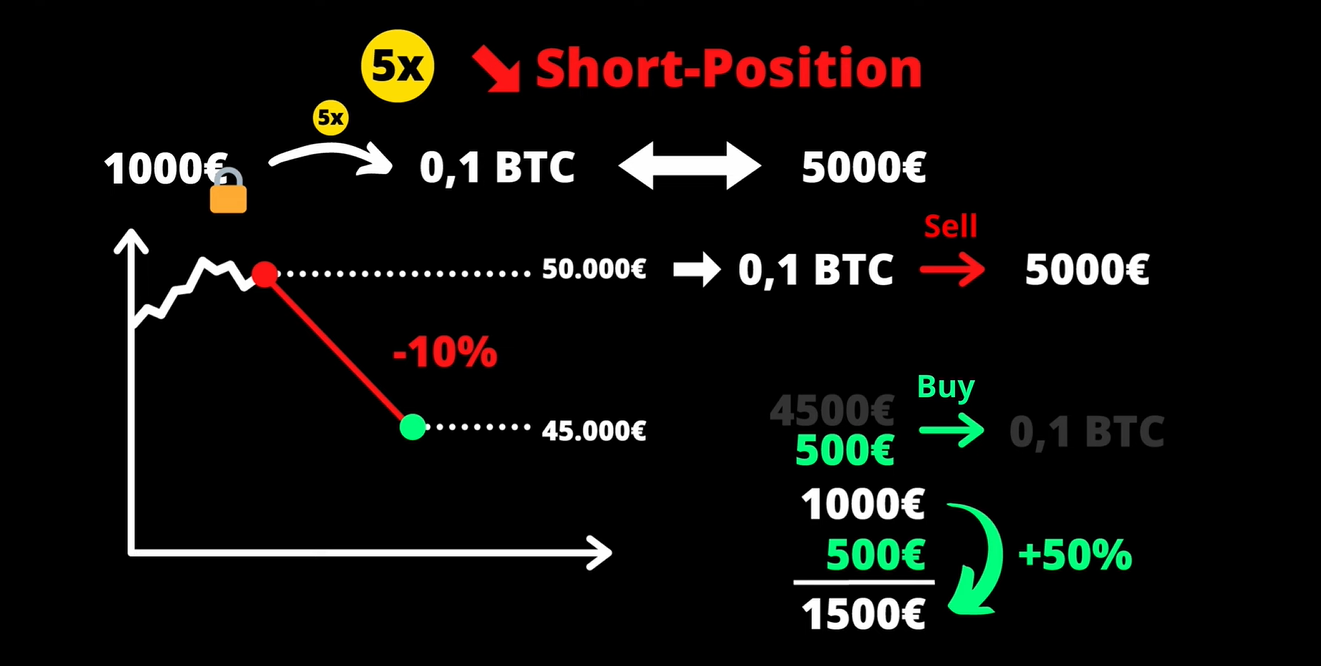
When you short sell, you make money when the price goes down. Both strategies make gains and losses bigger when there is margin, but they also give you the freedom to take advantage of different market trends.
Example Scenario
If you initiate a $1,000 Bitcoin long position with $100 margin at 10x leverage, a 5% market price increase means a $50 gain, or a 50% gain on your margin. On the other hand, a 5% drop could quickly lower your margin, which would make it more likely that you would have to sell.
Margin Trading in Crypto: Pros and Cons
Benefits Risks ✅ Allows you to benefit from market downturns via short selling. ✅ Helps diversify your investment strategies beyond spot trading. ✅ Widely available on various cryptocurrency exchanges worldwide. ✅ Potential to generate higher returns in volatile markets when managed well. ❌ Possible margin calls force you to add funds to maintain your position. ❌ Liquidation risk is significantly higher in volatile crypto markets. ❌ Complex fee structures and interest charges can erode profits. ❌ Requires a strong grasp of market dynamics to avoid costly mistakes.
✅ Boosts your buying power, letting you control larger crypto positions.
❌ Exposes you to rapid losses that can exceed your initial investment.
Best Practices for Margin Trading in Crypto
Start with Low Leverage: When you first start trading, use low leverage ratios (2x–3x) to keep your losses to a minimum while you learn.
Use Stop-Loss Orders: Set up preset exit points to keep the funds safe and stop major losses.
Keep Enough Margin: Keep an eye on your positions and have extra money on hand to avoid margin calls and liquidation.
Know the rules and fees for the platform: Learn about the margin requirements, return on investment, and funding fees that are specific to each exchange.
Limit Position Size: Don’t put all your money into one trade; instead, spread it out to lower your overall risk.
Stay Calm: Don’t let fear or greed make you make decisions quickly. Stick to your trading plan.
Conclusion
Margin trading in crypto remains closely aligned with other crypto market dynamics, characterised by high gains and high losses. Here, you borrow and invest from a broker but risk a dedicated amount as collateral. So, impulsive trading, chasing losses, and poor decisions can lead to bulk asset losses in margin trading. Prioritize promising cryptos with tested business models.